Basement waterproofing options and costs in Beechborough-Greenbrook
Beechborough-Greenbrook, Ontario residents usually face basement moisture from the same few sources: water pressure pushing through cold joints, tie holes, and cracks, or older drainage systems quietly failing. With a population of 6,577 in 2021 (Statistics Canada, 2021 Census), the local housing mix is close to the Toronto-area pattern—especially common are post-war and 1960–1980s homes where original drainage can be partially collapsed or clogged. Those earlier weeping tiles and early plastic drains often look “fine” from the outside but underperform after years of freeze–thaw and soil swelling.
In Toronto’s mixed glacial till and clay pockets, saturated backfill can expand against foundation walls, increasing lateral pressure and widening small defects over a few winters. That’s why contractors in Beechborough-Greenbrook tend to price exterior excavation and membrane work higher than in drier, sandier areas, but also to recommend interior systems more often when access is tight around additions, decks, or shared driveways. Availability of crews who can excavate carefully near footings also affects schedule and labour rates.
In neighbourhoods like the busier residential pockets near local parks and older subdivisions (where lots are narrower and gardens sit close to foundation lines), homeowners often call for solutions before the next spring melt. From there, the choice usually comes down to whether you need to address water at the source (exterior) or manage it after it enters (interior), plus whether you have isolated crack leaks.
Below is a practical comparison of common waterproofing approaches and typical pricing for Beechborough-Greenbrook projects.
| Method |
What It Addresses |
Disruption Level |
Durability |
Price Range |
| Exterior excavation + new membrane + drainage tile |
Hydrostatic water pressure at foundation perimeter; failing exterior drainage; keeps soil water from migrating to the wall |
High (excavation, landscaping restoration) |
Long-term with proper backfill and protected membrane details |
$7,000 – $25,000 |
| Interior perimeter drain channel + sump pit |
Active seepage through cracks and joints; collects water after it enters the basement |
Medium (partial floor/finish removal) |
Very good for chronic seepage when discharge is properly routed |
$3,500 – $15,000 |
| Foundation crack injection (epoxy or polyurethane) |
Isolated cracks; stops leaks from entering and reduces dampness |
Low (localized drilling/patching) |
Depends on crack type; “active leak” requires flexible systems |
$600 – $3,000 |
| Sump pump installation (primary + battery backup) |
Controls groundwater intrusion and sump pit water; reduces flood risk during power interruptions |
Medium (pit, discharge line, minor patching) |
High when backup is installed and discharge is correct |
$1,800 – $5,000 |
| Window well drain installation |
Surface water pooling around basement windows; reduces overflow and damp window framing |
Low to medium (window well work) |
Moderate to high (depends on grading and downspout routing) |
$1,000 – $4,000 |
| Lot re-grading / downspout extension |
Directs roof and surface runoff away from foundation; lowers infiltration |
Low (minor site works) |
Good as part of a full plan; limited if interior hydrostatic pressure is the main issue |
$800 – $3,000 |
Prices are estimates only and vary by project scope, site access and material selection.
What affects the price of waterproofing in Beechborough-Greenbrook
In the Toronto region, it’s common to see waterproofing quotes for “the same” basement leak that differ by 30–50%. The reason usually isn’t the contractor being careless—it’s that the scope is shaped by site conditions and how much of the water path needs to be interrupted. Two homes can both have damp corners, but one may have failing clay-drain weepers and a high water table, while the other’s issue is simply roof runoff directed at a window well.
Three drivers typically separate Beechborough-Greenbrook-area costs from the national average: soil type, water table, and freeze–thaw. Clay-heavy soils common around southern Ontario hold water and expand when saturated, increasing lateral pressure on foundation walls; that pressure can turn a hairline crack into an active leak after winter cycles. High water tables (frequent during spring recharge and heavy rains) increase sump run times and mean larger discharge and proper backup planning. By comparison, regions that stay drier often need less robust perimeter drainage. Freezing temperatures then widen small defects in concrete and block foundations, making targeted repairs less effective unless the leak path is fully addressed.
Here are a few concrete Beechborough-Greenbrook examples that raise or lower cost. If exterior weeping tile is original (often 60+ years old), it may be completely failed; adding exterior excavation and a new drainage system can move a job into the $7,000 – $25,000 band. If access is restricted by a deck or narrow side yard, interior drainage may be the cost-controlled option in the $3,500 – $15,000 band, because it avoids full excavation. If the leak is limited to a short crack near a corner, epoxy or polyurethane injection may fit closer to the $600 – $3,000 repair range—provided the crack behaviour matches the product selection.
| Price Factor |
Why It Matters |
Cost Impact |
| Interior vs. exterior approach — interior is less disruptive but addresses symptoms |
Exterior targets water before it reaches the wall; interior manages water after entry |
Exterior can add thousands due to excavation and membrane; interior often reduces disruption |
| Foundation type — poured concrete vs. block vs. stone vs. ICF |
Different materials respond differently to injection, movement and crack patterns |
Block and stone often need more drainage detail; ICF may still require sealing but behaves differently |
| Soil type — clay expands more than sand, adding pressure |
Clay saturation increases hydrostatic/lateral pressure |
Higher likelihood of active seepage; may push scope toward exterior drainage or stronger interior systems |
| Crack type and length — hairline vs. structural horizontal cracks |
Structural movement requires assessment and may need underpinning or engineering |
Horizontal or step cracks can increase cost beyond typical injection pricing |
| Sump pump backup system — battery or water-powered backup needed |
Power outages during spring flooding can stop pumps right when water rises |
Backup adds cost but reduces flood risk; typically increases the sump-related portion of the budget |
| Access — landscaping, decks, or driveways must be removed for exterior |
Excavation is more expensive when landscaping and hardscapes must be dismantled and rebuilt |
Can shift a job upward within the exterior range |
| Weeping tile age — original tile (60+ years) may be completely failed |
Old tiles are often clogged, collapsed, or detached |
More likely to require replacement and added drainage work |
| Mould or efflorescence remediation required before sealing |
Moisture must be controlled and surfaces prepped before sealing/injection |
Additional remediation time and disposal can add cost to interior approaches |
Permits & regulations in Ontario
In Ontario, some foundation-related work will typically require a building permit. In practice, foundation excavation and any work that changes the structure or affects load paths commonly needs a permit. Structural crack repair—especially when you’re dealing with horizontal cracks in block walls, major step cracks, or signs of movement—often requires an engineering assessment first to determine whether underpinning or other structural measures are necessary. In many Toronto-area cases, a sump pump installation that includes connections to a municipal service (storm or sanitary) or a discharge modification needs municipal approval. Even where permits aren’t explicitly required for minor interior sealing, you should still expect code-compliant drainage discharge and proper waterproofing detailing.
Does require a permit (typical scenarios): exterior foundation excavation, structural repairs that may affect integrity, and most changes to drainage routing/discharge tied into municipal systems.
Typically does not require a permit (common scenarios): localized crack injection for isolated leaks (when there’s no structural implication), replacing interior finish materials after approved waterproofing, and downspout extensions or re-grading that don’t alter drainage into a municipal system. That said, your contractor should confirm based on your specific scope.
To verify an Ontario contractor in Beechborough-Greenbrook, do it in order: (1) check the contractor’s licence/registration through the appropriate online registry for your trade; (2) request a current certificate of liability insurance (COI) showing coverage for waterproofing-related work; (3) confirm WSIB/WCB coverage (or the equivalent clearance documents provided by the contractor); and (4) for structural repairs, ask whether engineering support is included or subcontracted—then verify the engineering engagement in writing before work starts.
Interior vs exterior waterproofing — what does Beechborough-Greenbrook need?
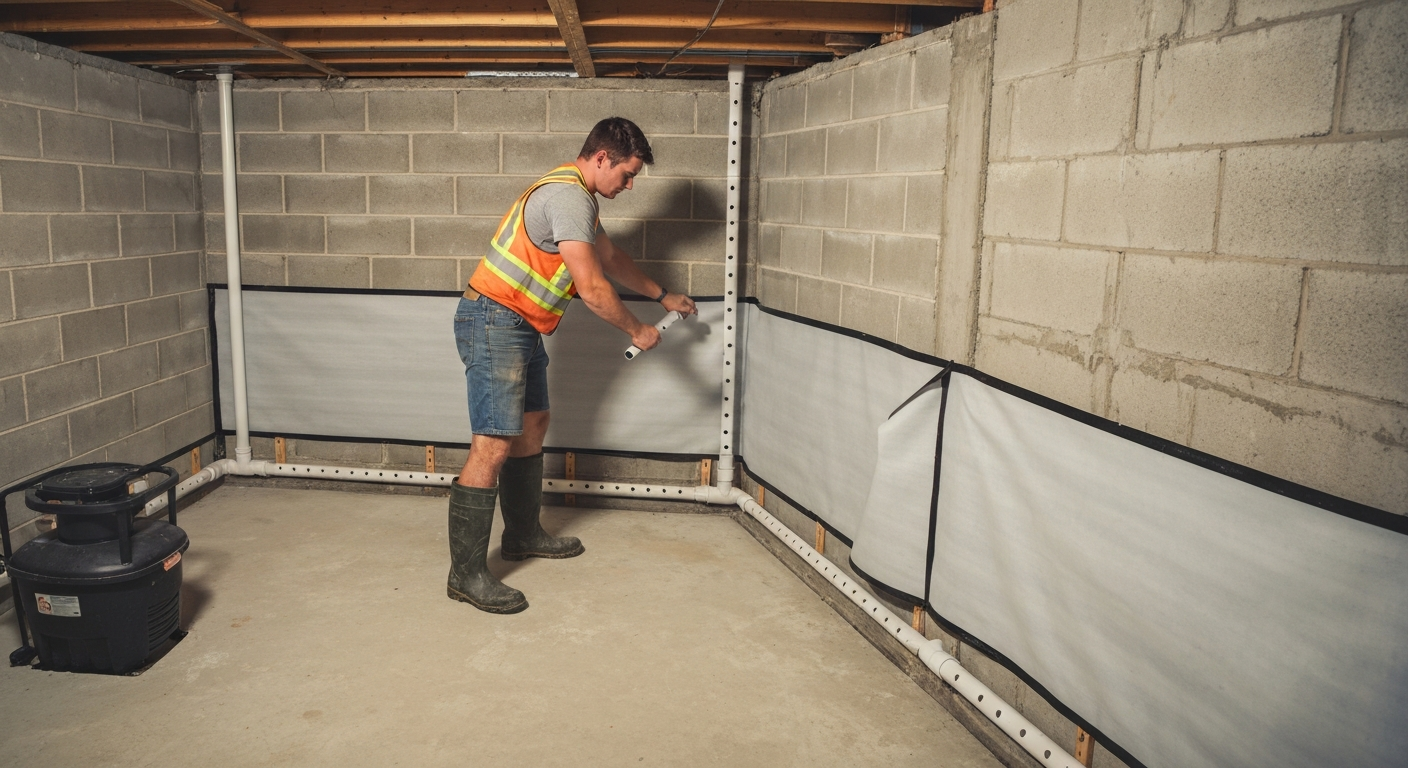
The fundamental difference is simple: exterior waterproofing addresses the source of water by excavating around the foundation, installing a proper membrane, and pairing it with new drainage tile and carefully detailed backfill. Interior waterproofing manages water after it enters the basement using a perimeter drain channel, sump pit, and sump pump. That’s important because in Beechborough-Greenbrook’s Toronto-clay conditions, saturated soil can expand against foundation walls and keep pushing water through cold joints and cracks; the exterior approach interrupts that cycle before it reaches the wall.
That said, interior solutions are often the practical first move when access is constrained by decks, driveways, or finished landscaping, or when the homeowner wants a lower-disruption plan. Poured concrete walls usually perform well with targeted crack injection paired with a sump strategy when needed, because properly selected injection systems can seal seep paths effectively. Block foundations, however, frequently need a practical complement—interior drains are commonly used to handle seepage that moves through masonry joints and mortar lines even after surface sealing.
Ontario spring conditions also make sump pump backup a real consideration. During heavy rain or ice-storm events, power interruptions can coincide with rapid groundwater rise. A battery backup system helps keep the pump running long enough to prevent a finished-basement disaster while you address the outage.
Here’s a typical price justification example: if you have a single leaking crack near a corner and no evidence of failed exterior drainage, crack injection can fit around $600 – $3,000. But if you’re seeing recurring perimeter dampness after freeze–thaw, efflorescence, and heavy spring seepage, the more complete plan—interior drainage up to $3,500 – $15,000, or exterior waterproofing at $7,000 – $25,000 where feasible—can be what it takes to actually stop the water path rather than repeatedly chasing symptoms.
| Method |
Best For |
Addresses Source? |
Disruption |
Lifespan |
Price Band |
| Full exterior excavation + membrane |
High lateral soil pressure, failing exterior drainage, recurring spring seepage |
Yes |
High |
Long-term when membrane and drainage are detailed correctly |
$7,000 – $25,000 |
| Interior French drain + sump system |
Chronic seepage with limited exterior access; dampness across multiple walls |
No (it manages water after entry) |
Medium |
Very good with correct discharge and maintenance |
$3,500 – $15,000 |
| Crack injection — epoxy (structural) |
Stable, non-moving cracks where water entry is through a defined channel |
Partially (seals the crack path) |
Low |
Good when crack movement is minimal |
$600 – $2,500 |
| Crack injection — polyurethane (active leak) |
Cracks with ongoing seepage, minor movement, or “weeping” behaviour in freeze–thaw |
Partially (seals while allowing flexibility) |
Low |
Good for active leaks when properly prepared and sealed |
$900 – $3,000 |
| Interior drain channel only (no sump) |
Light seepage where gravity drainage to a suitable outlet is reliable |
No |
Medium to low |
Moderate; performance depends on discharge feasibility |
$2,000 – $8,000 |
| Re-grading + downspout extensions |
Surface-water issues, wet window wells, runoff that hits foundation |
No (prevents additional intake) |
Low |
Moderate; limited if hydrostatic pressure is ongoing |
$800 – $3,000 |
How to choose a waterproofing contractor in Beechborough-Greenbrook
Choosing the right contractor matters because waterproofing isn’t a “one product fits all” trade—Toronto-area clay soils and freeze–thaw demand the correct system design. Start by verifying the contractor’s Ontario credentials and coverage. Ask for (and review) their liability insurance certificate—make sure it lists your property as applicable or shows project-appropriate coverage limits. Confirm WSIB/WCB coverage by requesting a clearance letter or documented proof of coverage. If they can’t provide up-to-date documents quickly, that’s a major warning sign.
Next, request 2–3 itemised written quotes. You want line items that separate labour and materials (excavation, membrane components, drainage tile, sump pit and pump, discharge piping, concrete patching, disposal, and any mould/efflorescence prep). Avoid lump-sum quotes that don’t say what’s included. Ask whether permits are included or excluded, and whether debris disposal, excavation restoration, and grading are part of the scope.
Warranty should be clear and in writing: workmanship warranty length, what exact materials are covered (and by the manufacturer), and whether the warranty is transferable if you sell your home. For payment schedule, never pay more than 10–15% upfront; hold back a portion until the job is complete and surfaces are restored. Finally, insist on a written start date and a completion estimate—so delays don’t quietly stack up during spring thaw.
- Ask for a site plan: which walls are treated, and where water will discharge.
- Require a basement moisture plan: identify whether the issue is hydrostatic pressure, surface runoff, or a localized crack.
- Confirm product selection: epoxy vs polyurethane injection matched to crack behaviour.
- Get the sump details in writing: discharge line routing and backup type.
- Verify excavation realities: how they’ll protect deck footings and handle narrow access.
- Check that disposal and restoration (soil, topsoil, grading) are included for exterior jobs.
- Ask about testing/verification: how they confirm the system is draining after completion.
- Ensure they include prep steps: drying, surface cleaning, and efflorescence/mould remediation if needed.
- Confirm warranty terms: workmanship coverage and manufacturer coverage, with durations.
- Review payment schedule: keep retainage until completion and walkthrough sign-off.
- Ask who pulls permits (if required) and whether contractor or homeowner bears the cost.
- Request proof of current insurance and WSIB/WCB coverage before work begins.
Red flags in Beechborough-Greenbrook: contractors who offer exterior excavation without explaining membrane details; quotes that don’t differentiate epoxy vs polyurethane for crack injection; promises of “guaranteed dry basements” without conditions; refusing to provide COI/WSIB/WCB clearance documents; and vague scopes that exclude discharge routing, disposal, or restoration.
Frequently asked questions — waterproofing in Beechborough-Greenbrook
What is a battery backup sump pump and do I need one in Beechborough-Greenbrook?
In Beechborough-Greenbrook, a battery backup sump system is designed to keep your sump pump running during power interruptions. When spring rains or freeze–thaw events cause rapid water rise, electrical outages can mean the main pump stops just when water levels climb. A battery system typically activates automatically when the primary pump loses power, running the pump for long enough to prevent basement flooding while you restore electricity. Whether you “need” it depends on your basement history: repeated sump tripping, past outages during heavy rain, and whether the basement is finished or contains valuable utilities.
In many Toronto-area projects, homeowners choose backup as a risk-reduction step—especially when interior drainage is managing chronic seepage in clay-heavy soils. Budget-wise, adding backup often lifts the sump portion of the job into the higher end of the typical sump installation range (commonly around $1,800 – $5,000 depending on system complexity).
How much does basement waterproofing cost in Beechborough-Greenbrook?
Basement waterproofing costs in Beechborough-Greenbrook vary mainly by whether you can address water at the source or only manage it inside. If you’re doing exterior excavation with a new drainage tile system and protected membrane, pricing commonly falls within $7,000 – $25,000. If site access is limited, an interior perimeter drain and sump strategy is often the practical route, with typical budgets in the $3,500 – $15,000 range. For isolated leaks from cracks, foundation crack repair via injection is frequently much lower, often $600 – $3,000, but only when the crack is stable and properly matched to the right injection product.
Local clay soils and Toronto’s freeze–thaw can make “symptom-only” fixes fail sooner, which is why scoped quotes matter. A detailed assessment usually saves money by selecting the correct approach rather than repeating partial repairs.
Interior vs exterior waterproofing — which is better?
“Better” depends on the water path. Exterior waterproofing is usually best when the primary problem is hydrostatic pressure pushing water against foundation walls. It involves excavation, membrane installation, and new perimeter drainage to keep soil water from reaching the foundation. That’s the most permanent solution when access allows, and it commonly prices in the $7,000 – $25,000 band. Interior waterproofing is better when excavation is impractical due to decks, driveways, tight lot lines, or when you’re dealing with ongoing seepage after entry. Interior systems control water using a perimeter drain channel, sump pit and pump, typically in the $3,500 – $15,000 range.
In Beechborough-Greenbrook’s clay-heavy conditions, interior can be excellent at preventing flooding, but it won’t stop lateral water pressure at the wall. For poured concrete walls with stable cracks, injection plus a sump plan may be sufficient; for block foundations with joint seepage, interior drainage is often the practical complement.
Why is my basement leaking in Beechborough-Greenbrook?
Basement leaks in Beechborough-Greenbrook are usually caused by one (or a combination) of three things: hydrostatic pressure from saturated clay backfill, failed or overwhelmed drainage systems, and freeze–thaw-driven crack movement. Toronto-area soils often include dense clay pockets that hold water and expand when saturated, increasing lateral pressure on foundation walls. During winter cycles, small defects—cold joints, tie holes, mortar joints in block, and hairline cracks—can widen, turning minor seepage into an active leak over a few seasons.
Common local patterns include dampness concentrated along wall corners, efflorescence on basement walls, and recurring dampness after spring melt. Post-war and 1960–1980s homes are also more likely to have older weeping tile or drains that are partially clogged or collapsed, resulting in interior dampness rather than obvious exterior failures. If you also notice wet window wells or heavy water around the perimeter during storms, surface runoff and grading may be contributing.
How do I know if a foundation crack is serious?
A crack’s seriousness depends on its type, location, and behaviour—not just how wide it looks. In Beechborough-Greenbrook, minor hairline cracks that show only occasional dampness are often manageable with targeted crack injection. But structural concerns are more likely with horizontal cracks in block walls, major step cracks in masonry, stair-stepping that is clearly widening over time, or cracks that extend across multiple sections of a wall and correlate with doors/windows that suddenly misalign.
Practical checks: take photos with a ruler for scale every 1–3 months; note whether dampness or seepage is active (polyurethane is usually considered for active leaks); and look for efflorescence, which suggests water movement through masonry. If the crack is accompanied by bowing or uneven wall geometry, don’t attempt a DIY injection without a structural assessment. For structural repairs in Ontario, engineering involvement is often necessary so the right scope is designed.
How much does foundation crack repair cost in Beechborough-Greenbrook?
Foundation crack repair in Beechborough-Greenbrook commonly falls around $600 – $3,000, depending on the number of cracks, total linear feet, whether the crack is actively leaking, and how much prep and surface patching is required. Isolated, stable cracks that can be treated with epoxy injection often sit toward the lower portion of the range. Cracks showing active seepage or mild movement are frequently treated with flexible polyurethane injection, which can increase labour and material cost—especially if multiple ports and re-injection steps are needed.
Cost can also rise if the walls show heavy efflorescence or if crack repair needs to be combined with an interior drainage upgrade to control ongoing hydrostatic pressure. A properly designed quote will explain why injection alone is enough—or why it needs to be paired with interior drainage—based on the observed water path in your basement.