Basement waterproofing options and costs in Concord
Basement waterproofing in Concord, Ontario, usually starts with one question: where is the water coming from—around your foundation, through cracks, or from failing internal drainage? In Concord (population 8,255, Statistics Canada, 2021 Census), many homes were built during waves of post-war and 1960s–1970s construction, when tar-and-paper or early drainage approaches were common. That matters because original systems often fail gradually—especially as clay-heavy soils hold water against foundation walls and expand during freeze–thaw cycles.
In the Toronto economic region, waterproofing costs are also shaped by how contractors work in built-up neighbourhoods. Tight lots, landscaped yards, and access limits near additions or shared driveways frequently increase excavation time and disposal costs for exterior jobs. At the same time, the region’s mixed glacial till and clay profiles and higher local water pressures can turn small defects—cold joints, tie holes, and hairline cracks—into active leaks after a few winters. That’s why Concord homeowners in areas such as Thornhill/Markham-adjacent pockets (where older drainage often underperforms and basement calls spike) commonly see a wider spread of solution types: full exterior excavation with membrane and drainage tile, or interior perimeter drainage and sump systems, or targeted crack repair when the source is isolated.
Use the table below to compare common approaches, how much they disrupt your property, and what they typically cost locally before you request itemised quotes.
| Method |
What It Addresses |
Disruption Level |
Durability |
Price Range |
| Exterior excavation + new membrane + drainage tile |
Hydrostatic pressure at the foundation perimeter; bulk water management around the footing |
High (yard/sidewalk/drive access may be disturbed) |
High (source-of-entry solution when installed correctly) |
$7,000–$25,000 |
| Interior perimeter drain channel + sump pit |
Water that already enters; intercepts seepage and directs it to a sump |
Medium (floor/wall sections opened) |
Medium-High (depends on drainage design and pump reliability) |
$3,500–$15,000 |
| Foundation crack injection (epoxy or polyurethane) |
Isolated cracks and leaking seams (epoxy for stable cracks; polyurethane for active leaks) |
Low to Medium (minimal concrete cutting) |
Medium-High (best for targeted, properly prepped cracks) |
$600–$3,000 |
| Sump pump installation (primary + battery backup) |
Chronic seepage response; reduces hydrostatic risk during heavy spring events |
Medium (pit excavation and electrical work) |
High when paired with backup and correct discharge routing |
$800–$3,500 |
| Window well drain installation |
Localized leaks near egress windows from clogged/gravel drainage or poor grading |
Low to Medium (window well area opened) |
Medium (performance depends on upkeep and outlet routing) |
$1,200–$4,000 |
| Lot re-grading / downspout extension |
Reduces surface water at the foundation; lowers the volume reaching soils |
Low (yard work only) |
Low-Medium (often needs combined drainage to fully solve) |
$800–$3,500 |
Prices are estimates only and vary by project scope, site access and material selection.
What affects the price of waterproofing in Concord
Homeowners in Concord often get bids for the “same” problem that vary by 30–50% across the Toronto area and Ontario because waterproofing pricing is driven less by the product line and more by the site conditions and labour effort required to reach the true water path. In practice, two homes can both have damp basements, but one may have a failing weeping tile with intact wall conditions, while the other has active wall leakage through cracks and tie holes that need targeted injection and a drainage upgrade.
The biggest regional cost drivers that separate Concord from national averages are soil type, water table, and freeze–thaw. Mixed glacial till and dense clay pockets in the region can expand during freeze–thaw and exert lateral pressure on foundation walls, widening defects and turning minor leaks into repeating seepage. High local water pressure also increases sump run times and drainage requirements; when weepers are partially collapsed or clogged, the interior solution must work harder (and sometimes needs upgrades) rather than relying on older tile. In coastal climates like BC, saturation can fill backfill quickly; in Ontario’s winter cycle, the damage becomes more obvious over several seasons as freeze–thaw widens small concrete and mortar gaps.
Concrete Concord examples: (1) a poured-concrete wall with isolated vertical cracking may fall closer to crack repair pricing (often in the $600–$3,000 band), while (2) a block foundation with multiple step cracks typically pushes you toward an interior drainage system and, if water pressure is higher, sump capacity (commonly $3,500–$15,000). If your drainage is severely compromised, exterior excavation with membrane and new drainage tile can be the most complete fix, often aligning with the $7,000–$25,000 range.
| Price Factor |
Why It Matters |
Cost Impact |
| Interior vs. exterior approach — interior is less disruptive but addresses symptoms |
Interior systems intercept water after it enters; exterior aims to stop water before it reaches the wall |
Interior can cost less upfront, but exterior is often higher yet more source-focused |
| Foundation type — poured concrete vs. block vs. stone vs. ICF |
Crack behaviour and sealing strategy differ by material |
Block and older walls often need more preparation and drainage work |
| Soil type — clay expands more than sand, adding pressure |
Clay holds water and expands during freeze–thaw |
More wall pressure usually increases scope and durability requirements |
| Crack type and length — hairline vs. structural horizontal cracks |
Horizontal/structural cracks may indicate movement and require engineering |
Structural assessment and additional remediation can raise total cost |
| Sump pump backup system — battery or water-powered backup needed |
Power outages during spring runoff can compromise pumping |
Backup adds cost but reduces the risk of flooding during outages |
| Access — landscaping, decks, or driveways must be removed for exterior |
Excavation and disposal time increases in tight lots |
Exterior work can rise sharply when multiple features must be removed and restored |
| Weeping tile age — original tile (60+ years) may be completely failed |
Old drainage often collapses or clogs, increasing water entry |
May push the job from targeted patching to full drainage replacement |
| Mould or efflorescence remediation required before sealing |
Sealers and membranes don’t bond well over active contamination |
Extra cleaning, disposal, and surface preparation increase labour |
Permits & regulations in Ontario
In Ontario, basement waterproofing work can trigger permits depending on what you’re changing. As a rule, foundation excavation, structural crack repair that could affect load paths, and changes to how lot drainage directs water typically require municipal review and a permit process. If your waterproofing plan involves routing a sump discharge to a storm or sanitary connection, expect municipal approval requirements. For structural crack repair—particularly horizontal cracks in block walls or major step cracking—a structural engineer’s assessment is often required to confirm whether underpinning or additional structural work is needed.
What typically DOES require a permit or approval (commonly): exterior excavation near foundations; any work that changes drainage patterns on the lot; structural crack repairs where movement or stability is in question; and sump discharge changes that connect to municipal services. What typically does NOT require the same level of permit scrutiny (common examples): interior crack injection for an isolated leak, installation of an interior perimeter drain channel and sump where discharge is handled to an approved non-service route, and re-grading/downspout extensions that only redirect roof runoff away from the foundation (confirm with your contractor and the municipality for your exact setup).
Before signing in Concord, verify the contractor is properly licensed for their scope and carries liability insurance and WSIB/WCB coverage. Ask for: (1) proof of WSIB/WCB clearance or account status, (2) an up-to-date certificate of insurance naming you as certificate holder if applicable, and (3) their Ontario business information from the public online registry. For structural repairs, request confirmation of engineering support in writing—who the engineer is and how they document findings.
Interior vs exterior waterproofing — what does Concord need?
The fundamental difference is where the water is managed. Exterior waterproofing means full excavation, new membrane, new drainage tile around the perimeter, and then controlled backfill and re-compaction. Done correctly, it addresses the source of water entry by relieving hydrostatic pressure before water reaches your wall. It’s also the most disruptive option in Concord because excavation often requires removing landscaping, restoring walkways, and disposing of significant soil.
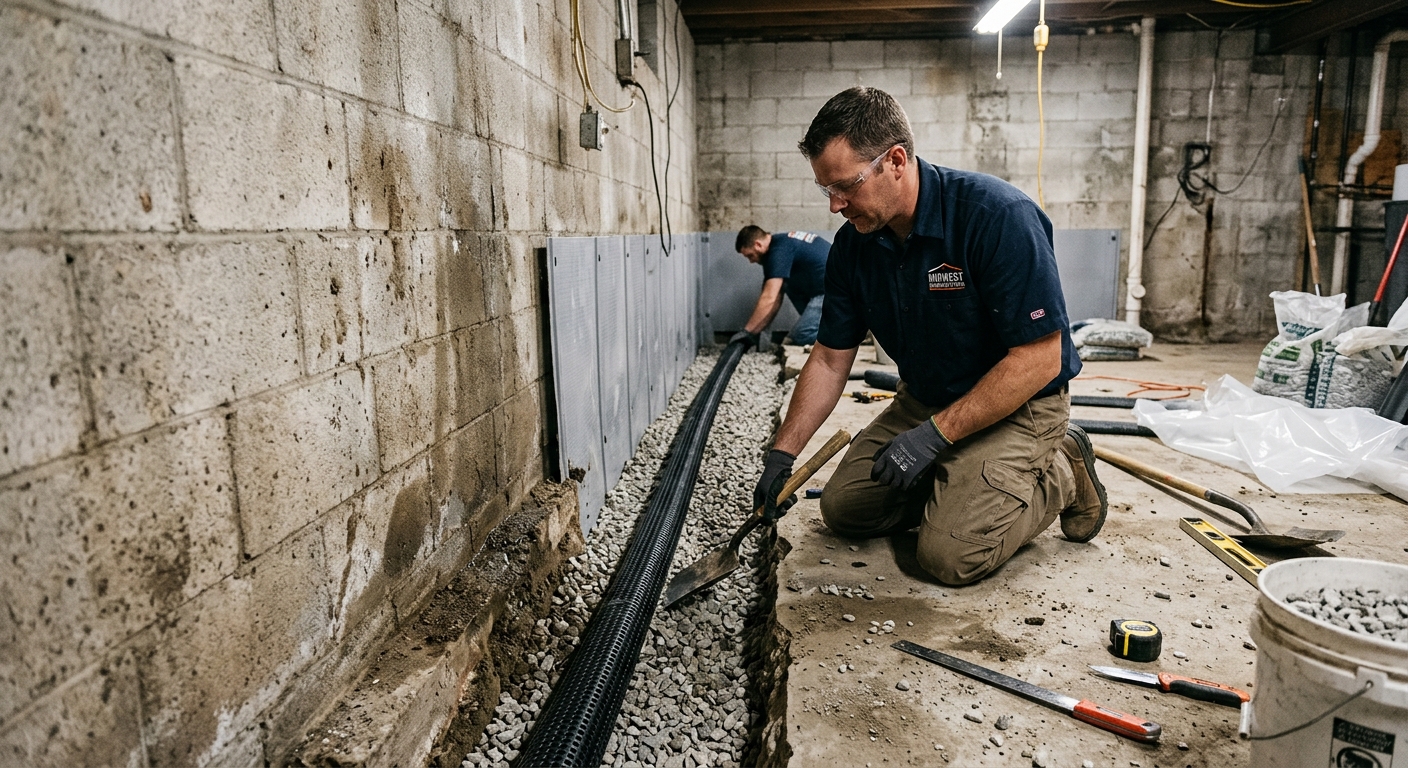
Interior waterproofing—typically a perimeter drain channel, sump pit, and sump pump—manages water after it enters. It’s usually less invasive, because work is performed from the basement side, not from the exterior yard. However, interior solutions do not stop hydrostatic pressure on the wall; they only intercept and move water away. In Concord, that matters most when the local soil is clay-heavy and water pressure is higher. Poured concrete walls often respond well to properly prepared crack injection plus drainage, while block foundations frequently benefit from interior drainage as a practical complement because block joints and capillary pathways can be harder to seal from the inside alone.
Ontario’s freeze–thaw cycles and spring runoff also make sump performance important. For chronic seepage, backup pumping (battery backup) can be worth it because outages happen during peak water events. A real example: if your issue is isolated crack leakage, crack injection may land near the $600–$3,000 band, and pairing it with improved downspouts could be enough. But if you’re seeing dampness across multiple walls or persistent efflorescence, an interior perimeter drain and sump system in the $3,500–$15,000 range may be justified; it may cost less than the $7,000–$25,000 exterior excavation, but it’s chosen when exterior access is limited or when your best option is to control seepage.
| Method |
Best For |
Addresses Source? |
Disruption |
Lifespan |
Price Band |
| Full exterior excavation + membrane |
High water pressure, repeated seepage, or failing exterior drainage on clay-heavy sites |
Yes |
High |
Long (when drainage, compaction, and membrane transitions are properly detailed) |
$7,000–$25,000 |
| Interior French drain + sump system |
Chronic seepage, damp floors, or failing weeping tile where exterior access is limited |
No (intercepts after entry) |
Medium |
Medium-High (depends on pump/backup and maintenance) |
$3,500–$15,000 |
| Crack injection — epoxy (structural) |
Stable, non-moving cracks (often in poured concrete) |
Partially (seals the defect) |
Low |
Medium-High (best when cracks are truly stable and prepared correctly) |
$600–$3,000 |
| Crack injection — polyurethane (active leak) |
Cracks with active moisture flow |
Partially (seals and manages active seepage) |
Low to Medium |
Medium (requires correct prep and may be combined with drainage) |
$600–$3,000 |
| Interior drain channel only (no sump) |
Light seepage where gravity discharge is viable and water volumes are low |
No |
Low to Medium |
Limited (performance depends on discharge and seasonal water pressure) |
$2,000–$7,500 |
| Re-grading + downspout extensions |
Surface water issues and recurring dampness after rainfall |
No (reduces load but doesn’t stop wall pressure) |
Low |
Low-Medium (often needs drainage support) |
$800–$3,500 |
How to choose a waterproofing contractor in Concord
When you’re choosing a waterproofing contractor in Concord, start with proof that they can legally and safely do the work. In Ontario, ask for three key items before any scheduling: (1) confirmation of Ontario business details/licensing for their scope (where applicable), (2) current liability insurance (and request to see a recent certificate of insurance), and (3) WSIB/WCB coverage—typically via a clearance letter or documented account status. If they can’t provide these on request, move on.
Next, get 2–3 itemised written quotes. You want a breakdown of labour and materials, not just a lump-sum number. The scope should clearly state what’s included: permit pull responsibility (if needed), disposal and soil haul-away, how the sump discharge is routed, and what restoration is covered after excavation or interior openings. A detailed scope prevents “scope creep” later when conditions are worse than expected.
Warranty matters too. Look for a workmanship warranty length (for example, typically several years) and separate product/manufacturer warranty documentation. Ask whether the warranty is transferable to future homeowners—this can matter in resale. On payment, never pay more than 10–15% upfront. Use a holdback until the job is fully complete and cleaned up.
Finally, insist on an in-writing start date and an estimated completion window. In Concord, excavation and cure times are impacted by access logistics and weather, so written timelines protect you.
- Ask for a site-specific inspection and a written water-source explanation (not just “apply a coating”).
- Confirm insurance certificate is current and includes liability limits suitable for foundation work.
- Verify WSIB/WCB coverage with a clearance letter/account document.
- Get 2–3 quotes with labour + materials broken out (membrane/drain tile vs. installation labour).
- Ensure the scope lists whether a permit will be pulled and who pays for it.
- Confirm disposal/soil hauling is included for excavation work.
- Ask how the sump pump discharge is routed and whether it has approved routing.
- Request details on sump backup (battery type, switching method, and what it covers).
- Ask who handles engineering/assessment if cracks suggest movement.
- Check warranty terms: workmanship duration, exclusions, and product warranty documentation.
- Plan payment schedule: 10–15% maximum upfront; hold back until final punch list is done.
- Get the timeline and cure/inspection steps in writing to avoid delays.
Red flags specific to waterproofing in Concord: contractors who promise “one-size-fits-all” waterproofing; quotes that don’t mention how water is controlled (drainage tile/sump discharge/crack type); missing details on where excavation or demolition ends and restoration begins; refusing to show insurance/WSIB/WCB clearance; and vague warranty wording that doesn’t distinguish workmanship from product performance.
Frequently asked questions — waterproofing in Concord
Can I waterproof my basement from the inside only?
Yes—many Concord homeowners can start with interior waterproofing, especially when exterior access is tight or when the water entry is primarily through localized cracks and seepage pathways. Interior solutions commonly include a perimeter drain channel and a sump pit/pump, and they’re designed to intercept water after it enters. However, interior work doesn’t remove hydrostatic pressure against your wall in clay-heavy sites, so you need the right design and pump reliability. If the issue is active leakage through cracks, crack injection may cost less than a full excavation, often falling in the $600–$3,000 band, but it should be paired with drainage if you see widespread dampness, efflorescence, or repeated spring seepage in Ontario.
What causes foundation cracks in Concord?
In Concord and the broader Toronto area, the usual causes are movement driven by soil moisture changes and freeze–thaw cycles. Clay-heavy soils expand when saturated, exerting lateral pressure on foundation walls and widening defects over multiple winters. Repeated freeze–thaw also affects mortar and concrete microcracks, turning hairline issues into active leaks. Add in older drainage systems—many post-war to 1960–1980s homes still rely on original clay weeping tile that can be clogged or partially collapsed, increasing local water pressure against the foundation. In practical terms, vertical cracks can come from settlement, while step cracks or horizontal cracking in block walls can suggest more serious movement and may require engineer assessment before sealing or injection.
How do I compare waterproofing quotes?
Compare quotes by scope, not by the headline price. A reasonable Ontario approach is to see (1) what exact method is proposed (exterior membrane and drainage tile versus interior perimeter drain and sump), (2) which defects are targeted (crack length/type, tie holes, cold joints, window well sources), and (3) what’s included in prep and restoration. Ask if permits are included and who handles them, whether disposal and soil haul-away are covered, and how the sump discharge is routed. For cost benchmarking in Concord, see where the quote sits relative to typical local bands: exterior excavation often aligns with $7,000–$25,000, while interior drainage/sump projects commonly fall in the $3,500–$15,000 range. If one quote is dramatically lower but lacks drainage details, that’s often the giveaway.
How long does basement waterproofing take in Concord?
Timing depends on whether you’re doing exterior excavation or interior drainage. Interior perimeter drain channel work plus sump installation often takes less time than full excavation, but it still includes concrete cutting, drainage installation, pump/electrical setup, and then testing and finishing—so many projects run over several days to a couple of weeks. Exterior waterproofing is longer because access, excavation, membrane installation, drainage tile replacement, backfill/compaction, and restoration all need careful sequencing. Weather matters in Ontario: freezing conditions and wet soils can slow excavation or curing, so contractors usually plan around site conditions. Ask your contractor for a written start date and completion estimate, and confirm whether cure times and any inspection/permit steps are included in the schedule.
What is a weeping tile and does my Concord home have one?
A weeping tile is an underground drain system around the foundation footing designed to collect groundwater and carry it away, usually to a discharge point or sump. Many homes built in earlier decades used clay weeping tile; in Toronto-area neighbourhoods, those older tiles are now frequently clogged, cracked, or partially collapsed, which can lead to interior dampness and sometimes basement flooding. Newer homes may use different drainage approaches, but the concept is similar: manage subsurface water before it builds pressure. Whether your Concord home has it depends on the original design and renovations. The most reliable way to confirm is a site-specific inspection—sometimes with probing, camera inspection of existing drains, or a review of permits/build records if available.
Can I waterproof my basement in winter in Concord?
Sometimes, but it’s situational. In Concord, winter conditions in Ontario can limit exterior excavation because frozen ground increases labour time and makes it harder to dig to footing depth, place drainage tile properly, and ensure backfill compaction. Interior work is often more feasible in winter because crews can cut and install systems from inside the foundation, provided the basement can be kept workable and dry enough for concrete finishing. Crack injection can also often be done in cold weather depending on product requirements and surface preparation, but active moisture needs careful handling. If your leak is tied to outside water pressure, winter interior work can reduce ongoing issues, but it may not fully solve the source without addressing drainage. For best results, discuss your symptoms with the contractor and ask how they’ll handle freeze–thaw related expansion and curing during the season.