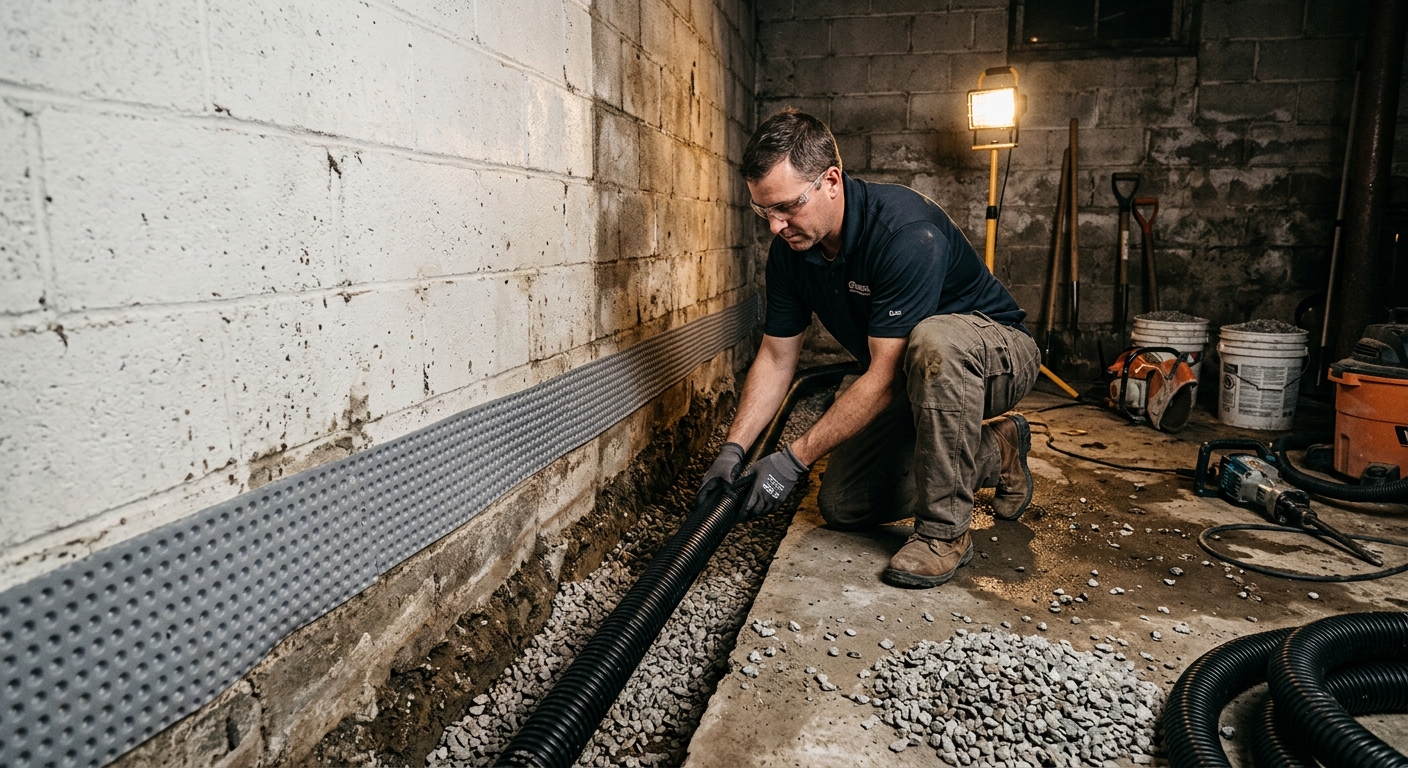
Basement waterproofing options and costs in Little Current
In Little Current, basement waterproofing usually comes down to where the water is entering and how hard the surrounding soils are pushing back. With a population of 2,156 people (Statistics Canada, 2021 Census), the local housing market is small, and homeowners often rely on a limited pool of contractors who know the typical foundation details in the area. That matters because many basements in the broader Toronto economic region include post-war and 1960–1980s homes—an age bracket where original clay weeping tile, early plastic drains, or older tar-and-paper systems have had decades to fail.
Pricing is also shaped by Ontario freeze–thaw cycles. Even minor hairline cracks can “open and close” over winter, turning seepage at cold joints, tie holes, or basement-wall cracks into active drips after a few seasons. In addition, mixed glacial till and pockets of dense clay can hold water against foundations, increasing lateral pressure on the wall and raising the importance of drainage design. In Little Current, work is especially in demand along the more developed residential areas near the waterfront and established streets, where excavation access can be tight and drainage upgrades are critical.
Because of these site factors, comparing options side-by-side helps you choose the right approach—whether you need to address the source with exterior excavation and a new membrane, or manage water after entry with interior perimeter drainage and a sump system. Use the table below as a realistic starting point for budgeting.
| Method |
What It Addresses |
Disruption Level |
Durability |
Price Range |
| Exterior excavation + new membrane + drainage tile |
Stops water at the source by adding a continuous waterproofing system and new weeping drainage around the foundation |
High (excavation, regrading, landscaping impacts) |
Long-term when drainage is correctly detailed |
$7,000–$25,000 |
| Interior perimeter drain channel + sump pit |
Collects seepage water and relieves hydrostatic pressure after entry |
Medium (basement floor/footing work) |
Very reliable with properly sized sump and discharge routing |
$3,500–$15,000 |
| Foundation crack injection (epoxy or polyurethane) |
Seals localized cracks; polyurethane is used where there’s active seepage pressure |
Low to medium (minimal interior patching) |
Good for isolated defects when the crack type is matched correctly |
$600–$3,000 |
| Sump pump installation (primary + battery backup) |
Moves collected water out during high water events and during outages (with backup) |
Low to medium (pit + wiring/plumbing) |
High reliability with correct discharge and backup power |
$800–$3,500 |
| Window well drain installation |
Prevents groundwater and rain infiltration at basement windows and window wells |
Low to medium (window well excavation/pipe routing) |
Solid for localized water entry points |
$1,000–$4,000 |
| Lot re-grading / downspout extension |
Moves roof runoff and surface water away from the foundation to reduce soil saturation |
Low (light landscaping changes) |
Moderate (depends on ongoing maintenance) |
$500–$3,000 |
Prices are estimates only and vary by project scope, site access and material selection.
What affects the price of waterproofing in Little Current
In Little Current, two homeowners can receive quotes for “the same” basement leak and still see 30–50% differences—especially across the Toronto region where soil pockets, access constraints, and drainage ages vary widely from street to street. Even within Ontario, the cost gap comes from three big drivers that separate local pricing from the national average: soil type, water table conditions, and freeze–thaw behaviour.
First, clay-heavy soils common across much of Ontario can expand when saturated and exert lateral pressure on foundation walls. When that pressure cycles through winter, small defects widen, and cracks at cold joints, tie holes, and mortar lines can become active. Second, higher water tables (or older, partially clogged weeping tile) increase sump run times and require more robust drainage design. Third, freeze–thaw makes every minor failure more expensive: the longer water has to work on concrete and blocks, the more likely you’ll need to combine systems—like interior drainage plus localized crack work—instead of a quick fix.
Concrete examples from typical Little Current situations: if the leak is near a basement corner where there’s a history of failing weeping tile, interior drainage plus a sump can land around the $3,500–$15,000 band; but if exterior access is available and the foundation perimeter needs membrane and new drainage tile, budgets often move toward the $7,000–$25,000 exterior range. Conversely, if the issue is mainly surface runoff from roof leaders, re-grading and downspout extensions can be a lower-cost fix, often far less than full excavation.
Housing age also matters. Older clay drains may be fully failed (or collapsed), and poured concrete or block foundations may have developed crack patterns that change how we select injection material—epoxy for stable cracks versus polyurethane for active seepage.
| Price Factor |
Why It Matters |
Cost Impact |
| Interior vs. exterior approach |
Interior work is less invasive but manages water after it enters; exterior addresses the source but needs excavation and landscaping restoration |
Can change total cost by 2× to 4× depending on access |
| Foundation type |
Poured concrete typically seals better with crack injection; block walls often need interior drainage as a practical complement |
Different prep, product selection, and amount of drainage work |
| Soil type |
Clay expands more than sand and holds water against walls, raising seepage and hydrostatic pressure |
Often increases the need for drainage sizing and backup |
| Crack type and length |
Hairline cracks may be limited seepage points; structural horizontal cracks suggest more water and possible movement |
Structural patterns may require engineer input and broader repair |
| Sump pump backup system |
Battery backup is insurance during outages, especially during wet spring events |
Commonly adds a few hundred to a few thousand dollars |
| Access |
Decks, driveways, and landscaping can force hand-digging or additional restoration |
Can raise exterior costs substantially |
| Weeping tile age |
Original clay weeping tile (often 60+ years) may be completely failed or partially collapsed |
May require replacement rather than tie-in, increasing labour/materials |
| Mould or efflorescence remediation required before sealing |
Sealing over active contamination can trap moisture and degrade coatings |
Adds prep time and sometimes specialty materials |
Permits & regulations in Ontario
In Ontario, foundation excavation, structural crack repair, and changes to lot drainage typically require a building permit. Sump pump installations that connect to the storm or sanitary sewer generally require municipal approval before discharge routing is finalized. If you’re planning to repair a crack that appears structural (for example, significant horizontal cracking in block walls, major step cracking, or evidence of differential movement), a structural engineer’s assessment is often required to confirm whether underpinning or other structural work is needed.
Step-by-step, here’s how a homeowner in Little Current can verify a contractor is properly covered and legally able to perform the work:
- Ask for their Ontario licence information (and any applicable trades registration) and confirm it matches the company name on the quote.
- Request a certificate of insurance (liability). Verify the policy is current and includes the named insured/company address.
- Confirm WSIB/WCB status (or the appropriate coverage/clearance documentation). Look for a clearance letter when applicable.
- For structural crack work, ask whether they can provide engineering support or coordinate directly with an engineer—especially if underpinning is on the table.
- Ask whether permit pulling is included in the scope, and if not, who will apply for the permit and what details you need to provide.
- Get the permit responsibilities in writing (what’s contractor’s job versus homeowner’s job).
If the contractor can’t clearly explain permits, insurance, and structural coordination, that’s a major warning sign—particularly for drainage changes and structural crack repairs.
Interior vs exterior waterproofing — what does Little Current need?
The fundamental difference is that exterior waterproofing is source control, while interior waterproofing is water management. Exterior waterproofing involves full excavation along the foundation perimeter, installing a continuous membrane, adding drainage tile, and backfilling with a properly graded system. Done correctly, it addresses the water entry pathway and reduces hydrostatic pressure at the wall. The tradeoff is cost and disruption: excavation affects landscaping, requires careful restoration, and can be more challenging where yards are tight.
Interior waterproofing typically uses a perimeter drain channel, a sump pit, and a sump pump. It’s less invasive and often faster to complete, but it doesn’t stop water pressure from acting on the wall—it captures and removes water after it enters. In Little Current, where mixed glacial till and clay pockets can hold water against foundations and freeze–thaw can worsen cracks over multiple winters, exterior solutions are strongest when water table impacts are consistent or when weeping tile has failed. However, interior drainage can be a practical “best next step” when exterior access is restricted, when we’re dealing with long-standing interior dampness, or when you need to complement crack repairs.
Foundation type also guides the choice. Poured concrete walls often respond well to correctly selected crack injection (epoxy for stable cracks, polyurethane for active leaks). Block foundations commonly benefit from interior perimeter drainage as a reliable complement, especially when mortar joints or block pores allow seepage pathways. Because Ontario spring events can bring power interruptions, sump pump backup is worth serious consideration—especially if the basement has a history of wet episodes rather than one-off spills.
As a dollar example: if you have chronic seepage and failing drainage at the perimeter, an exterior project can fall around $7,000–$25,000. For many homeowners, pairing interior perimeter drainage and a sump system (often within $3,500–$15,000) can be justified when exterior excavation would be disproportionately disruptive or when only certain walls show active leakage.
| Method |
Best For |
Addresses Source? |
Disruption |
Lifespan |
Price Band |
| Full exterior excavation + membrane |
Frequent seepage, high water pressure conditions, or failed exterior drainage where access allows |
Yes |
High |
Long-term when drainage is correctly detailed |
$7,000–$25,000 |
| Interior French drain + sump system |
Basement dampness, seepage through cracks, and chronic water entry when exterior isn’t practical |
No (manages water after entry) |
Medium |
Very reliable with correct pump sizing and discharge |
$3,500–$15,000 |
| Crack injection — epoxy (structural) |
Stable cracks in poured concrete that are not actively seeping under pressure |
Partial (seals the crack pathway) |
Low to medium |
Good for non-moving cracks |
$600–$2,500 |
| Crack injection — polyurethane (active leak) |
Active weeping seepage where water is still pushing through |
Partial (seals active pathway) |
Low to medium |
High when crack type and injection staging are correct |
$1,200–$3,000 |
| Interior drain channel only (no sump) |
Minor seepage where water volumes are low and can be handled without sump cycling |
No |
Medium |
Moderate (depends on local water conditions) |
$3,000–$8,000 |
| Re-grading + downspout extensions |
Surface runoff issues, short-term wetting near walls after storms |
Sometimes (reduces perimeter saturation) |
Low |
Moderate (maintenance-dependent) |
$500–$3,000 |
How to choose a waterproofing contractor in Little Current
Choosing the right contractor starts with proof. In Ontario, you should verify three things: licensing/trade registration where applicable, liability insurance, and WSIB/WCB coverage (or appropriate clearance documentation). How to check each: request the insurance certificate and look for the current effective/expiry dates, the named insured company, and the jobsite/location coverage. For WSIB/WCB, ask for a clearance letter or proof of coverage, then confirm it matches the contractor’s legal entity.
Next, get 2–3 itemised written quotes. You want a labour + materials breakdown (not a lump sum with unclear inclusions). Confirm whether disposal is included, whether permits are included, and what site restoration is part of the price (for example, basement flooring patching, exterior backfill, topsoil, sod/landscaping reinstatement). Make sure the scope states exactly what’s being installed: drainage tile type, membrane system components, sump pump model/specs, and discharge route.
Warranty matters too. Ask for the workmanship warranty length, whether it’s transferable to a new homeowner, and whether there’s a separate manufacturer warranty for the product system. Payment schedule should be conservative—never more than 10–15% upfront, and hold back a portion until the job is complete and cleaned up.
Finally, insist on a written timeline with a start date and realistic completion estimate, plus a plan for weather delays around Ontario freeze–thaw periods.
- Verify liability insurance certificate (current dates, matching legal company name).
- Verify WSIB/WCB clearance/coverage documentation.
- Confirm permit responsibility in writing (and who pulls it).
- Request an itemised quote (labour, materials, pump, membrane, tile, labour hours).
- Ask what’s excluded (demo limits, landscaping restoration scope, disposal, mould remediation).
- Match crack repair method to crack type (epoxy vs polyurethane)—no one-size-fits-all.
- Confirm sump pump discharge route (no guessing about tie-ins or routing).
- Ask if they include backup power (battery) when outages are a concern.
- Get product/manufacturer specs and warranties in writing.
- Clarify warranty coverage: workmanship vs product, and transferability.
- Use a payment schedule with a holdback until completion and final walkthrough.
- Get start date, phases, and completion estimate in writing.
Red flags in Little Current include: (1) quoting exterior waterproofing without a drainage-tie-in plan for soil saturation and weeping tile condition, (2) promising “guaranteed dry basement” without diagnosing crack type and water entry pathway, (3) refusing to provide insurance/WSIB documentation or avoiding permit questions, (4) pushing large upfront deposits beyond 10–15%, and (5) not specifying sump pump model/specs or backup provisions in the scope.
Frequently asked questions — waterproofing in Little Current
Why is my basement leaking in Little Current?
Basement leaks in Little Current are often caused by water pressure building up against the foundation during wetter periods, then finding pathways through cracks, tie holes, or cold joints. In Toronto-region conditions, mixed glacial till and clay pockets can hold water against foundation walls, and freeze–thaw can widen small defects over successive winters. Many homeowners also find that the original weeping tile or early drainage is partially clogged or failed—so water that should drain instead seeps inward, leading to damp floors, efflorescence, or puddling near corners. The most important step is a proper assessment of where the water appears (corner, wall mid-point, under windows) and whether it’s active seepage versus surface runoff after storms.
How do I know if a foundation crack is serious?
A crack can be “fixable” or it can indicate a bigger issue, and the difference comes from behaviour and appearance. In Little Current and the broader Ontario climate, active cracks that show fresh moisture, staining, or seasonally worsening seepage are often more urgent. Horizontal cracks, significant step cracking in block walls, or cracks that widen over time can point to structural movement or persistent hydrostatic pressure. Hairline vertical cracks without moisture may be less concerning, especially on poured concrete. Still, don’t assume—have a contractor evaluate whether it’s stable (epoxy-type sealing) or actively leaking (often requiring polyurethane injection). If there’s any hint of movement, plan for engineer input before major structural decisions.
How much does foundation crack repair cost in Little Current?
Typical foundation crack repair in Little Current is often in the range of $600–$3,000, depending on the number of cracks, their total length, and whether the crack is actively seeping or simply stabilized. For example, an isolated, stable crack in poured concrete that’s dry enough for epoxy injection may land closer to the lower portion of the band, while active seepage that requires polyurethane injection often pushes the price toward the middle or upper end. If remediation is needed first (like cleaning efflorescence or addressing moisture conditions), that can also affect total cost. Contractors should assess the crack type and water presence before quoting, rather than guessing.
Do I need a sump pump in Little Current?
Many homeowners in Little Current don’t need a sump pump if the leak is minor, brief, and corrected by surface drainage changes or localized crack sealing. You’re more likely to need a sump system when seepage is recurring, when interior perimeter drainage collects continuous water, or when the groundwater pressure is high enough that a drain channel alone can’t keep up. In Toronto-region soil conditions—especially clay pockets that hold water—sump pumps are a common part of practical interior waterproofing. If you do install one, ask about a backup system. During spring flooding periods and occasional outages, backup (like battery power) can prevent the pump from failing when the basement is most at risk. Costs vary, but sump pump installation typically falls within $800–$3,500.
How does Little Current's soil affect my foundation?
Soil affects your foundation mainly through how much water it holds and how that water behaves during freeze–thaw. In the Toronto economic region, the mix of glacial till and clay pockets can increase groundwater retention, keeping moisture pressed against the foundation longer than sandy soils would. Clay soils also expand when saturated and can exert lateral pressure on walls, worsening cracks over time. That’s why a contractor may recommend exterior excavation and new drainage tile when the water is coming from the perimeter, or interior drainage plus a sump when exterior access is limited. Even on the same street, soil conditions can vary, which is why one basement may need a full membrane-and-tile solution while another only needs targeted sealing and grading.
Do I need a permit for foundation work in Ontario?
In Ontario, foundation excavation, structural crack repair, and changes that affect lot drainage commonly require a building permit. Sump pump installations that connect to the storm or sanitary sewer typically require municipal approval as well—don’t tie into services without confirming requirements first. For structural cracks (like major horizontal cracks in block walls or signs of movement), a structural engineer assessment is often required before proceeding with any major repair strategy. For Little Current homeowners, the practical step is to ask the contractor: “Who pulls the permit, and what exactly is covered in the permit application?” A reputable contractor should also verify insurance and WSIB/WCB coverage and be able to coordinate engineered assessments when structural work is involved.