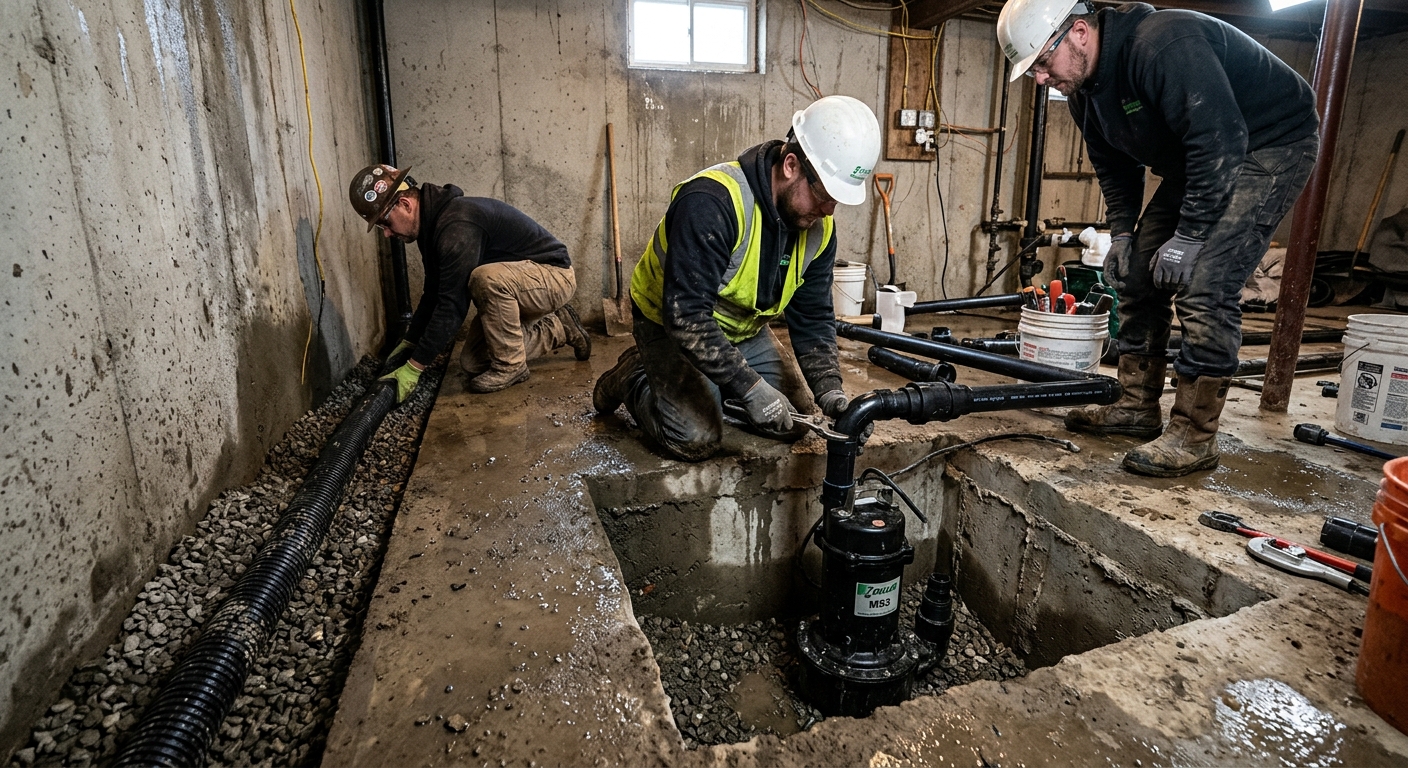
Basement waterproofing options and costs in Binbrook
Basement waterproofing in Binbrook typically comes down to one decision: do you stop water before it reaches your foundation (exterior waterproofing), or do you manage water after it enters (interior systems). Binbrook has a small population of 8,796 (Statistics Canada, 2021 Census), but it’s surrounded by the Hamilton–Niagara Peninsula market where older housing stock is common and many basements were originally protected with early-generation tar-and-paper systems and then patched over time. In practice, that means you’ll often see corroded or failed weeping tile and staining that worsens during Ontario’s freeze–thaw season.
In the Hamilton–Niagara Peninsula region—made up of clay and silty clay subsoils and areas influenced by relatively high groundwater—water management is rarely “one size fits all.” Costs rise when contractor time is higher (wet, cohesive soils requiring deeper, slower excavation), when drainage must be rebuilt with robust stone and membrane, and when the sump needs reliable pumping capacity. Conversely, projects can come in lower when access is straightforward (no deck or driveway removal) and when the source of water entry is clearly identified.
In Binbrook, exterior work is especially in demand around the newer growth areas where lots are tighter and grading/downspout discharge tends to be more sensitive—so small site fixes can have big payoff. Once you know which approach matches your foundation condition, you can compare typical scopes in the table below.
| Method |
What It Addresses |
Disruption Level |
Durability |
Price Range |
| Exterior excavation + new membrane + drainage tile |
Bulk water entry and hydrostatic pressure at the foundation perimeter |
High (excavation, landscaping restoration) |
Long-term when properly installed with drainage |
$12,000 – $25,000 |
| Interior perimeter drain channel + sump pit |
Water after it enters, reducing seepage and basement dampness |
Medium (floor/footing channel work) |
Good with proper pump sizing and maintenance |
$8,000 – $18,000 |
| Foundation crack injection (epoxy or polyurethane) |
Crack sealing to reduce leakage through joints/cracks |
Low (localized interior work) |
Depends on crack type and movement |
$600 – $1,800 |
| Sump pump installation (primary + battery backup) |
Continuous control of groundwater/sump inflow |
Low to medium (pit/costruction and discharge) |
High when paired with backup power |
$1,800 – $4,200 |
| Window well drain installation |
Localized water entry around egress wells |
Low to medium (small excavation and grading) |
Moderate to high with good discharge and sealing |
$1,200 – $3,000 |
| Lot re-grading / downspout extension |
Directing roof/yard water away from foundation |
Low (minor excavation and restoration) |
Moderate (performance depends on grading maintenance) |
$2,000 – $6,500 |
Prices are estimates only and vary by project scope, site access and material selection.
What affects the price of waterproofing in Binbrook
Even when two homeowners ask for the same “waterproofing,” quotes across the Hamilton–Niagara Peninsula and Ontario can swing by 30–50% because the scope can quietly change: excavation depth, drainage design, soil handling, and how far contractors must go to reach stable material. Locally, the biggest separation from a national average comes from Binbrook’s clay-heavy pockets, the practical reality of freeze–thaw, and seasonal groundwater behaviour common to the region.
First, soil type: clay and silty clay expand during freeze–thaw and can exert lateral pressure on foundation walls as moisture migrates and freezes. That pressure often worsens cracking over time, so sealing-only approaches may not hold unless drainage and pressure relief are addressed. Second, water table and seepage: where groundwater sits roughly 2–4 m below grade in many areas, deeper basements or poorly drained lots can experience higher inflow volumes, translating into more robust sump and drainage stone requirements. Third, freeze–thaw: Ontario’s repeated expansion/contraction can fail marginal drainage or undersized sump setups, which increases labour and materials when contractors have to correct the system—not just add a patch.
Two concrete Binbrook examples: a homeowner with a shallow-fill driveway that sheds water toward the foundation may see lower costs if grading and downspouts resolve the source—sometimes in the $2,000–$6,500 range before you ever excavate. In contrast, homes with exterior weeping tile that has failed for decades typically require excavation and a full drainage assembly; that’s where projects more often land in the $12,000–$25,000 exterior band. If you only need targeted crack repair, foundation crack injection may stay closer to the $600–$1,800 band, but only when the crack is not actively moving.
| Price Factor |
Why It Matters |
Cost Impact |
| Interior vs. exterior approach — interior is less disruptive but addresses symptoms |
Exterior targets water entry; interior manages water after it enters |
Interior can be 20–40% less, but may require stronger sump capacity |
| Foundation type — poured concrete vs. block vs. stone vs. ICF |
Wall composition affects crack behaviour and sealing compatibility |
Poured concrete often supports crack injection better; block may need drainage complements |
| Soil type — clay expands more than sand, adding pressure |
Moisture movement and freeze–thaw increase wall stress |
Clay sites can require deeper excavation and more robust backfill/drainage layers |
| Crack type and length — hairline vs. structural horizontal cracks |
Movement changes the success of injection and sealing |
Structural cracks can shift the project from sealing-only to structural assessment/repairs |
| Sump pump backup system — battery or water-powered backup needed |
Reduces risk of flood events during power loss |
Backup adds cost but prevents major damage; can add hundreds to over $1,000+ |
| Access — landscaping, decks, or driveways must be removed for exterior |
Excavation becomes longer and more labour-intensive |
Access issues can increase labour and restoration, pushing exterior toward the top of the band |
| Weeping tile age — original tile (60+ years) may be completely failed |
Old tile often collapses or plugs, leaving water no path |
Failed tile typically means full replacement, not spot repairs |
| Mould or efflorescence remediation required before sealing |
Sealers can fail if moisture-bearing contamination remains |
Remediation adds time and materials, especially when ventilation and disposal are required |
Permits & regulations in Ontario
In Ontario, the work that typically triggers a building permit includes foundation excavation that changes support conditions, structural crack repair where the wall may require structural intervention, and alterations to lot drainage that affect how water leaves the property (especially when tied to municipal discharge requirements). Sump pump installations that connect to storm or sanitary sewer discharge usually require municipal approval—your contractor should confirm how they plan to discharge and whether a permit is required for the connection.
For structural crack repair—particularly horizontal cracks in block walls, significant step cracking, or signs of wall movement—an engineer’s assessment is commonly needed to determine whether underpinning or other structural work is required. Before you sign anything, ask whether the contractor has engineering support available for structural scenarios, and confirm they carry liability insurance and WSIB/WCB coverage where applicable.
Step-by-step, you can verify a contractor in Binbrook quickly:
- Check the contractor’s licensing/registration details through Ontario’s appropriate online contractor verification resources (ask them which trade category applies).
- Request a current certificate of insurance (liability) and verify the effective dates and property address coverage.
- Request WSIB/WCB clearance (or proof of registration/exempt status if they claim an exemption).
- For structural work, require evidence of engineer involvement (proposal language naming an engineer or “engineering support” in writing).
- Ask whether they pull permits and whether permit costs are included, then confirm in writing.
- Request a written scope that states discharge location and whether municipal approvals are required.
Interior vs exterior waterproofing — what does Binbrook need?
Exterior waterproofing is the “source control” approach: it requires full excavation, new membrane on the foundation exterior, installation of new drainage tile, then carefully engineered backfill and re-grading. When it’s done properly, it addresses water entry and helps relieve hydrostatic pressure before it reaches the basement. The trade-off is higher cost and disruption—excavation in clay-heavy soils around Binbrook can mean more labour time and more extensive landscaping restoration.
Interior waterproofing is different: it manages water that has already entered by creating a perimeter drain channel, installing a sump pit and sump pump, then pumping water away or to a permitted discharge point. Interior systems are generally less invasive and can be a practical solution when exterior access is limited (mature landscaping, decks, driveways) or when you need to stabilize dampness quickly. However, interior work does not stop hydrostatic pressure on the wall itself—it reduces the water level and flow path after entry.
In the Hamilton–Niagara Peninsula market, poured concrete walls often respond well to crack injection when the crack is not actively moving, because sealed cracks can reduce seepage paths. Block foundations, meanwhile, frequently benefit from interior drainage as a complement because block mortar joints and wall permeability can allow seepage even when a localized crack is treated. Given Ontario’s spring flooding cycles and typical power outages during peak demand, a sump pump with backup (battery or other approved backup method) is often worth considering so a power interruption doesn’t turn a damp basement into water damage.
To illustrate the price logic: if your main issue is a few localized cracks and there’s no active seepage, foundation crack injection may land near the $600–$1,800 band. But if you’re seeing ongoing inflow during wet seasons in Binbrook clay soils and the weeping tile is failing, exterior waterproofing at roughly $12,000–$25,000 is often justified because it reduces the amount of water your interior system has to manage—or may make a sump system unnecessary in the first place.
| Method |
Best For |
Addresses Source? |
Disruption |
Lifespan |
Price Band |
| Full exterior excavation + membrane |
Recurring wet basements, high inflow during spring thaws, failing exterior weeping tile |
Yes |
High |
Long-term with correct drainage design |
$12,000 – $25,000 |
| Interior French drain + sump system |
Dampness with measurable seepage, limited exterior access, stabilizing after tile failure |
No (manages after entry) |
Medium |
High with proper pump sizing and discharge |
$8,000 – $18,000 |
| Crack injection — epoxy (structural) |
Non-moving structural cracks (often in poured concrete) where sealing is viable |
Partial (seals a path) |
Low |
Good when the crack is stable |
$600 – $1,800 |
| Crack injection — polyurethane (active leak) |
Cracks with active seepage where flexible injection is needed |
Partial (seals leakage route) |
Low |
Good for active leakage; depends on ongoing movement |
$700 – $1,950 |
| Interior drain channel only (no sump) |
Light seepage and slower water entry where pump capacity is not needed |
No |
Medium |
Moderate (pump may be needed later) |
$6,500 – $12,000 |
| Re-grading + downspout extensions |
Surface water management issues (roof runoff and yard water) |
Yes (for surface sources) |
Low |
Moderate (depends on maintenance) |
$2,000 – $6,500 |
How to choose a waterproofing contractor in Binbrook
Start by verifying the contractor’s Ontario readiness. Ask for their proof of Ontario licensing/registration for the trade they’re performing, then confirm liability insurance and current WSIB/WCB status. You’ll want to see certificates that match your property address and cover the job period. If they mention structural repair, request clarity on engineering support—structural crack situations should not be handled purely by “standard injection” without the right assessment.
Next, get 2–3 itemised written quotes rather than lump sums. A good quote breaks labour and materials into line items: excavation (if exterior), membrane/drainage tile, stone backfill, sump pit and pump, discharge piping, disposal, and restoration/cleanup. Also confirm what’s excluded: permit fees, engineering, soil disposal, restoration (sod, interlock, topsoil), and any remediation for mould/efflorescence. If a contractor says they’ll “handle permits,” require it in writing—otherwise you may discover later that the permit is your responsibility.
Warranty matters. Look for a workmanship warranty length and whether it covers labour for leaks related to the installation. Product/manufacturer warranties should be provided for membranes/pumps/related systems, and you should ask if warranties are transferable to new owners (common for basement systems). On payment, never pay more than 10–15% upfront, and use a holdback until key milestones (like waterproofing completion and pump testing) are done. Finally, require a start date and completion estimate in writing so you can plan around excavation scheduling and restoration.
- Use itemised quotes (labour + materials) and compare like-for-like scopes.
- Ask how they identify the water source (dye/inspection, assessment of tile failure, signs of active seepage).
- Confirm the drainage design: correct stone gradation, geotextile use, and slope to discharge.
- Require membrane specification (type, thickness, overlaps, and how it’s protected at the foundation).
- Verify sump pump discharge plan and whether backup power is included or optional.
- Ask who handles permits and approvals for drainage connections.
- Check disposal and restoration inclusions (topsoil/sod/interlock cleanup).
- Confirm how they protect adjacent structures during excavation in clay soils.
- Get warranty terms in writing (workmanship + product coverage, limitations, transferability).
- Use milestone-based payments; keep a holdback until testing and final cleanup.
- Request a site protection and dust control plan for interior work.
- Ensure the proposal includes pump testing/commissioning and documentation (especially for backups).
Red flags in Binbrook: contractors who provide a low price but omit drainage tile/membrane details; who won’t provide proof of insurance or WSIB/WCB; who recommend only crack injection even when you have active seepage or wet floors after rain; who avoid discussing discharge location/approvals; and who ask for large upfront payments (beyond 10–15%).
Frequently asked questions — waterproofing in Binbrook
How much does foundation crack repair cost in Binbrook?
In Binbrook and the broader Hamilton–Niagara Peninsula area, foundation crack repair typically depends on crack type and length, and whether the crack is actively leaking. For many homeowners, crack injection work lands around the $600 – $1,800 band when it’s a manageable number of cracks and the wall isn’t showing major movement. Epoxy injection is often used where the crack is stable, while polyurethane may be chosen for active seepage because it can accommodate minor movement. If the crack is horizontal or there are signs of structural movement, you may need an engineer assessment first, which changes the scope. That’s why a correct inspection matters before anyone quotes a “per crack” price.
Do I need a sump pump in Binbrook?
Not every basement in Binbrook needs a sump pump, but many do—especially where clayey soils hold moisture and where groundwater can sit relatively close to the surface for much of the year. If you notice recurring seepage, water collecting in a low spot, or dampness that increases during spring thaws, a sump system can protect your basement by lowering water levels and preventing hydrostatic pressure from turning into inflow. In this region, sump pump installation commonly falls in the $1,800 – $4,200 range, and backup power (battery backup or other approved backup method) is often recommended for spring when outages are more likely. If water entry is primarily from surface runoff, re-grading/downspout extensions may reduce the need for a sump.
How does Binbrook's soil affect my foundation?
Binbrook homes are often impacted by clay and silty clay subsoils, which can retain moisture and expand during freeze–thaw cycles. That expansion can increase lateral pressure on foundation walls and contribute to cracking over time, particularly in basements that are deeper or on poorly drained lots. Where perched water exists in shallow fill layers, seepage can become persistent even if the foundation looks “mostly dry” in early winter. Practically, that soil behaviour is why waterproofing quotes can vary by 30–50%: clay sites may require more robust drainage stone, careful backfill, and a properly designed sump plan. If your weeping tile is older or failed, the soil moisture has nowhere to go, which can raise inflow volume and shorten the time you have before you notice interior dampness.
Do I need a permit for foundation work in Ontario?
In Ontario, permits are commonly required for foundation excavation that changes support conditions, structural crack repair where the wall may be structurally involved, and changes to lot drainage that affect how water is managed/discharged. Sump pump installations that connect to storm or sanitary sewer discharge generally require municipal approval. For major crack repairs—especially horizontal cracks or step cracking—an engineer’s assessment is often needed to determine whether underpinning or other structural work is required. To verify, work with a contractor who can clearly state in writing: what permit they will pull (if any), what engineering is required (if applicable), and where discharge will go. Before signing, ask for a written scope that states permit responsibility and whether permit costs are included.
How long does waterproofing last?
How long waterproofing lasts in Binbrook depends on the system type, how correctly it matches the water entry path, and whether it’s protected by good site drainage. Exterior waterproofing (membrane + drainage tile) is designed as long-term source control, typically providing many years of reliable performance when installed with proper membrane overlaps, drainage stone, geotextile, and backfill. Interior systems (perimeter drain + sump) can also perform for a long time, but their longevity is tied to pump reliability, discharge management, and backup power during outages. Crack injection can last for years when the crack is stable, but if water pressure and wall movement continue through Ontario’s freeze–thaw cycles, new leaks can develop elsewhere. A strong warranty helps, but the real determinant is matching the solution to whether water is entering through cracks, porous walls, or surface runoff.
Can I waterproof my basement from the inside only?
Yes, you can often waterproof from the inside only—especially when exterior access is limited—but it depends on what’s causing the water entry in your Binbrook home. Interior drainage (a perimeter drain channel with a sump pit) manages water after it enters, and interior approaches may be appropriate for dampness issues where you can’t excavate outside. However, interior methods do not stop hydrostatic pressure from acting on the wall itself, so results are best when paired with correct crack treatment and a properly sized sump system. If you’re dealing with consistent inflow during wet seasons and failed exterior weeping tile, exterior waterproofing may be the more complete solution. For reference, interior waterproofing commonly falls in the $8,000 – $18,000 band, while exterior excavation approaches are usually higher due to full-source control and excavation.