Basement waterproofing options and costs in Hanover
Basement waterproofing in Hanover is usually a “solution match” exercise: the right system depends on where the water is coming from, how your foundation was originally built, and how the freeze–thaw cycles affect existing cracks. In Hanover, the stakes are higher because a large share of homes—about 64.2% built before 1981—were erected when many properties relied on older, less-consistent dampproofing and have since seen weeping tile failure, clogged outlets, or corroded drainage components. At the same time, single-detached homes make up 64.2% of dwellings, which means homeowners often have direct access for exterior work along one or more sides, but also lots of landscaping and driveway interfaces that can increase demolition and restoration costs.
In the Stratford–Bruce Peninsula region, pricing is shaped by clay and clay-loam soils that hold water and drain slowly, creating wet backfill and higher lateral pressure on foundation walls. Add Ontario’s repeated freeze–thaw, and small hairline movement can turn into active seepage. Contractor demand is especially noticeable around family-focused residential pockets like Highway 6 corridor properties and the downtown-to-north residential areas, where older basements are common and spring melt often brings complaints quickly.
Below are the most common options we see in Hanover, with realistic cost bands so you can compare like-for-like before you decide whether to excavate or control water from inside.
| Method |
What It Addresses |
Disruption Level |
Durability |
Price Range |
| Exterior excavation + new membrane + drainage tile |
Major water entry, hydrostatic pressure, failed exterior drainage |
High (excavation + landscape restoration) |
Long-term (typically 20–30+ years with proper installation) |
$14,000–$35,000 |
| Interior perimeter drain channel + sump pit |
Water that enters through weeping tile failure, minor cracks, slab edge dampness |
Moderate (interior excavation along perimeter) |
High (depends on pump sizing and discharge) |
$6,000–$18,000 |
| Foundation crack injection (epoxy or polyurethane) |
Cracks allowing seepage or movement—epoxy for dry/structural cracks, polyurethane for active leaks |
Low (localized drilling and curing) |
Good to high when crack type is matched to material |
$600–$1,800 |
| Sump pump installation (primary + battery backup) |
Controls interior water level during heavy rain and spring melt |
Low to moderate (pit + discharge routing) |
Good (upgrade depends on backup reliability) |
$2,200–$4,500 |
| Window well drain installation |
Water intrusion at window wells, blocked weep holes, pooling against foundation |
Low to moderate |
Good (when discharge and grading are corrected) |
$1,200–$3,200 |
| Lot re-grading / downspout extension |
Surface water runoff management to reduce saturation around foundation |
Low to moderate |
Moderate (best paired with drainage repairs) |
$1,000–$5,000 |
Prices are estimates only and vary by project scope, site access and material selection.
What affects the price of waterproofing in Hanover
Even when two homeowners describe the “same” basement symptom, waterproofing quotes in Hanover can vary by roughly 30% to 50% across the Stratford–Bruce Peninsula region and the wider Ontario market. The reason is simple: the contractor’s recommended approach changes with the actual source of water—soil saturation, a failed weeping tile system, foundation crack type, and how the home is responding during spring melt and storms.
Three local drivers separate Stratford–Bruce Peninsula costs from the national average: soil type, water table, and freeze–thaw. Clay-heavy soils common in Southwestern Ontario can expand during wet conditions and exert lateral pressure on foundation walls, widening cracks over time. In areas where groundwater sits closer to foundation level, sump systems run longer, discharge lines need more capacity, and interior drainage becomes more labour-intensive. Freeze–thaw also increases the number of “active” leak points, which changes whether a crack injection calls for polyurethane versus epoxy and whether you need supplemental drainage.
In Hanover, we commonly see two cost patterns. First, older homes (again, around 64.2% built before 1981) often have weeping tile that’s decades past its service life—sometimes completely failed—so an interior perimeter drain plus sump may be the only practical immediate control. Second, the same home can become more expensive if exterior excavation requires rebuilding steps, redoing portions of lawn and sod, or working around tight side yards—labour and disposal rise, even if the membrane package is “standard.” On the low end, interior work may stay near $6,000–$18,000, while homes needing full excavation and new drainage can align with $14,000–$35,000 depending on footage and restoration.
Local demand also affects scheduling. In spring, when symptoms show up quickly after melt, crews may prioritize assessment visits and standby labour, which can shift labour availability and tighten appointment windows—without changing the underlying construction scope.
| Price Factor |
Why It Matters |
Cost Impact |
| Interior vs. exterior approach — interior is less disruptive but addresses symptoms |
Exterior stops water at the source; interior controls water after it enters |
Exterior typically increases cost substantially (often the largest jump) |
| Foundation type — poured concrete vs. block vs. stone vs. ICF |
Crack behaviour and sealing success differ by material |
Block often needs drainage as a practical complement; costs can rise |
| Soil type — clay expands more than sand, adding pressure |
Wet clay increases lateral pressure and speeds deterioration |
More drainage and more robust detailing may be required |
| Crack type and length — hairline vs. structural horizontal cracks |
Active-leak cracks need the right injection product and sometimes additional work |
Structural concerns can push the project from sealant to engineered remediation |
| Sump pump backup system — battery or water-powered backup needed |
Power interruptions during spring storms can allow water levels to surge |
Backup adds cost but reduces repeat flooding risk |
| Access — landscaping, decks, or driveways must be removed for exterior |
Removal and restoration is a major line item |
Tight sites can increase labour and disposal significantly |
| Weeping tile age — original tile (60+ years) may be completely failed |
Collapsed/clogged drainage forces water to find alternate paths |
More excavation and re-routing; interior drainage becomes more likely |
| Mould or efflorescence remediation required before sealing |
Sealers may not bond on contaminated surfaces; health controls may be needed |
Can add days and specialized materials |
Permits & regulations in Ontario
In Ontario, some types of basement and lot drainage work typically require permits, while other cosmetic or limited repair work often does not. As a rule of thumb for Hanover homeowners: foundation excavation, work that changes drainage patterns, and structural crack repairs usually trigger permit requirements and/or engineering involvement. Also, sump pump installations that discharge to a municipal system (storm or sanitary) typically require municipal approval, since the discharge method must follow local requirements.
Structural crack repair deserves extra attention. If you have horizontal cracks in block walls, step cracks that suggest movement, or signs the foundation is deforming, a structural engineer’s assessment is often needed to determine whether you’re looking at injection only, or whether underpinning/other structural measures are required.
To verify a contractor in Ontario, take these steps in Hanover:
- Ask for their Ontario licensing/registration information (and confirm it matches the work you’re hiring for) via the relevant provincial registry.
- Request certificate of liability insurance before work starts; the certificate should name you/your property as required by contract and show current coverage.
- Confirm WSIB/WCB coverage for workers performing excavation and demolition (ask for the clearance letter or proof of active status).
- For structural repairs, confirm they have engineering support or a process for bringing in an engineer when required.
- Get your permit responsibilities in writing: whether the contractor pulls the permit or you must, and what documentation they provide.
This is also a good way to avoid delays—permits and inspections can affect scheduling more than most homeowners expect.
Interior vs exterior waterproofing — what does Hanover need?
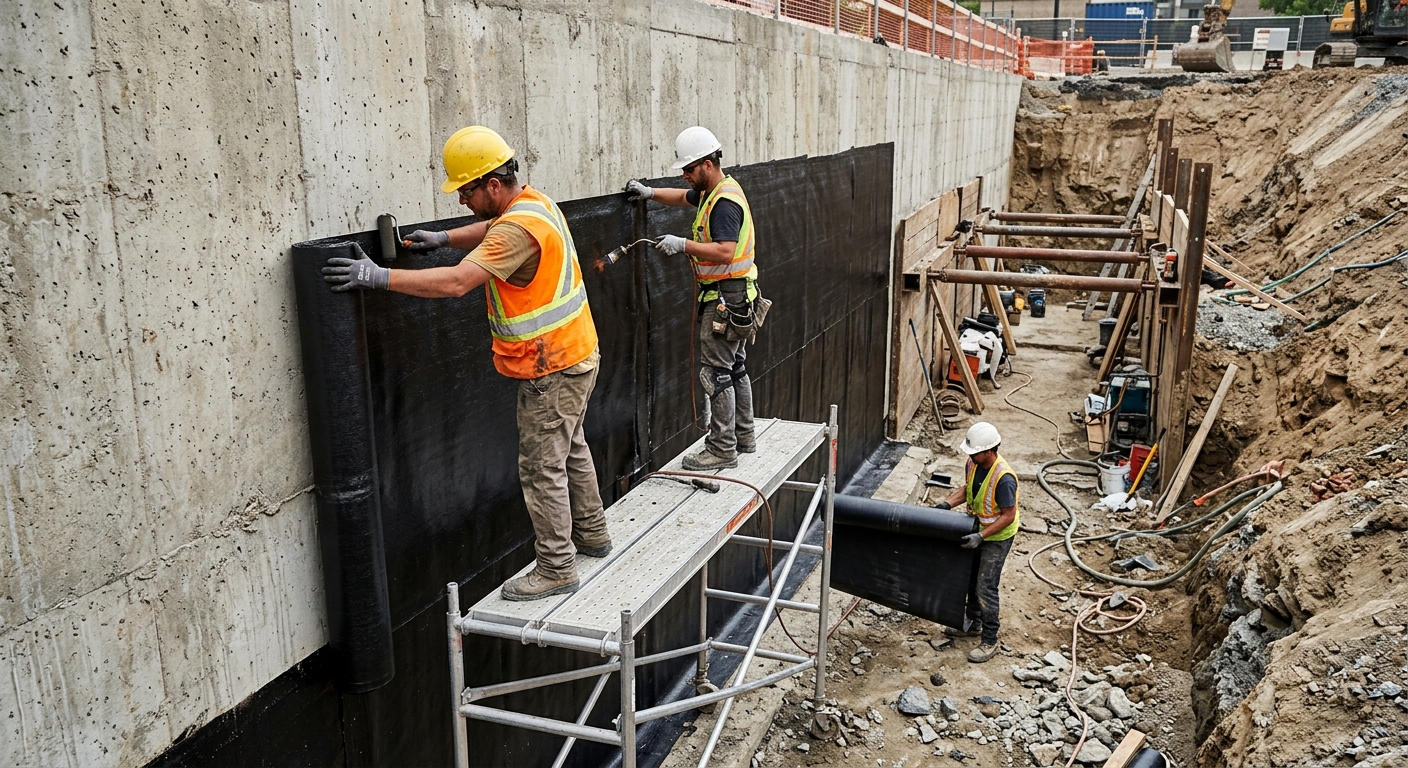
The fundamental difference is where the water problem is addressed. Exterior waterproofing involves full excavation, a new membrane, new drainage tile, and then backfilling and re-grading. Done correctly, it permanently reduces water entry by intercepting and diverting groundwater and surface water before it reaches the foundation. The trade-off is cost and disruption: in Hanover, you may be dealing with sod restoration, re-building steps or portions of a driveway edge, and removing landscaping to access the foundation wall.
Interior waterproofing (perimeter drain channel, sump pit, sump pump, and often a discharge route) manages water after it enters. It does not stop hydrostatic pressure against the wall; instead, it keeps the interior dry by lowering the water level. This approach can be a better fit when exterior access is limited, when the existing exterior system is mostly intact, or when we’re mainly seeing seepage during storms and spring melt.
Given Hanover’s clay-prone soils and freeze–thaw cycles, exterior is the best “root-cause” option when the exterior drainage and dampproofing are compromised—especially when weeping tile is clearly failed or surface water is being driven toward the foundation. Interior is often the practical choice when excavation would be very disruptive, or when the foundation is block and needs a dependable water-control system. For crack work, poured concrete walls often respond well to epoxy crack injection when the cracks are dry/structurally stable, while active leak points frequently require polyurethane to seal ongoing moisture pathways.
Sump pump backup matters here because Ontario power can be interrupted during spring storms. Adding backup (battery or other approved backup) helps prevent “one-hour outages” from turning into long-duration basement flooding.
As a real-world example: if an assessment finds active seepage primarily through a few cracks plus recurring spring sump overflow risk, an interior package may land around $6,000–$18,000. If later testing shows widespread exterior system failure and saturated backfill along multiple walls, the same property can justifiably move into $14,000–$35,000 exterior excavation—because you’re replacing the source control, not just cleaning up the symptoms.
| Method |
Best For |
Addresses Source? |
Disruption |
Lifespan |
Price Band |
| Full exterior excavation + membrane |
Widespread exterior water entry, failed exterior drainage/dampproofing, persistent seepage on multiple walls |
Yes |
High |
20–30+ years |
$14,000–$35,000 |
| Interior French drain + sump system |
Clay saturation or weeping tile failure where exterior is impractical, recurring spring melt seepage |
No (controls after entry) |
Moderate |
Typically 10–20 years (pump dependent) |
$6,000–$18,000 |
| Crack injection — epoxy (structural) |
Dry cracks that are structurally stable (common in poured concrete) |
Partially (seals openings, not bulk water pressure) |
Low |
Good when the crack is not actively moving |
$600–$1,800 |
| Crack injection — polyurethane (active leak) |
Active seepage where water is currently tracking through cracks (often during wet seasons) |
Partially (seals pathways, not exterior pressure) |
Low |
Good for active leaks when installed correctly |
$600–$1,800 |
| Interior drain channel only (no sump) |
Small dampness issues where water can be gravity-managed |
No |
Moderate to moderate-low |
Variable (depends on where water discharges) |
$3,500–$9,000 |
| Re-grading + downspout extensions |
Surface water problems, gutter overflow, minor dampness tied to runoff paths |
Yes for surface water |
Low to moderate |
Moderate (requires ongoing maintenance) |
$1,000–$5,000 |
How to choose a waterproofing contractor in Hanover
Choosing the right waterproofing contractor in Hanover starts with verifying coverage and competence—not just comfort on the phone. First, check Ontario licensing/registration for the type of work they’ll do (and whether they’re qualified for excavation and any permitted scope). Next, request a current certificate of liability insurance. Then confirm WSIB/WCB clearance for their workers; you should be able to obtain proof (often a clearance letter) before work begins.
When you get quotes, insist on 2–3 itemised written estimates with a labour-and-materials breakdown. You want line items for assessment, drilling/injection, drainage tile and geotextile, sump pit components, discharge piping, pump type (including backup), and any restoration. Avoid lump sums that don’t show what’s included.
Read the scope carefully: does the quote include permit pulls (if required), disposal, protection for landscaping and neighbouring fences, and cleaning/efflorescence remediation before sealing? Ask about warranty details: confirm the workmanship warranty length, the manufacturer warranty on membranes or injection materials, and whether the warranty transfers to future owners.
For payment schedule, never pay more than 10% to 15% upfront. Hold back a portion until the work is complete, inspected, and any commissioning steps (like sump pump testing and discharge verification) are finished. Finally, get a start date and completion estimate in writing so spring-melt expectations are realistic.
- Ask for a site assessment plan: inspection of cracks, drainage paths, and discharge points.
- Request foundation photos and a written explanation of crack type (hairline vs active/structural indicators).
- Confirm pump make/model and what “backup” means (battery vs other approved backup).
- Verify discharge location and route (not just “to daylight”).
- Check whether window wells and weep areas are included if they’re part of the leak pathway.
- Ensure interior work specifies how far the perimeter excavation goes and how the drain is routed.
- Confirm materials: membrane system components, drainage tile specification, and geotextile type.
- Ask how they handle mould/efflorescence before sealing and whether surface prep is included.
- Get restoration listed (sod, backfill topsoil, landscaping reinstatement) with quantities.
- Confirm permit responsibility in writing (contractor vs homeowner).
- Verify disposal/recycling of excavated soils and concrete where applicable.
- Review warranty terms and whether the workmanship warranty is in your name and location.
Red flags we see with some waterproofing contractors in Hanover include: promising an exterior fix without verifying weeping tile condition; offering crack injection without identifying whether the crack is active; quoting “cheap” sump work with no backup for spring-season risk; leaving discharge and restoration vague; and refusing to provide itemised scope, insurance documentation, or warranty details in writing.
Frequently asked questions — waterproofing in Hanover
How do I compare waterproofing quotes?
Start by comparing scope, not just the total price. For example, a quote that includes exterior excavation and new drainage tile typically sits in the $14,000–$35,000 band, while an interior perimeter drain plus sump is often closer to $6,000–$18,000. Ask each contractor to itemise labour and materials (membrane, drainage tile, geotextile, sump components, discharge piping, restoration). Also compare what they investigate: crack type (epoxy for dry/structural vs polyurethane for active leaks), weeping tile status, and how they plan to address surface runoff with downspout extensions. Finally, confirm timelines, permits, and warranties. In Ontario, missing permit responsibility or vague discharge routing is a common reason projects run over budget.
How long does basement waterproofing take in Hanover?
Timelines depend on whether you’re doing interior control, crack injection, or full exterior excavation. Crack injection is often the fastest—typically a short visit plus curing time, with the basement usable soon after. Interior perimeter drainage and sump work usually takes longer because it involves perimeter excavation, drainage installation, sump pit construction, routing, and pump testing; projects commonly take several days to a couple of weeks depending on complexity and drying/restoration needs. Full exterior waterproofing takes the longest because excavation, membrane and drainage tile installation, inspections, backfilling, and landscape restoration must all be sequenced. In Hanover, spring scheduling can affect start dates—winter access is also limited by freeze conditions, so plan around inspection windows and weather.
What is a weeping tile and does my Hanover home have one?
A weeping tile is the foundation perimeter drainage system installed around the base of the foundation (behind or integrated into the foundation wall era system) to collect groundwater and direct it away from the home. Many older Hanover houses—especially those built before the late 1970s/early 1980s—were more likely to have an original system, but clay-heavy soils and decades of freeze–thaw can lead to failure, clogs, or collapsed sections. Since about 64.2% of Hanover homes were built before 1981, it’s common to see aging weeping tile or remnants that no longer function correctly. If you don’t know, a contractor may use inspection through cleanouts, sump pit history (if present), and excavation/observations during assessment to confirm whether it exists and how well it’s working.
Can I waterproof my basement in winter in Hanover?
Sometimes you can, but it depends on what work is needed. In Hanover’s Ontario winter conditions, excavation for exterior waterproofing can be challenging because ground can be frozen and access may be restricted. Interior work is more workable—crack injection can often be completed even when exterior soils are frozen, since it’s mostly drilling and injection with controlled curing. Interior perimeter drainage may still be possible if the basement space is accessible and temperatures allow safe installation and curing, but the schedule can shift. If mould is present, you may need surface remediation first. The best approach is a winter assessment to determine whether the leak is active and where it’s coming from, then plan the exterior excavation for a period when freeze–thaw risk is reduced and the site can be excavated properly.
What is the difference between waterproofing and damp-proofing?
In plain terms, damp-proofing is designed to resist moisture (like minor dampness and condensation) but it’s not always built to handle active water entry and hydrostatic pressure. Waterproofing systems are intended to manage or divert water—even during heavy rain and spring melt—by intercepting seepage paths, draining water away from the foundation, or sealing cracks and joints appropriately. In Hanover, where freeze–thaw cycles can widen hairline cracks and where older homes often have failing drainage components, dampness problems can escalate into measurable seepage. That’s why a home built before 1981 (about 64.2% of dwellings) may need a true waterproofing strategy—often an interior perimeter drain/sump or, in more severe cases, exterior excavation and membrane replacement.
Will basement waterproofing affect my property value in Hanover?
Yes, it can, especially when the work is properly scoped and supported by documentation. Waterproofing typically improves marketability by reducing ongoing damage risk from seepage, mould, and floor/finish deterioration. Buyers in Ontario often ask about basement moisture history, sump operation, and the presence of active leaks. A completed project with a workmanship warranty, manufacturer warranty on key materials, and clear discharge/pump details is easier to underwrite during resale. The value impact won’t match the full cost of the job dollar-for-dollar, but it can protect value by avoiding repeated repairs. If you’re deciding between options, note that a targeted approach (like interior waterproofing around $6,000–$18,000) may offer strong payback when the source is localized, while exterior work around $14,000–$35,000 can be more persuasive when it addresses widespread failure.