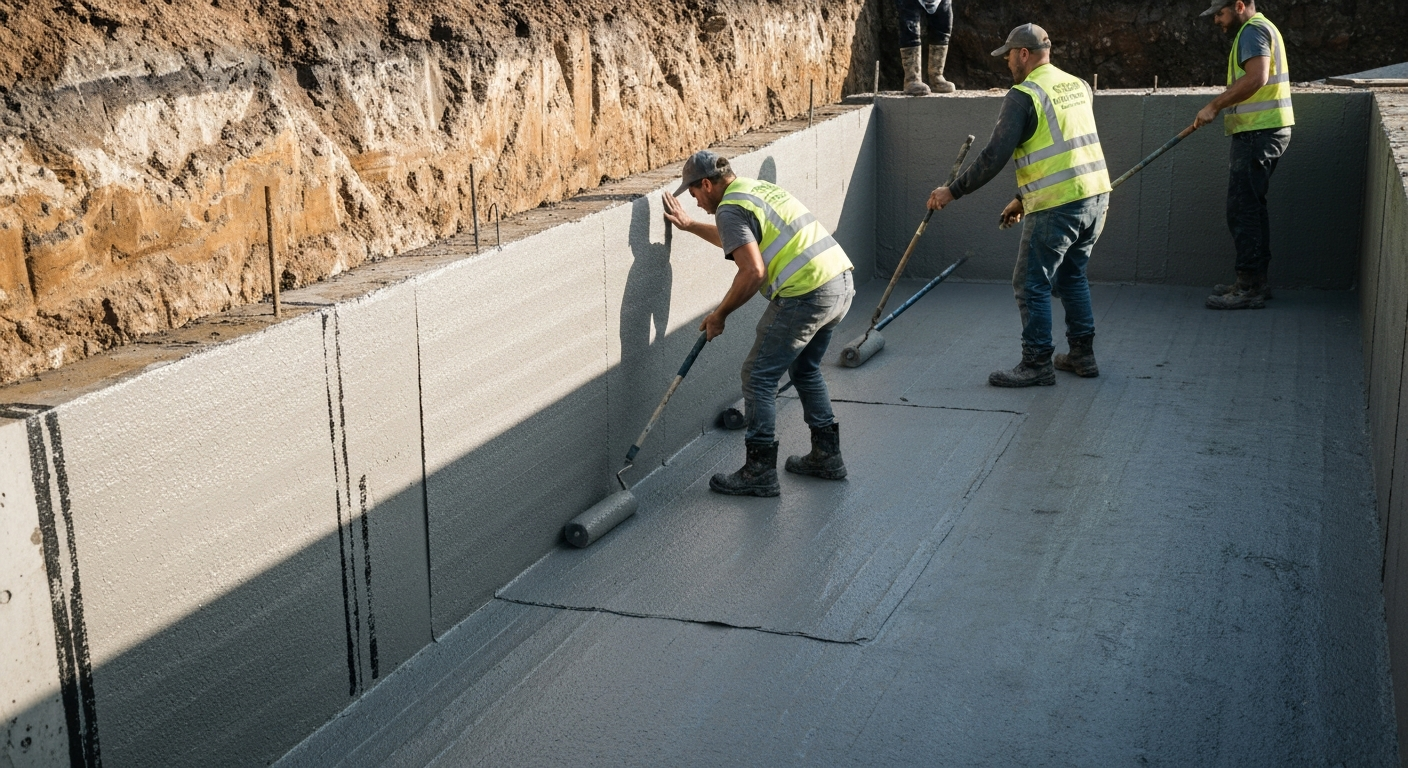
Basement waterproofing options and costs in Richfield
Richfield, Alberta homeowners typically face waterproofing decisions that start with one question: is the water coming from outside the foundation, or is it entering and pooling inside? With a population of 3,299 (Statistics Canada, 2021 Census), Richfield and nearby Calgary-area neighbourhoods can see a lot of similar foundation ages and drainage layouts, especially in older pockets where original tar-and-paper systems and first-generation weeping tile have long since aged out. When weeping tile fails and clay-heavy backfill holds moisture, freeze–thaw cycles can widen joints and cracks, letting meltwater and spring runoff migrate deeper.
In Calgary’s market, pricing is shaped by the realities of southern Alberta: predominantly clay and clay-till soils that expand when saturated, plus frequent temperature swings that stress seals and membranes. Labour availability and access constraints also matter—lots with mature landscaping, concrete patios, or tight urban setbacks often require more demo, hauling, and careful re-compaction, which can push exterior work toward the top of the range. In Richfield, crews are particularly in demand around established residential pockets where basements are older and interior finishes are already in place—meaning homeowners often ask for interior solutions first, even when exterior waterproofing would be the true root fix.
Below is a practical comparison of common approaches, what each targets, and the typical cost bands used for Richfield-area quotes before you decide whether to chase the water at the source or manage it after entry.
| Method |
What It Addresses |
Disruption Level |
Durability |
Price Range |
| Exterior excavation + new membrane + drainage tile |
Water at foundation perimeter; reduces lateral hydrostatic pressure and directs flow to perimeter drainage |
High (excavation, landscaping/patio removal, re-backfill) |
High (long-term source control when properly detailed) |
$9,500 – $24,500 |
| Interior perimeter drain channel + sump pit |
Captures seepage after it enters; lowers hydrostatic pressure inside |
Medium (partial interior demo, floor/footing modifications) |
Medium to high (depends on sealing details and reliable discharge) |
$6,000 – $14,500 |
| Foundation crack injection (epoxy or polyurethane) |
Stops leaks through cracks; stabilizes and seals depending on crack type |
Low to medium (drilling, patching, surface prep) |
Medium (epoxy for structural cracks; polyurethane for active leakage) |
$900 – $2,400 |
| Sump pump installation (primary + battery backup) |
Manages collected groundwater; reduces risk during spring storms and outages |
Low to medium (excavation for pit, electrical work) |
Medium to high (improved reliability with backup) |
$1,100 – $3,200 |
| Window well drain installation |
Controls water at egress points; reduces dampness and localized seepage |
Low to medium (cutting and grading around wells) |
Medium (depends on grading and discharge pathway) |
$1,000 – $2,500 |
| Lot re-grading / downspout extension |
Improves surface runoff management to reduce water reaching foundation |
Low (landscape work and minor excavation) |
Low to medium (maintenance impacts performance) |
$1,200 – $6,500 |
Prices are estimates only and vary by project scope, site access and material selection.
What affects the price of waterproofing in Richfield
Even when two homeowners describe the “same” basement leak, Richfield-area quotes can vary by 30–50% across Calgary and surrounding communities because waterproofing is detail-driven, not one-size-fits-all. A contractor estimating an interior perimeter drain with sump capacity may price quite differently than a team that will excavate the exterior, add a continuous membrane, replace drainage tile, and re-grade the lot. Where pricing lands often comes down to three major separation points from the national average: soil type, water table conditions, and freeze–thaw severity.
First, soil type in the Calgary economic region is often clay and clay-till, which expands when saturated. That movement increases lateral pressure on foundation walls and can worsen cracks over time—meaning a “simple seal” may fail if the underlying water movement isn’t addressed. Second, water table and groundwater pocketing—especially along river valleys and low-lying coulees—can create hydrostatic pressure and longer sump run times, requiring stronger discharge design and reliable alarms/backup. Third, southern Alberta’s freeze–thaw cycles widen existing joints and can undermine poorly detailed membranes; sections that would survive in milder climates often need more robust installation here.
Concrete examples that commonly raise cost in Richfield: (1) older yards with clogged or undersized weeping tile can force full perimeter excavation rather than spot repairs; (2) interior work on finished basements may require additional labour to remove and reinstall flooring to access footings; (3) thick clay spoil disposal during exterior excavation can add hauling/disposal time and increases the overall $9,000–$25,000 exterior band ceiling. Conversely, cost can be lowered when the leak path is localized (for example, a window well with poor grading) and when discharge routes are straightforward—keeping projects closer to the $5,000–$15,000 interior waterproofing band.
| Price Factor |
Why It Matters |
Cost Impact |
| Interior vs. exterior approach — interior is less disruptive but addresses symptoms |
Exterior typically targets water at the source; interior manages water after entry |
Interior often reduces demo, but may cost more over time if exterior source control isn’t addressed |
| Foundation type — poured concrete vs. block vs. stone vs. ICF |
Each material responds differently to cracking and sealing products |
Poured concrete may seal better with crack injection; block often benefits from drainage complements, raising labour/materials |
| Soil type — clay expands more than sand, adding pressure |
Clay saturation increases wall loading and leak persistence |
Often pushes toward more complete perimeter drainage/membrane work in exterior quotes |
| Crack type and length — hairline vs. structural horizontal cracks |
Structural horizontal cracks can indicate movement and require engineering review |
Structural work, additional sealing steps, and possible underpinning increase costs significantly |
| Sump pump backup system — battery or water-powered backup needed |
Backup protects against spring storm power interruptions |
Small equipment added cost, but reduces risk of flooding losses |
| Access — landscaping, decks, or driveways must be removed for exterior |
Complicated access increases demolition, restoration, and excavation time |
Can move exterior projects toward the top of the $9,000–$25,000 range |
| Weeping tile age — original tile (60+ years) may be completely failed |
Failed tile can mean water has nowhere to go and seeps through multiple pathways |
Often requires full replacement and more excavation |
| Mould or efflorescence remediation required before sealing |
Moisture must be controlled and surfaces cleaned for membranes/injection to bond |
Specialty cleaning and time add cost, especially for heavy efflorescence |
Permits & regulations in Alberta
In Alberta, foundation excavation and work that changes how water leaves a site typically triggers permitting requirements, and “waterproofing” isn’t treated the same as general home renovation. In most cases, foundation excavation, structural crack repair, and modifications that affect lot drainage require a building permit because they can impact building performance and drainage routing. If you’re adding or altering a sump pump system, especially where discharge connects to a municipal storm system or follows a regulated pathway, municipal approval may be required—your contractor should tell you upfront what approvals are needed for your specific discharge location.
For structural crack repair—particularly horizontal cracks in block walls, major step cracks, or any crack pattern that suggests movement—an engineer’s assessment is often required to determine whether underpinning or other structural remediation is needed. A responsible contractor will coordinate that engineering support before injecting or sealing anything, since sealing over active movement won’t solve the underlying issue.
To verify a contractor in Richfield step-by-step: (1) confirm they have the correct Alberta licensing/registration for the work category they’re performing; (2) ask for a current certificate of liability insurance and check that it’s valid for the contract dates and scope; (3) request clearance documentation for WSIB/WCB coverage (or provide proof they’re registered/covered where applicable); (4) for structural work, ensure they have documented engineering partners or an engineer-of-record on file; and (5) confirm whether the permit application will be pulled by the contractor or with your approval/assistance.
Interior vs exterior waterproofing — what does Richfield need?
The fundamental difference is source control versus water management. Exterior waterproofing—full excavation, new membrane, new drainage tile, and re-backfill—addresses the source of water entry by interrupting seepage pathways and reducing lateral pressure on the foundation wall. It costs more because you’re paying for excavation, shoring/means-and-methods, disposal of heavy clay spoils, and restoration of patios/landscaping. Interior waterproofing—perimeter drain channels, a sump pit, and a reliable sump pump—captures water after it enters and helps lower hydrostatic pressure inside. It’s often less invasive, but it doesn’t stop wall pressure; it manages the consequences.
In Richfield’s Calgary-area climate, clay and clay-till soils that hold moisture and expand during freeze–thaw are a strong reason to consider exterior solutions when water appears during spring melt, after heavy rains, or across multiple wall segments. Poured concrete walls often respond well to properly prepared crack injection in addition to targeted drainage, while block foundations frequently benefit from interior drainage as a practical complement—especially where excavation access is limited. If spring outages or power flickers are a concern, backup systems become important. A sump pump with battery backup (or an approved alternate backup method) reduces risk during Alberta’s stormy shoulder seasons, when run time can spike.
As an example, homeowners sometimes choose interior drainage at roughly the $6,000–$14,500 band to stabilize a single seepage route. That choice can be justified when access prevents exterior excavation or when leaks are localized. However, if your weeping tile is failing across the perimeter and seepage increases each spring, exterior waterproofing in the $9,000–$25,000 band may be the better long-term value because it targets the water path rather than repeating interior interventions.
| Method |
Best For |
Addresses Source? |
Disruption |
Lifespan |
Price Band |
| Full exterior excavation + membrane |
Widespread seepage, recurring spring flooding, failed perimeter drainage, or high hydrostatic pressure |
Yes |
High |
Long-term when properly detailed and backfilled |
$9,500 – $24,500 |
| Interior French drain + sump system |
Interior seepage, limited exterior access, or when you need fast stabilization |
No (manages entry consequences) |
Medium |
Medium to long-term with good maintenance and discharge reliability |
$6,000 – $14,500 |
| Crack injection — epoxy (structural) |
Non-active structural cracks where movement has stopped or been engineered |
Partially (seals crack path, not exterior pressure) |
Low to medium |
Medium (depends on crack activity and preparation) |
$900 – $2,200 |
| Crack injection — polyurethane (active leak) |
Active seepage, water weeping through joints/cracks |
Partially (targets the crack leak route) |
Low to medium |
Medium (good when matched to active conditions) |
$1,000 – $2,600 |
| Interior drain channel only (no sump) |
Minor dampness or low-volume seepage where gravity drainage/discharge is dependable |
No |
Low to medium |
Shorter to medium (depends on discharge and seasons) |
$5,000 – $9,500 |
| Re-grading + downspout extensions |
Surface water issues, gutter overflow, or early signs after roof/grade changes |
No (reduces water reaching foundation) |
Low |
Low to medium (performance depends on ongoing maintenance) |
$1,200 – $6,500 |
How to choose a waterproofing contractor in Richfield
Choosing the right waterproofing contractor in Richfield is about verifying competence, not just chasing the lowest number. In Alberta, start by confirming licensing/registration appropriate to the work scope, then verify insurance and coverage before any materials are ordered. Ask for a current certificate of liability insurance and check that the policy is active and the coverage limit matches typical construction risk. For WSIB/WCB coverage, ask for clearance documentation or proof of registration and coverage for the trades involved. Don’t accept “we’ll insure later” statements—get the documents before signing.
Next, request 2–3 itemised written quotes that separate labour and materials. You should see line items for excavation/demolition, drainage tile and membrane (or interior drains and sump equipment), crack prep and injection materials, disposal fees, and any electrical/backup components. Scope clarity is critical: confirm what’s excluded (for example, soil hauling beyond a certain quantity, restoring landscaping, replacing basement drywall, or engineering fees). Ask whether permits are included, and if not, who is responsible for pulling them.
For warranty, look for both workmanship warranty length and product/manufacturer warranty terms—plus whether the warranty transfers if you sell the home. Payment scheduling should be conservative: never pay more than 10–15% upfront, and hold back a meaningful portion until the work is complete and deficiencies are corrected. Finally, get a start date and a completion estimate in writing, including the expected waterproofing milestones (demo, drainage install, membrane/injection, curing/inspection, backfill and final grading).
- Provide Alberta proof of licensing/registration for the specific scope (exterior excavation, drainage work, crack repair).
- Show a current certificate of liability insurance before work starts.
- Ask for WSIB/WCB clearance or coverage documentation for the crews who will be on site.
- Require a written scope with measurements (linear feet of drain, crack length, number of injection ports).
- Get an itemised quote (labour, materials, disposal/hauling, electrical/backup components).
- Confirm whether permits are included and who coordinates them.
- Ask what happens if unexpected clay conditions increase excavation (disposal and labour allowances).
- Verify that the plan includes discharge routing for sump discharge and any backup system details.
- Require a surface prep and testing plan for injection (how they confirm active vs non-active leaks).
- Insist on photos/documentation before and after waterproofing steps.
- Ask for warranty terms in writing: workmanship duration, product warranty, and transferability.
- Confirm the payment schedule: 10–15% upfront maximum, and a holdback until completion and punch-list.
In Richfield, red flags include: contractors who dismiss active seepage without recommending polyurethane or drainage, vague quotes with no disposal/permitting details, missing insurance/WSIB/WCB documentation, “guarantees” that don’t specify warranty terms or transferability, and crews who start digging before confirming your discharge pathway and access constraints.
Frequently asked questions — waterproofing in Richfield
Interior vs exterior waterproofing — which is better?
In Richfield, exterior waterproofing is usually the “best” long-term fix because it treats water at the source—excavating to install continuous membrane and new perimeter drainage tile. However, it’s also the most disruptive, and cost can land in the $9,000–$25,000 range depending on excavation depth, access (patios/decks), and how much heavy clay spoil must be hauled away. Interior waterproofing can be the better choice when exterior access is limited or when you need to stabilize the basement quickly; it typically falls around the $5,000–$15,000 band for interior perimeter drains and related work. If leaks worsen during spring melt in clay-heavy conditions, many homeowners ultimately benefit from source control.
Why is my basement leaking in Richfield?
Basement leaks in Alberta often come from water movement through saturated soils, not just “a bad crack.” In Richfield and the wider Calgary region, clay and clay-till backfill holds moisture and can expand during freeze–thaw, pushing water laterally toward foundation walls. Common triggers include spring runoff, heavy rain, clogged or failing weeping tile, and undersized interior drainage. If you notice dampness along multiple wall segments or recurring floor seepage, it usually points to perimeter drainage or hydrostatic pressure rather than a single localized flaw. Tackling only one patch can lead to repeat issues, especially when older drainage systems have been inactive for years.
How do I know if a foundation crack is serious?
All cracks should be assessed, but not all indicate structural movement. Hairline vertical cracks that aren’t widening may be less urgent; however, horizontal cracks in block walls, step cracks that grow seasonally, or cracks accompanied by bulging/misalignment deserve an engineer’s look. In Richfield, freeze–thaw cycles can widen joints over time, so “stable for years” matters. Watch for active signs like fresh seepage, growing wet patches, or visible efflorescence that returns each spring. A serious crack pattern may require engineering and possibly underpinning before injection, because sealing over moving foundations can fail. A proper contractor will identify crack type and recommend the correct injection system accordingly.
How much does foundation crack repair cost in Richfield?
Cost depends on crack type, length, and whether the leak is active. For many homeowners in Richfield, injection-based crack repairs fall within the $500–$1,800 foundation crack repair band for smaller, straightforward issues, with typical projects often landing around $900–$2,400 once drilling, prep, and materials are included for multiple crack segments. Epoxy (structural) is generally used for non-active structural cracks, while polyurethane is used when water is actively seeping through. If the crack pattern suggests movement requiring engineering review, additional costs may apply before any injection is attempted. The most accurate pricing comes from an inspection and confirmation of crack activity.
Do I need a sump pump in Richfield?
You may not always “need” a sump pump, but many Richfield basements benefit from one where seepage volumes or seasonal groundwater cause recurring interior wetness. Interior French drain systems often rely on a sump pit to collect and discharge water away from the foundation. If you have active seepage during spring melt, a primary sump pump is commonly recommended, and backup is worth considering—especially with spring storms where outages can happen. Sump pump installations typically run about $900–$3,000 depending on whether you add primary-only components or a battery backup system. A contractor should also confirm where the discharge will go and whether municipal approvals apply for your specific routing.
How does Richfield's soil affect my foundation?
Richfield’s Calgary economic region commonly has clay and clay-till soils, which absorb and hold water. When saturated, these soils can expand during cold periods and exert lateral pressure on foundation walls and footings, worsening cracking over time. Freeze–thaw cycles then widen existing cracks and joints, allowing meltwater and spring runoff to penetrate. This is why waterproofing solutions that simply patch interior symptoms can underperform if the perimeter drainage and exterior membrane aren’t addressed. In low-lying pockets with higher seasonal groundwater, hydrostatic pressure can also increase, making continuous exterior membranes, functioning perimeter drains, and reliable sump systems more critical. An inspection that identifies leak timing and pattern is key to matching the right method.