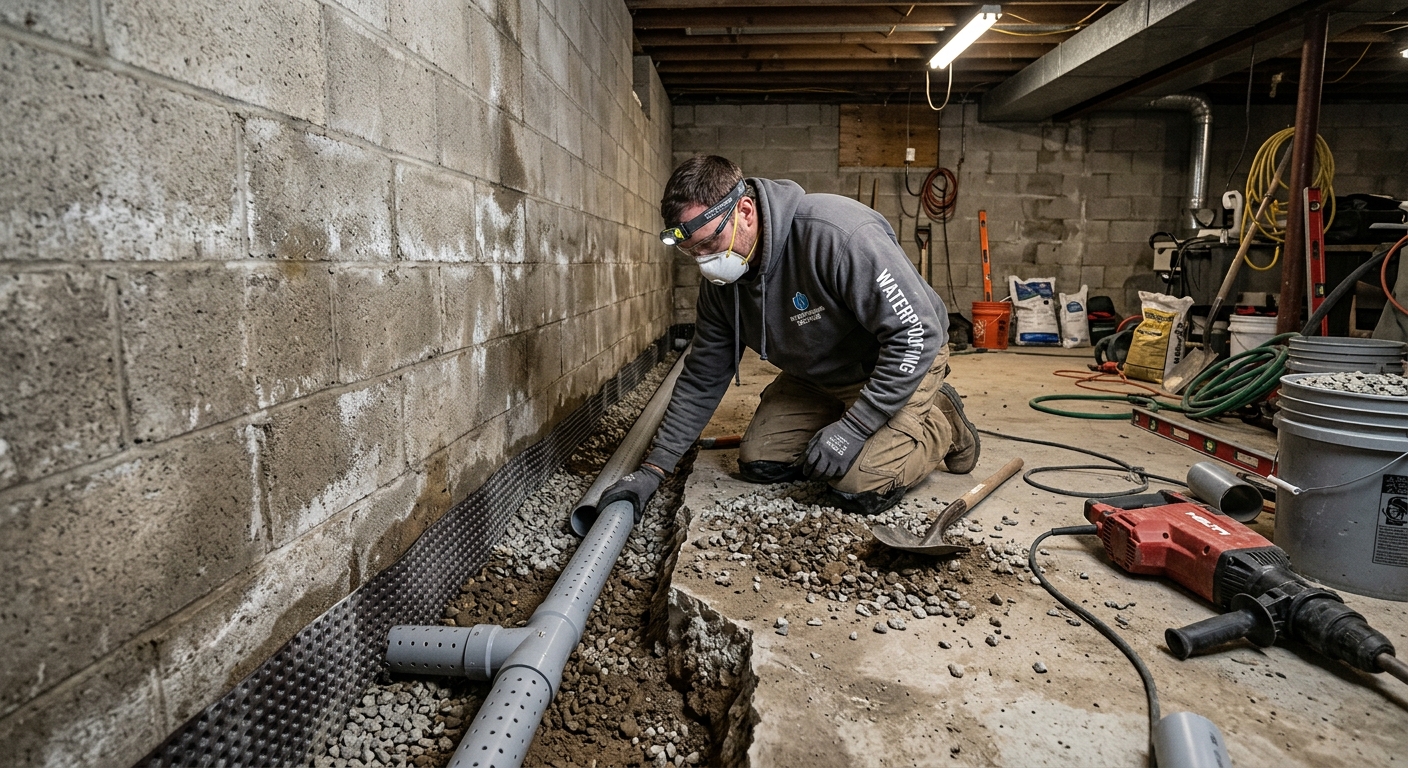
Basement waterproofing options and costs in Royal Oak
In Royal Oak, British Columbia, basement waterproofing is usually about controlling two things at once: water entry and the pressure that pushes water through cracks, joints, and floor-to-wall transitions. With a population of 8,855 (Statistics Canada, 2021 Census), the neighbourhood market is active but not “factory-like”—most jobs hinge on site access, excavation complexity, and how the original drainage system has aged. In Lower Mainland–Southwest, older homes are especially likely to have tired perimeter drainage (often the original weeping tile) and moisture migration paths that aren’t obvious until a heavy rain period or spring melt.
Because coastal BC can maintain high groundwater conditions and persistent saturation, contractors often see hydrostatic pressure that keeps driving seepage even when the interior “looks dry” during mild stretches. Add mild winters with frequent freeze-thaw, and you get widened cracks and loosened mortar over time—meaning small leaks can become ongoing moisture issues. Labour and access costs also run higher here: tight lots in/around areas like the Royal Oak shopping corridor and nearby residential lanes can require more careful mechanical excavation, trucking, and landscaping restoration. That’s why comprehensive exterior systems and full interior drainage retrofits tend to sit toward the top of the national range for waterproofing and basement drainage work.
Below are the most common approaches homeowners consider in Royal Oak, with typical cost bands to help you compare contractor proposals before you decide on scope.
| Method |
What It Addresses |
Disruption Level |
Durability |
Price Range |
| Exterior excavation + new membrane + drainage tile |
Stops water at the source by replacing perimeter drainage and waterproofing the foundation exterior |
High (excavation, re-grading, landscaping restoration) |
Long-term (typically 20+ years when properly detailed) |
$15,000 – $30,000 |
| Interior perimeter drain channel + sump pit |
Collects seepage that enters the basement and directs it to a sump |
Medium (floor cutting/repairs, limited excavation) |
Strong performance (often 15+ years with maintained components) |
$8,000 – $18,000 |
| Foundation crack injection (epoxy or polyurethane) |
Seals cracks to reduce leakage pathways; polyurethane targets active moisture |
Low to medium (drilling, patching) |
Moderate to long-term (depends on crack type and movement) |
$500 – $2,000 |
| Sump pump installation (primary + battery backup) |
Controls basement water levels during storms and power disruptions |
Low to medium (pit/cap, minor concrete work) |
High reliability when paired with backup power |
$1,000 – $5,000 |
| Window well drain installation |
Redirects surface water and prevents water pooling near egress windows |
Low (cut/drain work around window wells) |
Good for targeted leaks (often 10+ years) |
$2,000 – $6,000 |
| Lot re-grading / downspout extension |
Improves drainage away from foundation to reduce inflow |
Low to medium (soil work, restoration) |
Variable (depends on maintenance and slope) |
$1,500 – $6,000 |
Prices are estimates only and vary by project scope, site access and material selection.
What affects the price of waterproofing in Royal Oak
Two homeowners in the Lower Mainland–Southwest can receive quotes for “the same” basement problem that differ by 30–50%—even after adjusting for basement size—because waterproofing is mostly about conditions, not just materials. Soil type, water table behaviour, and freeze-thaw are the big three drivers that separate local costs from the national average. In the Lower Mainland–Southwest, persistent saturation and elevated groundwater can keep hydrostatic pressure against foundation walls and slabs through the wet season. That typically means higher drainage capacity requirements (bigger sump pits, check valves, more discharge line work) and more labour spent locating and matching existing drainage routes.
By contrast, many clay-heavy areas elsewhere can worsen problems through seasonal expansion and lateral wall pressure, while persistent wet conditions in coastal BC often keep water present. In Royal Oak specifically, heavy rainfall saturates backfill quickly when original weeping tile has failed or daylighting connections are blocked. Add frequent freeze-thaw: small gaps and hairline cracks widen, so contractors may need crack remediation before sealing or before exterior membranes can perform as intended. Older housing stock also drives cost upward because failing perimeter systems are more common, and poured-concrete or block walls that have been damp for years require careful moisture management before coatings or interior sealing.
Here are a few practical examples of cost movement in Royal Oak. A job with intact access for full perimeter excavation near a rear lane may land closer to the lower end of exterior waterproofing (for example, around $15,000 – $30,000). A tight front yard with utilities and mature landscaping can push you toward the higher end because mechanical breaking and restoration take longer. If your issue is an active seep through a known crack, crack injection may be selected as a lower-cost option (typically $500 – $2,000)—but only if the crack is the true pathway and the drainage is addressed.
| Price Factor |
Why It Matters |
Cost Impact |
| Interior vs. exterior approach — interior is less disruptive but addresses symptoms |
Exterior stops water at the wall; interior manages water after it enters |
Interior usually costs less upfront; exterior costs more but can be more complete |
| Foundation type — poured concrete vs. block vs. stone vs. ICF |
Different walls crack/seep differently and accept sealing/membranes differently |
Poured concrete often suits crack-focused repairs; block commonly needs stronger drainage complements |
| Soil type — clay expands more than sand, adding pressure |
Soil movement and lateral pressure can stress seals and joints |
More pressure or shifting increases prep and repair scope |
| Crack type and length — hairline vs. structural horizontal cracks |
Active, moving cracks require different products and sometimes structural assessment |
Structural cracks typically increase labour, engineering involvement, and repair duration |
| Sump pump backup system — battery or water-powered backup needed |
Power interruptions during spring storms can quickly raise water levels |
Backup adds cost but reduces risk of repeat flooding |
| Access — landscaping, decks, or driveways must be removed for exterior |
Excavation time rises when you must dismantle and rebuild |
Can swing a job by thousands depending on restoration complexity |
| Weeping tile age — original tile (60+ years) may be completely failed |
Failed tile increases seepage and can change the drainage route |
Replacement scope can move you from “targeted fixes” to comprehensive exterior or full interior systems |
| Mould or efflorescence remediation required before sealing |
Moisture-migrating surfaces must be treated and dried correctly |
Adds cleaning, time, and often a more complete interior system sequence |
Permits & regulations in British Columbia
In British Columbia, foundation excavation, structural crack repair, and changes to lot drainage typically require a building permit. If a contractor’s work affects how stormwater is managed (for example, drainage routing, tie-ins, or a sump discharge connection that may approach municipal systems), municipal approval may be required as well. For structural crack repair—especially horizontal cracks in block walls, major step cracking, or any signs of wall movement—a structural engineer’s assessment is often needed to confirm whether underpinning or other structural work is required before waterproofing proceeds.
For homeowners in Royal Oak, the safest approach is to confirm your scope before work begins. Ask the contractor to tell you whether they will pull the permit and whether engineering is required. Then verify the contractor carries the right paperwork: (1) a valid BC business licence/contractor authorization as applicable to their trade and scope, (2) liability insurance, and (3) WSIB/WCB coverage where required.
Step-by-step, you can check like this: (1) ask for their licence/registration details and search the appropriate provincial online registry; (2) request a certificate of insurance naming you (or confirming their customer/contractor coverage) and check the policy dates; (3) request a clearance letter or proof of coverage for WSIB/WCB and verify it matches the current period; (4) for structural work, ask to see proof of engineering support—sometimes via a report letter, scope confirmation, or an engineering engagement document.
Interior vs exterior waterproofing — what does Royal Oak need?
Interior and exterior waterproofing differ in one key way: exterior systems aim to prevent water from entering by excavating around the foundation, applying a proper membrane, and restoring a functional perimeter drainage system. Interior waterproofing usually comes after water has already found a pathway; it collects seepage with a perimeter drain channel and sump pit and then pumps it away. In Royal Oak’s Lower Mainland–Southwest conditions—high coastal rainfall, persistent saturation, and freeze-thaw that widens joints—exterior work is often the “most complete” solution when perimeter drainage is failing or when seepage is widespread. However, many homeowners choose interior systems first when excavation is constrained by landscaping, decks, patios, or limited access.
Foundation type matters. For poured concrete walls, crack injection (after proper assessment) can be an effective component because concrete cracks can be sealed if movement is limited. For block foundations, interior drainage is frequently a practical complement because block mortar joints can transport water and require a collection system to prevent recurring dampness. Regardless of approach, sump pump reliability is crucial in British Columbia. During spring flooding and power disruptions, a backup system (battery or water-powered backup) can prevent a short outage from turning into days of saturated flooring.
To illustrate the choice: if your perimeter weeping tile is failing and water is entering along most walls, exterior waterproofing may run from $15,000 – $30,000. If the problem is localized seepage plus a reliable sump strategy, an interior perimeter drain and sump system may fit closer to $8,000 – $18,000, with less yard disruption. The cheaper option can be the correct one—but only if it matches the true water-entry source.
| Method |
Best For |
Addresses Source? |
Disruption |
Lifespan |
Price Band |
| Full exterior excavation + membrane |
Widespread seepage, failed weeping tile, or chronic wet basements where access allows |
Yes (at the foundation exterior) |
High |
20+ years when detailed correctly |
$15,000 – $30,000 |
| Interior French drain + sump system |
Managing hydrostatic seepage when exterior access is difficult or as a retrofit |
No (controls water after entry) |
Medium |
15+ years with maintained components |
$8,000 – $18,000 |
| Crack injection — epoxy (structural) |
Non-active cracks where movement is not ongoing |
Partial (seals the pathway) |
Low to medium |
Moderate to long-term if movement is controlled |
$500 – $2,000 |
| Crack injection — polyurethane (active leak) |
Active seepage through cracks where moisture pressure is present |
Partial (seals active pathways) |
Low to medium |
Moderate to long-term; depends on water pressure management |
$700 – $2,500 |
| Interior drain channel only (no sump) |
Minor seepage where gravity drainage is feasible and water volume is low |
No (collection only) |
Medium to low |
Variable; performance depends on discharge method |
$4,000 – $10,000 |
| Re-grading + downspout extensions |
Surface water driving toward the foundation, especially after landscaping changes |
Limited (reduces incoming water near grade) |
Low |
Variable with maintenance |
$1,500 – $6,000 |
How to choose a waterproofing contractor in Royal Oak
Choosing the right contractor in Royal Oak starts with verification. In British Columbia, confirm they can lawfully carry out the trade work they’re proposing and that they have current liability insurance and WSIB/WCB coverage where applicable. How to check: (1) ask for their certificate of insurance and verify policy start/end dates and coverage amounts; (2) request WSIB/WCB clearance or proof of coverage and confirm it’s active for the current period; (3) check the relevant provincial online registry for their business/contractor status; and (4) for any structural component, ask how they involve engineering support and get that in writing.
Next, get 2–3 itemised written quotes. A good quote lists labour and materials separately (membrane product, drainage pipe and filter fabric, sump pump model, discharge line components, concrete cutting/chipping, disposal/restoration). Make sure the scope shows what’s included and excluded: permit pull included or not, disposal of excavated material included, and whether landscaping restoration is “rough grade” or finished slope.
Warranty should be specific. Ask for the workmanship warranty length (often multi-year) and the product/manufacturer warranty details. Also ask whether warranties are transferable if you sell the home. For payment schedule, never pay more than 10–15% upfront; keep holdback until the job is complete and tested. Finally, get a written timeline with a start date and completion estimate, plus how delays are handled in wet-weather weeks.
- Confirm they conduct an assessment (interior moisture mapping, leak pathway identification, drainage review) before quoting.
- Require a written scope that names products and methods, not just “waterproofing membrane.”
- Ask whether they will inspect and assess existing weeping tile, sump condition, and discharge routing.
- Check that permit/engineering responsibilities are clearly assigned and documented.
- Verify liability insurance and WSIB/WCB coverage before work starts; keep copies.
- Insist on itemised labour/materials and disposal/restoration details.
- Confirm how they manage freeze-thaw risks at transitions (foundation-to-slab, joints, penetrations).
- Ask how they handle mould/efflorescence remediation before sealing or coating.
- Get sump specs: pump capacity, float switch type, check valves, and backup system option.
- Request details on discharge direction (where water goes) and what happens during high-rain periods.
- Clarify warranty terms: workmanship coverage, product warranty, and transferability.
- Use a payment schedule with a holdback and avoid large upfront payments.
Concrete red flags in Royal Oak include: (1) quoting only “epoxy injection” while ignoring failed weeping tile or repeated seepage patterns; (2) skipping a proper drainage plan (no discharge route clarity, no sump backup discussion); (3) vague warranties like “guaranteed” without dates or product names; (4) asking for most payment up front; and (5) refusing to provide proof of insurance/coverage or engineering support when structural cracks are present.
Frequently asked questions — waterproofing in Royal Oak
How do I know if a foundation crack is serious?
In Royal Oak, focus on the crack’s behaviour and location. Hairline cracks that don’t change and are mostly vertical are often less urgent than horizontal cracks, especially in block foundations, because horizontal movement can indicate structural concerns. Also take seriously any crack that coincides with dampness, efflorescence (white mineral staining), or water appearing after rain—Lower Mainland–Southwest wet seasons can keep hydrostatic pressure elevated. A good sign of “serious” is recurring seepage plus expanding crack width after freeze-thaw cycles. If you have a suspected structural crack, a structural engineer assessment is often required in British Columbia before sealing or injection. Don’t rely on a sales pitch—ask for a crack assessment and a written plan for either injection or drainage improvements.
How much does foundation crack repair cost in Royal Oak?
Foundation crack repair cost in Royal Oak commonly depends on whether the crack is active, how long it is, and whether the surrounding area needs preparation. For many typical residential crack injection jobs, homeowners often see budgets in the range of $500 – $2,000 for targeted repairs (smaller crack runs with straightforward access). If multiple cracks are involved, if additional drilling/patching is needed, or if polyurethane is chosen for active leaks, the total can climb. Importantly, crack injection is usually only part of the answer in a wet coastal climate—if perimeter drainage is failing, sealing the crack may not stop recurring moisture. That’s why reputable contractors pair injection with a drainage plan when the water source is unresolved.
Do I need a sump pump in Royal Oak?
You may need a sump pump if your basement experiences seepage during prolonged rainfall or if interior drains need to discharge below grade. In Royal Oak and the wider Lower Mainland–Southwest, persistent saturation can keep water levels high enough that gravity drainage isn’t reliable. If you already have moisture at the floor perimeter, a sump system often becomes the practical solution. Budget-wise, sump pump installation typically falls in the range of $1,000 – $5,000, and many homeowners choose battery backup due to power outage risk during spring storm periods. A contractor should also confirm your discharge direction and check valves so the sump doesn’t push water back during heavy rain. If the issue is only at one window well or downspout discharge, you might not need a sump—targeted grading and drainage improvements may be enough.
How does Royal Oak's soil affect my foundation?
Royal Oak’s waterproofing challenges are usually less about extreme seasonal soil swelling (more common in other parts of Canada) and more about persistent saturation and drainage reliability. When surrounding soils stay wet for long periods, hydrostatic pressure increases against foundation walls and slabs, which can turn small cracks and joints into active leak pathways. Freeze-thaw in British Columbia then worsens the situation by widening gaps and loosening mortar at joints and penetrations. If you have areas where backfill drains poorly—common where downspouts discharge near the foundation or where perimeter drainage has failed—water can remain near the foundation longer and increase seepage. A good assessment should consider soil drainage patterns, grading, existing weeping tile condition, and how quickly water drops after a storm.
Do I need a permit for foundation work in British Columbia?
In British Columbia, foundation excavation, structural crack repair, and changes to lot drainage typically require a building permit. If your sump pump installation changes how water is connected or discharged in a way that affects municipal systems, municipal approval may be required as well. For cracks that appear structural—particularly horizontal cracks in block walls or major step cracks—an engineering assessment is often needed to determine whether underpinning or other structural work is required. The practical step for Royal Oak homeowners is to ask the contractor whether they will pull the permit and what documentation (including engineering support if required) they’ll provide. Don’t assume it’s “just waterproofing”—the permit need is driven by what’s being repaired or modified, not only by the basement finishing aspect.
How long does waterproofing last?
“Lasts how long” depends on whether you address the water source or only manage water after entry. In Royal Oak, full exterior excavation with membrane and new drainage tile is designed as a long-term system and can perform for 20+ years when installed with correct detailing and discharge. Interior perimeter drains and sump systems can also last many years, often 15+ years, but their lifespan depends heavily on pump performance, backup power decisions, and whether components are maintained. Crack injection can last a shorter or moderate timeframe depending on whether the crack is active and whether drainage is corrected—sealing a pathway without addressing hydrostatic pressure may lead to recurrence. Because Lower Mainland–Southwest conditions involve persistent moisture and freeze-thaw cycles, reputable contractors should include a clear maintenance and monitoring recommendation, not just an installation date.