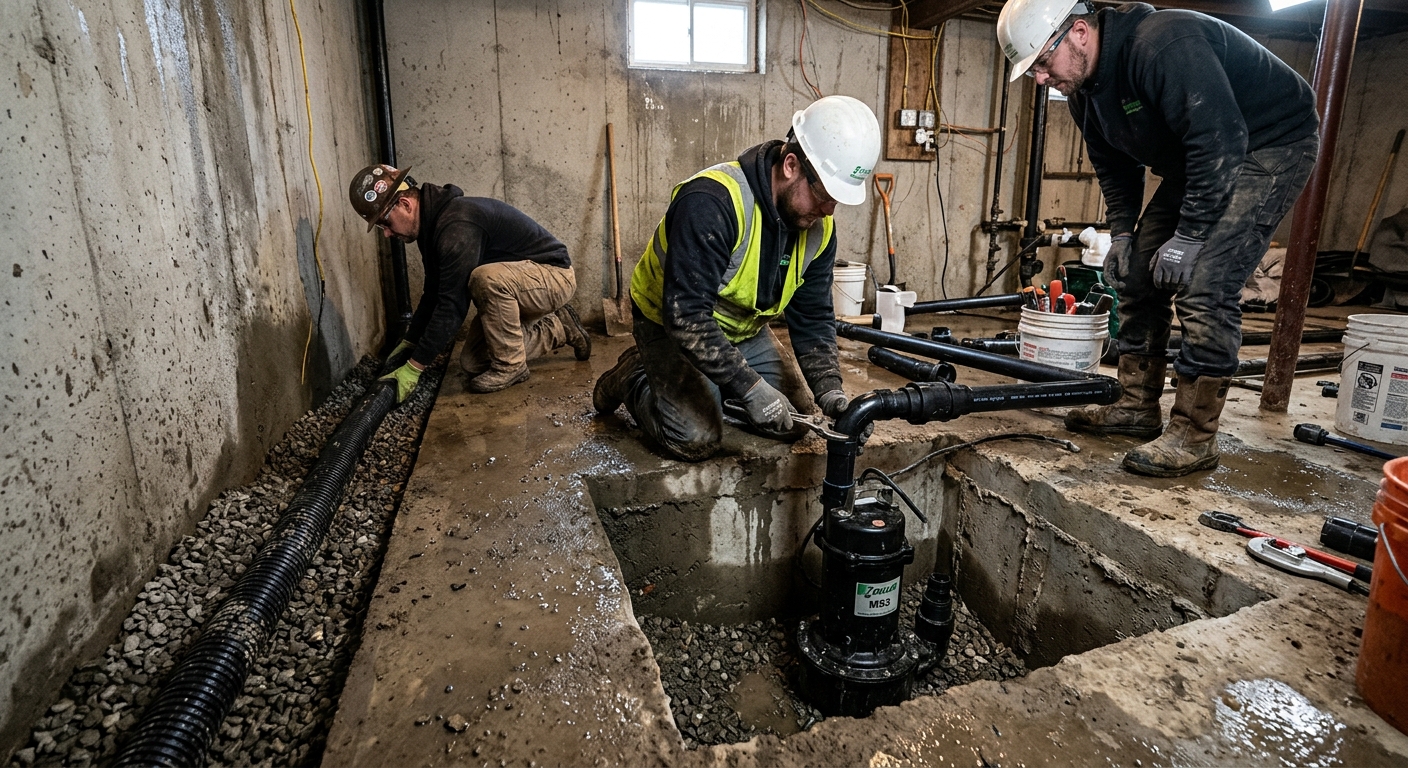
Basement waterproofing options and costs in Victoria
In Victoria, basement waterproofing usually comes down to stopping water at the foundation source, not just cleaning up what shows up after a storm. With 63.6% of homes built before 1981, there’s a higher likelihood of aging original waterproofing details and older perimeter drainage systems failing over time. That matters because once hydrostatic pressure builds behind basement walls, even a crack that looked “dry” can become a consistent leak path. In fact, homeowner households make up 39.5% of all households in the region (Statistics Canada, 2021 Census), so there’s a steady local market for both full exterior projects and focused interior remedies.
On Vancouver Island and the Coast, waterproofing costs are often shaped by exterior water movement around the foundation. Heavy rainfall and higher local groundwater can saturate backfill quickly when original drainage fails, pushing projects toward excavation, membrane work, and perimeter drainage—which are labour-intensive. Victoria neighbourhoods with older streets and mature lots (including parts of Oak Bay) frequently see access constraints from landscaping, fences, and established driveways, which can increase exterior disruption and excavation time. Contractor availability can also affect pricing in peak wet seasons, when multiple homes require work right after major rain events. Interior systems remain popular because they’re usually faster and less invasive, but if the exterior water path is still active, interior-only fixes can struggle to keep up.
Below are the most common options homeowners compare in Victoria, along with typical cost bands and what each method addresses before you move on to understanding price drivers in the next section.
| Method |
What It Addresses |
Disruption Level |
Durability |
Price Range |
| Exterior excavation + new membrane + drainage tile |
Primary water entry path by rebuilding the perimeter waterproofing and drainage system |
High (excavation, landscaping restoration) |
High (source control when installed to spec) |
$7,000 – $18,000 |
| Interior perimeter drain channel + sump pit |
Water that enters through cracks or wall seams by collecting and pumping it away |
Medium (interior floor cutting, patching) |
Medium to high (depends on wall condition and pump setup) |
$3,000 – $10,000 |
| Foundation crack injection (epoxy or polyurethane) |
Crack as a leak path—epoxy for non-moving/structural cracks, polyurethane for active seepage |
Low to medium (minor drilling; spot repairs) |
Medium (can be excellent when combined with drainage) |
$250 – $800 |
| Sump pump installation (primary + battery backup) |
Prevents long wet periods by pumping collected groundwater; backup protects during outages |
Low to medium |
Medium to high (reliant on maintenance) |
$800 – $2,500 |
| Window well drain installation |
Direct water away from basement window wells that capture runoff |
Low (targeted excavation around wells) |
Medium (effective for localized seepage) |
$1,200 – $4,000 |
| Lot re-grading / downspout extension |
Reduces surface runoff and directs water away from foundation |
Low to medium |
Low to medium (best as a complement) |
$650 – $3,500 |
Prices are estimates only and vary by project scope, site access and material selection.
What affects the price of waterproofing in Victoria
In Victoria, two homeowners can receive quotes that differ by 30–50% for the “same” basement leak because Vancouver Island and the Coast pricing is driven by the realities of water movement around foundations—not just the visible problem inside. The main separation versus a broader national average comes from three local drivers: soil type, water table, and freeze-thaw conditions. Clay-heavy soils (more common inland or in certain pockets) hold water and can increase lateral pressure on foundation walls during wet periods, which can worsen cracking over time. In coastal BC conditions like Victoria, higher water tables can mean longer sump run times and increased drainage scope. While Victoria isn’t the coldest part of Canada, freeze-thaw still matters: moisture trapped in small cracks expands when it freezes, widening defects and increasing recurring seepage after storms.
Here are practical examples of what pushes costs up or down in Victoria. First, if you have persistent wetting after heavy rainfall, exterior excavation projects often cost closer to the upper end of the exterior band (for example, near the $7,000–$18,000 range) because contractors must dig, re-membrane, and rebuild perimeter drainage correctly. Second, if you’re only seeing localized seepage at a crack line, crack injection may land toward the $250–$800 band, but only if the water path is controlled with grading, downspouts, or interior drainage—otherwise the leak can return. Third, older housing stock (a large share built before 1981) often means older weeping tile has corroded or collapsed; when that’s the case, contractors typically have to upgrade drainage rather than “patch” it, which adds labour and disposal costs. On tougher access lots—steep grades, mature landscaping, or tight side yards—labour increases even when the foundation size is similar.
With these factors in mind, the next section breaks down how specific price drivers map to the scope you’ll be asked to pay for.
| Price Factor |
Why It Matters |
Cost Impact |
| Interior vs. exterior approach — interior is less disruptive but addresses symptoms |
Exterior tackles the water source; interior manages collected water after it enters |
Interior typically runs lower, but exterior can cost more due to excavation and membrane work |
| Foundation type — poured concrete vs. block vs. stone vs. ICF |
Different materials crack and leak differently, affecting drainage and repair technique |
Poured concrete often benefits from targeted injection; block can require stronger interior drainage complements |
| Soil type — clay expands more than sand, adding pressure |
Clay retains water and can exert higher lateral forces during wet cycles |
Higher pressure can increase prep, sealing, and drainage requirements |
| Crack type and length — hairline vs. structural horizontal cracks |
Structural movement changes what “repairable” means and may require engineered solutions |
Horizontal/active cracks generally increase both time and pricing |
| Sump pump backup system — battery or water-powered backup needed |
Backup protects against outages during spring flooding and wet power disturbances |
Adding backup increases material and installation scope |
| Access — landscaping, decks, or driveways must be removed for exterior |
More demolition means more labour and restoration |
Can add substantial cost on mature Victoria lots |
| Weeping tile age — original tile (60+ years) may be completely failed |
Old systems often collapse; “reconnecting” may not be possible |
May push you toward full drainage replacement rather than minor repairs |
| Mould or efflorescence remediation required before sealing |
Sealers can’t perform well over active contaminants and ongoing moisture |
Remediation extends time and adds cleaning/controlled drying steps |
Permits & regulations in British Columbia
In British Columbia, some basement waterproofing-related work requires a building permit, while other items typically do not. Foundation excavation and any work that changes foundation drainage patterns or involves significant structural repairs usually trigger permit requirements. Structural crack repair—especially where horizontal cracks in block walls or larger step cracks suggest possible movement—often needs a structural engineer’s assessment to determine whether underpinning, targeted structural repairs, or other measures are required.
In many Victoria basements, homeowners also ask about sump pumps. Installing a sump pump that discharges to an approved connection (and especially if it ties into storm or sanitary systems) typically requires municipal approval before the connection is made. Similarly, changes to lot drainage, downspouts, and how water is routed away from the foundation can be treated as “site works,” so it’s smart to confirm requirements before starting.
Step-by-step verification is the safest way to protect yourself. First, ask the contractor for their British Columbia licence/registration details and verify them through the appropriate online registry. Second, request a current certificate of insurance (liability) showing coverage for property damage and jobsite liability. Third, confirm WSIB/WCB coverage through their documentation—this matters for labour protection and jobsite accountability. Finally, for any structural crack work, confirm the contractor has engineering support in-house or through a qualified professional, and that they can provide the engineer’s scope recommendation before any sealant or membrane work begins.
Interior vs exterior waterproofing — what does Victoria need?
The fundamental difference is simple: exterior waterproofing addresses the source of water entry by excavating to the foundation, installing membrane and perimeter drainage, then restoring the backfill properly. Interior waterproofing, by contrast, manages water after it enters—typically through a perimeter drain channel, sump pit, and sump pump. In Victoria’s coastal climate, exterior systems often perform best because the main cost driver is the movement of water around the foundation after heavy rainfall and high groundwater. However, full excavation is labour-intensive and disruptive, especially on older, landscaped lots common around the city.
When choosing between approaches, you’ll want to consider foundation material and local water behaviour. Poured concrete walls often respond well to crack injection (epoxy for non-moving cracks, polyurethane for active seepage) because the cracks can be sealed effectively when the exterior water source is reduced or controlled. Block foundations are also commonly seen in older Victoria homes, and they often benefit from an interior drainage complement—especially if exterior access is limited—because water can migrate through wall interfaces and voids. If you go interior, a sump pump with battery backup becomes more important on Vancouver Island because wet seasons can coincide with storm-driven power disruption and long periods of elevated groundwater.
For a realistic price example: full exterior waterproofing might be quoted in the $7,000–$18,000 band when excavation and perimeter drainage replacement are required, while a typical interior perimeter drain plus sump approach may land in the $3,000–$10,000 range. The extra cost for exterior is justified when you have repeated wetting during heavy rains, failing perimeter drainage, or widespread dampness—conditions that strongly suggest the source control option. If the issue is limited to a single active leak and grading/downspouts are sound, interior crack injection and localized drainage may be more appropriate—sometimes keeping costs near the $250–$800 injection band when done as part of a properly planned system.
| Method |
Best For |
Addresses Source? |
Disruption |
Lifespan |
Price Band |
| Full exterior excavation + membrane |
Repeated leaks after storms, failed perimeter drainage, and wet basements where source control is needed |
Yes |
High |
High (when installed and backfilled correctly) |
$7,000 – $18,000 |
| Interior French drain + sump system |
Limited exterior access, moisture seeping through walls, or groundwater management where source control is impractical |
No (manages incoming water) |
Medium |
Medium to high (system performance depends on pump/backup) |
$3,000 – $10,000 |
| Crack injection — epoxy (structural) |
Non-moving cracks in poured concrete or stable foundation walls |
No (seals the crack; exterior water may still need control) |
Low |
Medium to high (best when water path is addressed) |
$250 – $800 |
| Crack injection — polyurethane (active leak) |
Active seepage through cracks where water pressure is present |
No (treats leak path; may still need drainage) |
Low |
Medium (often improved with perimeter drainage) |
$250 – $800 |
| Interior drain channel only (no sump) |
Light seepage situations where water volumes are low and collection is manageable |
No |
Low to medium |
Low to medium (risk of inadequate removal in wet seasons) |
$1,500 – $5,500 |
| Re-grading + downspout extensions |
Surface runoff management and localized wetting from roof drainage near foundation |
Partial (reduces source load) |
Low to medium |
Low to medium (best as a complement to sealing/drainage) |
$650 – $3,500 |
How to choose a waterproofing contractor in Victoria
Choosing a contractor in Victoria is about verifying capability before you compare prices. Start by confirming British Columbia licensing/registration where applicable, then request proof of liability insurance and confirm WSIB/WCB coverage. You should be able to produce a certificate of insurance on request (often including policy number, coverage limits, and effective dates) and a clearance letter or direct documentation supporting WSIB/WCB coverage. If they can’t provide paperwork quickly, that’s a red signal—waterproofing disputes are expensive.
Next, get 2–3 itemised written quotes. Ask for a labour-and-materials breakdown, not a single lump sum. Make sure the scope lists disposal, patching, any required remediation (like mould or efflorescence cleaning), and whether the contractor includes permit pull if it’s required. Confirm warranty terms clearly: workmanship warranty length, product/manufacturer warranty coverage, and whether the warranty is transferable to future owners. For payment, a safe schedule is never more than 10–15% upfront; hold back payment until the job is complete and the system is demonstrated (for sump setups, that means a functional test). Finally, require a timeline in writing including start date and a completion estimate, because wet-season delays can affect curing and drying.
- Ask how they diagnose water source vs. entry point (rainfall pattern, grading check, crack mapping).
- Require crack type identification (hairline vs. structural/horizontal) before injection recommendations.
- Confirm whether exterior excavation includes new membrane and perimeter drainage tile replacement, not just “patching.”
- Get details on disposal and restoration (topsoil, sod, or hardscape repairs).
- Ask what happens if groundwater is higher than expected during excavation.
- Confirm sump pump model, discharge method, and whether battery backup is included.
- Request warranty in writing, including product/manufacturer warranty documentation.
- Verify permit responsibility in the quote (permit pull included or homeowner-managed).
- Ensure they provide a step-by-step method statement for your specific foundation type.
- Check insurance certificate and WSIB/WCB coverage dates before signing.
- Make sure the quote includes drying/curing time assumptions for sealers and membranes.
- Clarify what is excluded: mould remediation extent, concrete replacement limits, or landscaping restoration quality.
In Victoria, common red flags include: (1) refusing to provide insurance/WSIB/WCB documentation, (2) quoting interior-only “one fix” even when the source is clearly exterior (failed drainage after storms), (3) no written scope showing what’s included/excluded (especially disposal and restoration), (4) vague warranties like “lifetime” without workmanship/product specifics, and (5) asking for large upfront payments beyond 10–15% without a written schedule and milestones.
Frequently asked questions — waterproofing in Victoria
Do I need a sump pump in Victoria?
Not every basement in Victoria needs a sump pump, but many do when groundwater keeps up after heavy rain. If you’re seeing recurring wetness at multiple locations, a longer-lasting damp season, or water that collects along a perimeter after storms, a sump pump is often the practical control method. Interior perimeter drains paired with a sump typically fall in the $3,000–$10,000 band, and adding battery backup can push the sump component toward the higher end of $800–$2,500 depending on electrical and discharge details. Because Victoria’s groundwater conditions can stay elevated after rain (and older homes frequently have failing weeping tile), the right decision depends on how much water is entering, not just whether you have one visible crack.
How does Victoria's soil affect my foundation?
Victoria’s coastal setting often means backfill can stay saturated longer after heavy rainfall, and the “type” of soil around your foundation determines how quickly water moves or stays trapped. Clay-heavy soils can hold water and exert more pressure on foundation walls during wet cycles, which increases the chance that small cracks act as leak paths. In practice, that often shows up as dampness returning repeatedly after storms rather than a one-time event. Soil conditions can also affect excavation and drainage design choices, which influences whether a full exterior approach (commonly $7,000–$18,000) or an interior system (commonly $3,000–$10,000) is the better value. Your contractor should map crack locations and review grading/downspouts before choosing a sealing-only plan.
Do I need a permit for foundation work in British Columbia?
Some waterproofing and foundation-related work in British Columbia requires permits, especially when it involves excavation to the foundation, changing lot drainage, or repairing structural issues. Structural crack repair (such as major horizontal cracks or step cracks in block) typically warrants an engineer’s assessment, and the associated work may require permitting depending on the scope. Sump pump installations that connect discharge to municipal systems also commonly require approval before the connection is made. For your Victoria project, verify what the contractor is handling versus what you must manage: ask whether permit pull is included, who submits documents, and how the discharge is routed. A reputable contractor should provide a clear plan and documentation, rather than assuming no permits are needed.
How long does waterproofing last?
Realistically, waterproofing longevity depends on whether you addressed the water source or only managed symptoms after the fact. Exterior excavation with new membrane and drainage typically offers the best long-term outcome when installed to spec, but lifespan can be impacted by backfill quality, drainage discharge, and site grading. Interior systems (perimeter drains and a sump) often perform well for years, but they rely on ongoing pump function and power reliability; adding backup can improve resilience during wet-season outages. Crack injection can last a long time when the crack is stable (epoxy for non-moving cracks), but active water flow usually requires polyurethane and often needs drainage control as well. For scale, homeowners commonly compare projects ranging from $250–$800 for targeted crack injection up to $7,000–$18,000 for exterior source-control.
Can I waterproof my basement from the inside only?
Yes, it’s often possible to waterproof from the inside only—especially when exterior access is limited or when the leak is primarily collecting water after it enters. Interior perimeter drain channels and sump pits manage groundwater by collecting and pumping it away, and the approach is frequently less disruptive than excavating the entire perimeter. However, interior-only waterproofing does not remove hydrostatic pressure at the wall; if the source drainage path remains active (for example, failing weeping tile plus saturated backfill after Victoria rainfall), interior systems can be overloaded and dampness can return. The best path is usually based on diagnosis: if you have repeated wetting after storms and evidence of exterior water entry, source control exterior waterproofing (often $7,000–$18,000) may be more cost-effective over time than repeated interior fixes.
What causes foundation cracks in Victoria?
Foundation cracks in Victoria commonly result from moisture and movement cycles rather than a single “bad pour.” When groundwater and soil remain saturated, swelling clay conditions can add lateral pressure to foundation walls. Coastal wet seasons can increase the frequency of small changes in moisture content, and freeze-thaw—though less extreme than interior Canada—can still widen small defects when trapped moisture freezes and expands. Older housing stock in Victoria also means you may be dealing with older construction details and drainage systems that have been struggling for years. A crack can start hairline, but when hydrostatic pressure builds against the wall, it can become an active leak path. The repair approach depends on whether the crack is stable or moving, which is why reputable contractors identify crack type before recommending injection (epoxy or polyurethane).