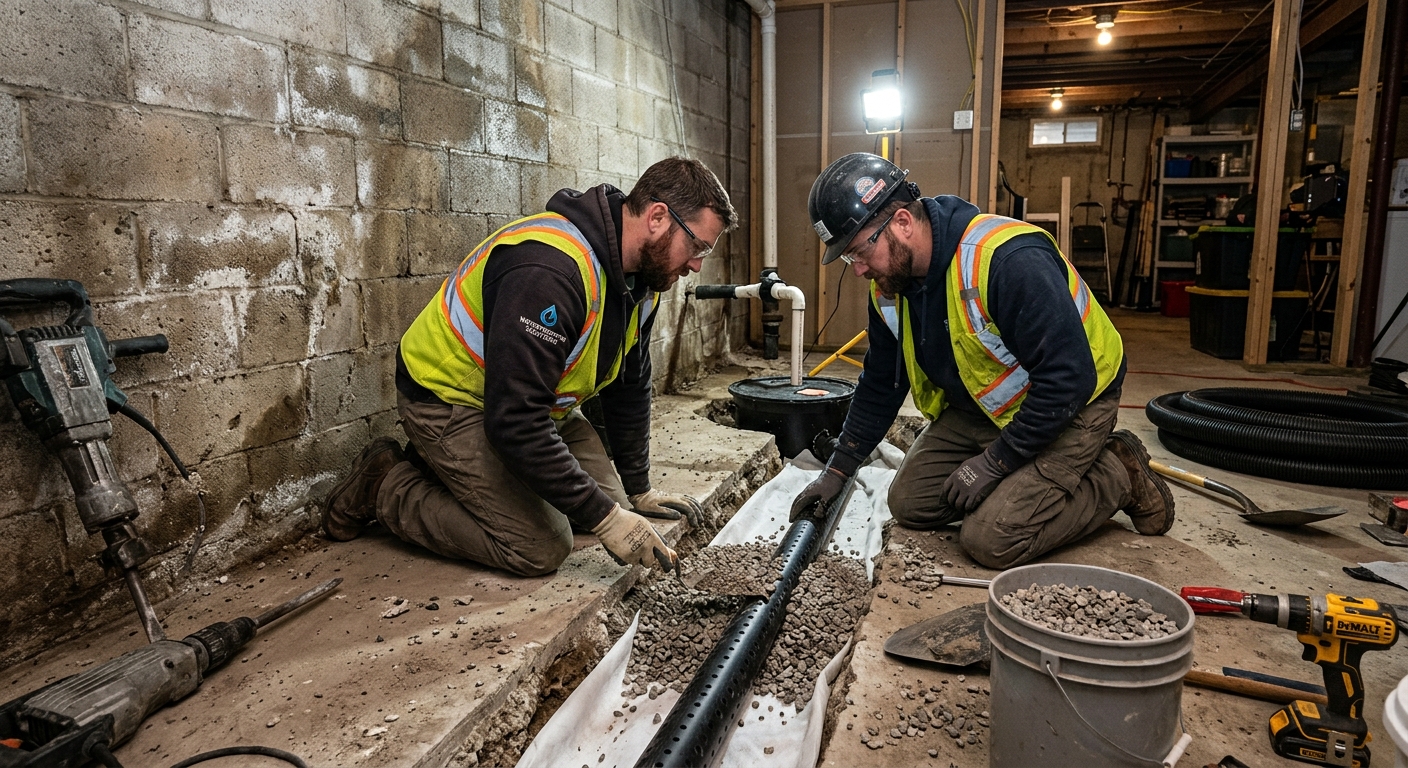
Basement waterproofing options and costs in Keswick
Keswick homeowners often start planning waterproofing after a few winters of wet corners, musty odours, or efflorescence—especially in neighbourhoods like Keswick South where older drainage practices meet newer landscaping changes. Keswick’s population is about 21,000 (Statistics Canada, 2021 Census), and most basements reflect a mix of home ages, from post-war builds to 1960–1980s construction. In older houses, original weeping tile systems and early tar-and-paper approaches are more likely to have partially failed, so water finds paths through cold joints, tie holes, and cracks. Toronto-area freeze–thaw cycles then widen small defects over time, turning slow dampness into active seepage after heavy spring melt.
Because Toronto and the surrounding region sit on mixed glacial till and clay pockets, lateral soil and water pressure can build against foundation walls. That’s why costs vary widely: excavation can be expensive when you’re working around deck footings, mature landscaping, or tight access, while interior systems still require correct sealing details and proper sump performance for persistent seepage.
In practice, many Keswick projects land in two lanes—source control with exterior membrane and drainage, or symptom control with interior perimeter drains and sump pumps. The best choice depends on foundation type, the condition of existing drainage, and whether you’re dealing with an isolated leak versus hydrostatic pressure. Use the table below to compare common methods, typical disruption, and expected price bands before you request itemised quotes.
| Method |
What It Addresses |
Disruption Level |
Durability |
Price Range |
| Exterior excavation + new membrane + drainage tile |
Water entry from the soil side; reduces hydrostatic pressure; replaces failing weeping tile and drainage |
High (excavation, backfill, landscaping/deck/sidewalk impacts) |
Long-term (typically 15+ years with correct installation and protection layer) |
$7,000–$25,000 |
| Interior perimeter drain channel + sump pit |
Captures seepage inside foundation and relieves water before it pools in the basement |
Medium (floor cutting along perimeter, limited demolition) |
Long-term (often 10–20 years, depending on sump/tile discharge reliability) |
$3,500–$15,000 |
| Foundation crack injection (epoxy or polyurethane) |
Seals cracks; epoxy is best for dry/structural stabilization, polyurethane for active leaks |
Low to Medium (minor interior wall/floor opening) |
Moderate to long-term (can extend life, but won’t stop exterior water pressure alone) |
$600–$3,000 |
| Sump pump installation (primary + battery backup) |
Moves collected water away; battery backup reduces risk during spring outages |
Low to Medium (pit excavation, pipe routing, electrical tie-in) |
Long-term (pump lifespan varies; quality installation matters) |
$800–$3,500 |
| Window well drain installation |
Controls water pooling near below-grade windows; reduces freeze-related inward seepage |
Medium (excavation around window well, re-labelling backfill) |
Good (typically 10+ years when properly drained) |
$1,200–$4,800 |
| Lot re-grading / downspout extension |
Improves surface shedding so water doesn’t saturate clay backfill and run toward foundation |
Low to Medium (yard work, small spot excavation) |
Moderate (depends on ongoing maintenance and slope) |
$900–$3,500 |
Prices are estimates only and vary by project scope, site access and material selection.
What affects the price of waterproofing in Keswick
In Keswick and the wider Toronto economic region, it’s not unusual to see quotes for the “same” basement waterproofing job differ by 30–50%. Part of that is scope clarity—whether you’re actually addressing water entry and hydrostatic pressure versus just managing a wet floor after water already penetrated. Another driver is how access and foundation specifics change labour time. Two contractors may both install a sump, but one may include proper discharge routing, backwater considerations, and a battery backup, while another leaves those out.
Three local variables often separate Keswick costs from the national average: soil type, water table, and freeze–thaw. Mixed glacial till and clay pockets can expand when saturated, exerting lateral pressure and worsening cracks. In areas where the water table is higher, sump pumps run longer and require better discharge and sometimes more interior excavation. Freeze–thaw then widens defects in poured concrete and block foundations; what begins as a hairline crack can become an active leak in a few winters.
Concrete examples in Keswick that move prices up or down: (1) a tight lot with mature hedges and a deck at the foundation can push exterior excavation costs toward the higher end of the $7,000–$25,000 band due to additional hand-digging and restoration; (2) a basement with efflorescence and elevated moisture often needs prep and remediation before sealing, adding time and materials compared with a “dry crack injection” job that sits near the $600–$3,000 repair band; (3) if existing weeping tile is original and completely failed (often 60+ years old), interior systems may still be needed, but exterior source control becomes more urgent, which can increase labour even if the visible leak seems small.
Finally, housing stock matters. Post-war and 1960–1980s basements are common in the area, and that age group frequently has older drainage that’s partially clogged, leading to chronic seepage. That’s why we often combine approaches—interior drainage and sump performance for day-to-day relief, and targeted sealing to prevent water pathways from reopening.
| Price Factor |
Why It Matters |
Cost Impact |
| Interior vs. exterior approach — interior is less disruptive but addresses symptoms |
Interior work manages water after entry; exterior aims to stop water before it enters |
Exterior typically costs more due to excavation and restoration |
| Foundation type — poured concrete vs. block vs. stone vs. ICF |
Crack patterns and sealing strategies vary by wall material and joint types |
Block and jointed construction often require more interior drainage detail |
| Soil type — clay expands more than sand, adding pressure |
Saturated clay increases lateral pressure during freeze-thaw cycles |
More robust drainage/membrane work may be required |
| Crack type and length — hairline vs. structural horizontal cracks |
Active leaks and horizontal movement change the repair method and engineering needs |
Structural assessment and extra prep increases labour/materials |
| Sump pump backup system — battery or water-powered backup needed |
Reduces risk when power is lost during spring storms or outages |
Adds cost but prevents failure during critical periods |
| Access — landscaping, decks, or driveways must be removed for exterior |
Excavation time and restoration scope rise with obstacles |
Can move pricing significantly within the exterior band |
| Weeping tile age — original tile (60+ years) may be completely failed |
Failing tile contributes to chronic seepage and increased hydrostatic pressure |
Often shifts the plan toward exterior replacement or deeper interior capture |
| Mould or efflorescence remediation required before sealing |
Sealers won’t perform correctly over contaminated or actively wet surfaces |
Can add remediation steps and dry-out time |
Permits & regulations in Ontario
In Ontario, foundation excavation and structural crack repair often trigger permitting expectations, especially when work affects structural integrity or involves changes to lot drainage. Many homeowners see basement waterproofing as “just sealing,” but once you’re excavating near a foundation, replacing drainage components, or repairing potentially structural cracks, you should plan for permit review. For sump pump installations, municipal approval can be required where discharge connects to storm or sanitary systems (the requirements vary based on where the discharge is routed and how it connects).
For structural crack repairs—particularly horizontal cracks in block walls or step cracks that indicate possible movement—contractors typically need a structural engineer’s assessment. If underpinning, additional structural supports, or other structural modifications are recommended, those steps generally require more formal oversight.
Here’s how a Keswick homeowner can verify a contractor is properly covered:
- Ontario licence/registration: check the contractor’s business listing and any relevant trade registration through the appropriate provincial registry sources available online.
- Liability insurance: ask for a current certificate of insurance (COI) naming you as an additional insured where applicable.
- WSIB/WCB: request proof of coverage and confirm the clearance letter status (or equivalent proof) before work begins.
- Engineering support: for structural repairs, confirm whether they arrange engineer sign-off and who pays/authorizes it.
- Written scope: ensure the quote specifies what permit tasks (if any) are included and who pulls permits—never assume.
Before signing, ask: “Which specific items require a permit in my scenario, and will you manage the permit paperwork?”
Interior vs exterior waterproofing — what does Keswick need?
The key difference is that exterior waterproofing addresses the source of water entry—full excavation, new membrane, new drainage tile, and backfill—so water can’t build pressure against your foundation wall in the first place. Interior waterproofing typically manages water after it enters: interior perimeter drain channels, a sump pit, and a sump pump that removes seepage before it pools. That can be less invasive and less expensive upfront, but it doesn’t stop hydrostatic pressure from stressing the wall, and it relies on the sump system working every day.
In Keswick’s Toronto-area climate, exterior approaches often perform best when clay-heavy soils hold water against foundations and freeze–thaw cycles are active. Exterior work is especially valuable when original weeping tile has partially collapsed or clogged, which is common in older post-war homes. Interior systems are often the practical choice when excavation is too disruptive or when only limited wall sections show active leakage.
Foundation type matters. Poured concrete walls often respond well to targeted crack injection when combined with correct interior drainage, because the wall surface and crack geometry are easier to seal. Block foundations, on the other hand, commonly have joint-related pathways and complex crack patterns, so interior drainage (and sometimes combined sealing) is often a smart complement.
Also consider power reliability during spring flooding. A sump pump with battery backup provides redundancy when outages happen, and in areas with periodic high runoff, it reduces the “all-or-nothing” risk of a single primary pump.
To illustrate: an exterior excavation plus membrane project can land in the $7,000–$25,000 range, while interior perimeter drainage with sump can start around $3,500–$15,000. The price difference is justified when you need to eliminate water at the soil line (source control). If you’re dealing with localized seepage and want minimal disruption, interior waterproofing may be the best value—provided the drainage and discharge are designed correctly for your specific discharge route and clay backfill conditions.
| Method |
Best For |
Addresses Source? |
Disruption |
Lifespan |
Price Band |
| Full exterior excavation + membrane |
Chronic seepage, failing original drainage, clay-heavy soil with lateral pressure, or multiple leak points |
Yes (soil-side source control) |
High |
15+ years when properly protected and backfilled |
$7,000–$25,000 |
| Interior French drain + sump system |
Active interior leaks, high water accumulation, tight yards where exterior excavation is difficult |
No (relieves water after entry) |
Medium |
10–20 years depending on pump quality and discharge |
$3,500–$15,000 |
| Crack injection — epoxy (structural) |
Dry or non-moving cracks where you’re stabilizing and sealing a defined crack path |
Partial (seals the crack but doesn’t stop exterior pressure) |
Low to Medium |
Often long-term for suitable, stable cracks |
$600–$3,000 |
| Crack injection — polyurethane (active leak) |
Active seepage through cracks where flexibility is needed to stop water flow |
Partial (stops water at the crack path; drainage still matters) |
Low to Medium |
Moderate to long-term, typically paired with drainage |
$800–$3,500 |
| Interior drain channel only (no sump) |
Very minor seepage where gravity drainage/discharge is sufficient |
No |
Medium |
Varies; less reliable if water table is high |
$1,500–$6,000 |
| Re-grading + downspout extensions |
Surface water problems, downspouts discharging too close to the foundation, moderate dampness |
Helps reduce source saturation |
Low to Medium |
Moderate (depends on slope maintenance) |
$900–$3,500 |
How to choose a waterproofing contractor in Keswick
Start by verifying coverage and competence. In Ontario, a reputable waterproofing contractor should have the right insurance and workplace coverage. To check liability insurance, ask for a current certificate of insurance (COI) and confirm limits are appropriate for foundation work. For WSIB/WCB, request proof of coverage or a clearance letter status before labour starts—this protects you as the homeowner.
Then get 2–3 itemised written quotes. You want a line-by-line labour + materials breakdown (membrane type, drain tile/discharge components, pumps, backup system, disposal/cleanup). Avoid vague “waterproofing package” language. Read the scope for exclusions: Is permit pulling included if needed? Is excavation disposal included? Is concrete floor saw-cutting and patching part of the price for interior work? Does the plan include prep for efflorescence/mould remediation before any coatings or sealers are applied?
Warranty matters too. Ask for both workmanship warranty length and the manufacturer/product warranty details. Confirm whether the warranty is transferable to a future owner (important if you sell). Finally, payment schedules should be conservative: never pay more than 10–15% upfront. Use a holdback until the job is complete and you’ve received all closeout documents (pump specs, maintenance guidance, photos of completed work, and any warranty paperwork).
Get the timeline in writing, including a start date target, estimated duration, and what weather constraints could pause excavation or membrane work in Keswick’s winter-to-spring transitions.
- Use itemised quotes with labour and materials listed separately (not lump sum only).
- Confirm whether they will do site testing: moisture condition, crack mapping, drainage assessment.
- Ask which membrane system they use and whether it’s compatible with your foundation type.
- Require details for discharge routing (where sump water goes and how backflow is handled).
- Clarify if they include battery backup for the sump pump when requested.
- Confirm excavation restoration scope (topsoil, grading, and landscape/deck/sidewalk repairs).
- Ask what’s included in demo and disposal of old tile/drain materials.
- Verify permit responsibility: who pulls it, what’s required, and what triggers a permit.
- Check COI and request WSIB/WCB clearance proof before signing.
- Request a written warranty statement for workmanship and product coverage.
- Review payment schedule: small deposit only, progress payments with a holdback.
- Ask for a written start/completion estimate and weather contingency plan.
Red flags I commonly see in Keswick include: (1) contractors who won’t provide a clear scope for discharge and pump backup; (2) “one-price-fits-all” quotes that skip crack mapping or drainage review; (3) promises of a guarantee without specifying products, install method, and warranty transfer terms; (4) missing COI/WSIB proof or reluctance to provide it; and (5) skipping surface remediation when efflorescence or active moisture is present.
Frequently asked questions — waterproofing in Keswick
What is a battery backup sump pump and do I need one in Keswick?
A battery backup sump pump is a secondary power system (battery-powered pump and/or backup controller) that can run the sump during power outages. In Keswick and the broader Toronto area, spring melt and heavy rain events can coincide with outages, and clay-heavy soils can increase how quickly basements fill. If you already have frequent seepage or you rely on the sump as your primary protection, battery backup is often a smart insurance layer. Pricing varies by system, but sump pump installations commonly fall in the $800–$3,500 band depending on whether backup power is included and how complex the discharge routing is. You don’t need backup for every minor dampness issue, but if there’s active water entry, it’s worth discussing.
How much does basement waterproofing cost in Keswick?
Basement waterproofing cost in Keswick depends mainly on whether you’re doing source control (exterior) or managing water after it enters (interior). Exterior excavation with new membrane and drainage tile often falls within $7,000–$25,000, especially when access is tight or landscaping/deck footings must be worked around. Interior perimeter drainage and a sump system typically land around $3,500–$15,000, depending on how much floor needs cutting, how long the drain runs are, and whether battery backup is included. If your issue is a single isolated crack, foundation crack repair by injection may be closer to $600–$3,000, but only when the crack is the true pathway and you address ongoing water pressure with correct drainage. Always request an itemised quote so you can compare like-for-like.
Interior vs exterior waterproofing — which is better?
In most cases, exterior waterproofing is the “better” long-term approach because it targets the source of water entry—excavation, membrane, and drainage tile that relieve hydrostatic pressure against the wall. However, it’s also more disruptive and more expensive in Keswick due to excavation access, restoration, and the site conditions common around the Toronto region’s clay pockets and freeze–thaw cycles. Interior waterproofing is often the better choice when excavation is impractical or the leaks are localized: it can be less disruptive and still highly effective at keeping the basement dry by collecting seepage. Poured concrete walls sometimes do well with crack injection plus interior drainage, while block foundations often need more attention to internal drainage paths. If you’re deciding on value, compare the $7,000–$25,000 exterior range to the $3,500–$15,000 interior range—exterior is justified when you’re dealing with chronic pressure and failing exterior drainage.
Why is my basement leaking in Keswick?
Basement leaks in Keswick are usually caused by a combination of water entry paths and winter cycling. Toronto-area soils often include glacial till and clay pockets that hold water against foundation walls; when they saturate and freeze, pressure increases and small defects can widen. Common pathways include cold joints, tie holes, and cracks created or enlarged by freeze–thaw. Many older homes also have weeping tile from earlier decades that’s partially collapsed or clogged, so water can’t drain away and instead backs up toward the foundation. Interior signs like efflorescence and musty odours often mean there’s ongoing moisture behind the wall. If you’re seeing wet corners after heavy spring melt, the cause is frequently drainage related. A proper inspection should map crack locations, check the condition of existing drainage, and review discharge routing—otherwise you may spend money treating symptoms only.
How do I know if a foundation crack is serious?
Not every crack is an emergency, but a “serious” crack typically shows signs of movement, is horizontal/step-like in masonry, or grows after freeze–thaw. In Keswick, horizontal cracks in block walls or pronounced step cracking can indicate more than simple shrinkage—especially if you also see active seepage, water staining, or bulging. Hairline cracks that stay dry and don’t change may be suitable for targeted injection, but active leaks often require polyurethane injection and a drainage plan. Practical indicators: water weeping from the crack during wet seasons, crack widening over a few winters, differential settlement signs (doors sticking, uneven floors), and cracks that cut across multiple foundation segments. If you suspect structural movement, ask whether a structural engineer assessment is needed before proceeding with sealing or any structural work.
How much does foundation crack repair cost in Keswick?
Foundation crack repair in Keswick is usually priced per project based on crack length, type, and whether the leak is active. For many typical residential crack injection jobs, pricing falls within $600–$3,000. Epoxy injection is commonly used when cracks are dry or need stabilization (often closer to the lower side for shorter runs), while polyurethane injection is used for active leaks because it can expand and better resist water flow. The actual cost can rise if preparation is extensive—such as opening access channels, dealing with efflorescence, or requiring additional sealing at tie holes adjacent to the crack. If you’re only dealing with a single isolated seep path, injection can be cost-effective; if hydrostatic pressure is the larger issue, combining crack repair with interior drainage (or exterior source control) is usually necessary to prevent recurrence.