Basement waterproofing options and costs in New Edinburgh
In New Edinburgh, waterproofing planning starts with understanding how water behaves around your foundation—because even small cracks or failing drains can become serious in a single freeze–thaw cycle. With a population of 3,539 (Statistics Canada, 2021 Census), the local homeowner demand is concentrated in a fairly small service area, which affects scheduling and how quickly contractors can mobilize for excavation work. New Edinburgh also has plenty of older post-war housing, where original tar-and-paper systems or early weeping tile are more likely to be partially collapsed or clogged, so leaks often show up as damp walls, efflorescence, or recurring seepage rather than a dramatic wall failure.
Toronto-area waterproofing costs are shaped by mixed glacial till and clay pockets that hold water, plus higher lateral pressure on foundation walls when backfill remains saturated. That pressure can widen hairline defects in concrete and block over a few winters, turning isolated leaks into active flows. Access constraints are another cost driver: dense lots, mature landscaping, and additions can require careful hand-digging or staged excavation, especially near deck footings and shared driveways.
In practice, contractors in New Edinburgh often get the busiest in basement-leak season—late winter inspections and spring discharge problems—particularly around the Rockcliffe Park and Ottawa River-adjacent properties where groundwater behaviour and yard drainage can be tricky. Below are the most common solutions and typical price ranges, so you can compare quotes item-by-item before selecting a method.
| Method |
What It Addresses |
Disruption Level |
Durability |
Price Range |
| Exterior excavation + new membrane + drainage tile |
Hydrostatic pressure from the soil; primary water entry point |
High (excavation, landscaping restoration) |
Long-term when drainage and membrane are properly detailed |
$7,000 – $25,000 |
| Interior perimeter drain channel + sump pit |
Water after it enters; reduces seepage to the perimeter |
Medium (interior concrete work) |
Very good if pump cycling and discharge are reliable |
$3,500 – $15,000 |
| Foundation crack injection (epoxy or polyurethane) |
Isolated cracks—epoxy for non-moving cracks, polyurethane for active leaks |
Low to medium (prep, sealing ports, patching) |
Good for properly identified crack type and depth |
$600 – $3,000 |
| Sump pump installation (primary + battery backup) |
Manages collected groundwater during wet periods and power interruptions |
Low to medium |
High when paired with proper interior drainage and backup |
$800 – $3,500 |
| Window well drain installation |
Water infiltration at below-grade window areas |
Low (targeted excavation) |
Good when overflow and grading are corrected |
$1,200 – $4,800 |
| Lot re-grading / downspout extension |
Stops surface water from saturating soil near the foundation |
Low to medium (yard work, minor restoration) |
Moderate (relies on maintenance and correct slope) |
$900 – $6,000 |
Prices are estimates only and vary by project scope, site access and material selection.
What affects the price of waterproofing in New Edinburgh
In Toronto’s surrounding market, two homeowners can receive very different waterproofing quotes for what looks like the “same” leak because the drivers behind hydrostatic pressure aren’t the same. It’s common to see 30–50% variation across the GTA depending on whether the scope is symptom-management (interior drainage) or source control (exterior excavation and drainage). Contractor availability also matters during peak seasons when crews are tied up with spring discharge calls.
The three biggest cost split-makers versus the national average are soil type, water table conditions, and freeze–thaw behaviour. Clay-heavy pockets common in Ontario can expand when saturated during winter freeze, exerting lateral pressure on foundation walls and worsening cracks over time. In New Edinburgh and the broader Toronto area, higher water tables in many neighbourhoods can mean longer pump run times and a need for stronger discharge solutions. Freeze–thaw cycles then widen small defects in poured concrete and block foundations, turning hairline cracking into active seepage. By comparison, regions that are drier or have freer-draining sand tend to see fewer “re-entry” failures and lower ongoing labour for pump cycling.
Concrete examples that often change price in New Edinburgh: (1) a house with failing original weeping tile (often 60+ years old) typically needs either full exterior drainage replacement or interior capture—both change material quantities and time; (2) a basement with efflorescence and persistent damp corners may require remediation and drying before any sealant work, adding days; (3) a tight infill lot with deck footings can turn excavation into a careful, slower hand-dig job, pushing exterior work closer to the upper end of the $7,000 – $25,000 band. In other cases, if you only have a short, well-defined crack, targeted injection may sit in the $600 – $3,000 range and avoid a major dig.
| Price Factor |
Why It Matters |
Cost Impact |
| Interior vs. exterior approach — interior is less disruptive but addresses symptoms |
Interior methods manage water after entry; exterior methods reduce the pressure source |
Interior often 40–70% of exterior cost when the problem is localized |
| Foundation type — poured concrete vs. block vs. stone vs. ICF |
Crack behaviour and wall permeability differ by system |
Block foundations may need interior drainage as a practical complement |
| Soil type — clay expands more than sand, adding pressure |
Saturated clay increases lateral pressure during freeze–thaw |
More robust drainage and membrane detailing increases scope |
| Crack type and length — hairline vs. structural horizontal cracks |
Active leaks and structural movement require different repair methods |
Structural evaluation can add engineering and may raise the repair budget |
| Sump pump backup system — battery or water-powered backup needed |
Power interruptions can convert seepage into flooding during spring cycles |
Backup commonly adds a material-and-labour line item (often several hundred to a few thousand) |
| Access — landscaping, decks, or driveways must be removed for exterior |
Time-consuming removals and restorations increase labour and disposal |
Access can shift exterior waterproofing toward the higher end |
| Weeping tile age — original tile (60+ years) may be completely failed |
Collapsed/clogged drains stop directing water away |
Replacement or bypassing drives up excavation and material costs |
| Mould or efflorescence remediation required before sealing |
Sealers and membranes fail over dirty or wet surfaces |
Additional drying time and cleaning steps can add days and cost |
Permits & regulations in Ontario
In Ontario, some basement waterproofing and foundation-related work triggers permit requirements, especially when you’re changing drainage patterns, altering structural elements, or touching foundation walls in a way that could affect stability. In New Edinburgh, most homeowners notice permit needs when the project includes foundation excavation, repairing structural cracks, underpinning, or making changes that influence how lot water leaves the property.
In general, the work that often DOES require a permit includes: foundation excavation for exterior waterproofing, any structural crack repair that addresses potential movement (for example, major horizontal cracks in block walls), and regrading/drainage modifications that change how water is managed at the foundation. Also, sump pump installations that connect to municipal storm or sanitary systems typically require municipal approval.
For structural crack repairs—especially horizontal or step-type failures—many municipalities and insurers expect an assessment by a structural engineer to confirm whether the crack is actively moving and whether underpinning or other structural remediation is needed. Ask your contractor whether they can coordinate engineering support for structural repairs, and confirm they carry liability insurance plus WSIB/WCB coverage.
To verify a contractor in Ontario, homeowners can: (1) check the contractor’s business details through online registries used for trade compliance; (2) request a current certificate of insurance and confirm it matches the company on the quote; (3) ask for proof of WSIB/WCB clearance and verify the clearance status letter directly from the insurer/coverage provider; and (4) ensure their scope aligns with the permits you’ll apply for or that they will pull on your behalf.
Interior vs exterior waterproofing — what does New Edinburgh need?
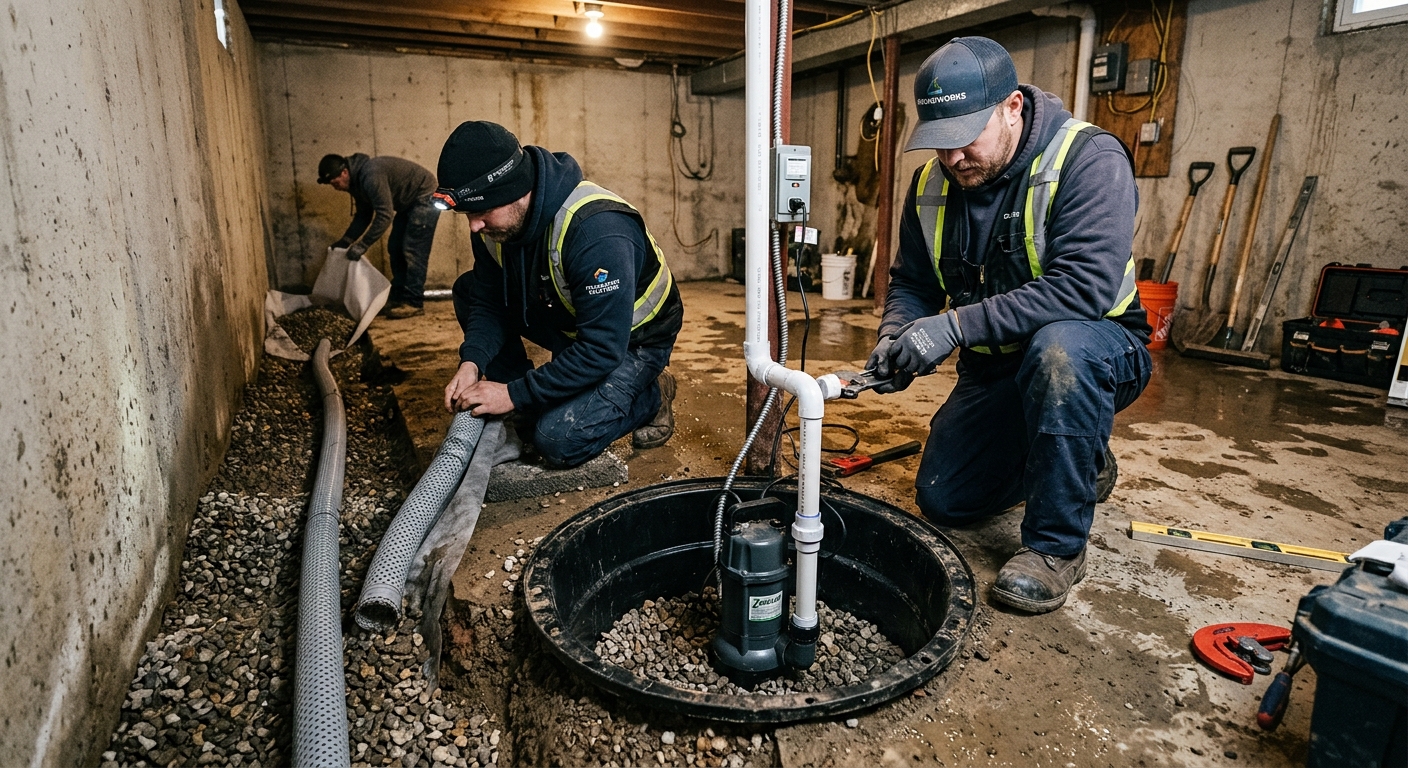
The fundamental difference is that exterior waterproofing permanently addresses the source by excavating around the foundation, installing a proper membrane system, and restoring drainage (new drainage tile, correct slope, and backfill). It costs more and creates more disruption because it involves landscaping removal and excavation. Interior waterproofing (perimeter drain channel, sump pit, and pump) manages water after it enters. This can be the most practical option when access is limited or when the goal is to stop a chronic seepage pattern quickly.
In New Edinburgh’s Toronto-area climate and soil conditions—mixed glacial till with dense clay pockets and repeated freeze–thaw—hydrostatic pressure is the enemy. If your foundation shows signs of ongoing lateral pressure (multiple damp areas, recurring seepage after heavy rain/snowmelt, or wall efflorescence), exterior work is more likely to be the long-term fix. Poured concrete walls often respond well to properly tested crack injection when cracks are isolated and not actively moving, while block foundations frequently benefit from interior drainage as a complement because block and mortar seams can act like channels over time.
Sump pump backup matters in Ontario because power interruptions during storms and spring flooding can occur when many homes experience discharge demands. A primary pump without backup can leave a wet basement exposed during the exact weeks when soil moisture peaks.
Where the price difference is justified: if you’re facing persistent wetness and failing exterior drainage, a full exterior approach in the $7,000 – $25,000 range may be worth it compared with repeating interior interventions at $3,500 – $15,000. But if the issue is a short, confirmed active crack or a single local infiltration point, targeted work may stop the problem with far less disruption—saving you from unnecessary excavation.
| Method |
Best For |
Addresses Source? |
Disruption |
Lifespan |
Price Band |
| Full exterior excavation + membrane |
Chronic seepage, multiple leak points, and suspected failed drainage around the foundation |
Yes |
High |
Long-term with correct drainage detailing |
$7,000 – $25,000 |
| Interior French drain + sump system |
Limited access, clogged weeping tile, or long-term seepage management |
No (manages after entry) |
Medium |
Very good if pumps and discharge are maintained |
$3,500 – $15,000 |
| Crack injection — epoxy (structural) |
Non-moving cracks where water entry is limited and the crack is stable |
Partially (stops entry at the crack) |
Low to medium |
Good when crack type is correctly identified |
$600 – $3,000 |
| Crack injection — polyurethane (active leak) |
Active seepage through cracks showing moisture under pressure |
Partially (targets the leak path) |
Low to medium |
Good for active leaks if properly drilled and sealed |
$900 – $3,500 |
| Interior drain channel only (no sump) |
Minor seepage where flow rates are low and gravity drainage is feasible |
No (manages after entry) |
Medium to low |
Moderate; depends on discharge and capacity |
$1,800 – $6,500 |
| Re-grading + downspout extensions |
Surface-water contribution, yard slopes pushing water toward foundation |
Yes for surface-water source |
Low to medium |
Moderate (maintenance-dependent) |
$900 – $6,000 |
How to choose a waterproofing contractor in New Edinburgh
Choosing the right waterproofing contractor in New Edinburgh starts with verifying three things: Ontario compliance, financial responsibility, and jobsite coverage. First, ask for their current business information and confirm their work is being performed under the appropriate trade/business arrangements for Ontario. Second, request a certificate of liability insurance and verify the policy is active and matches the company name on the quote. Third, ask for proof of WSIB/WCB coverage (or clearance where applicable) and verify the status letter details match the same company. Don’t accept “we’re covered” without documents.
Next, get 2–3 itemised written quotes that separate labour and materials. The lowest bid is often missing scope: membrane products, drainage tile specifics, pump type, discharge piping, disposal, or restoration. Make sure the proposal states whether permits will be pulled (where required), whether demolition and disposal are included, and what “exclusions” cover (for example, mold remediation or replacing damaged weeping tile connections).
Warranty quality is another deciding factor. Look for a workmanship warranty length and ask whether the product/manufacturer warranty is tied to the installation. If you sell the home, a transferable warranty can matter. Payment scheduling should protect you: never pay more than 10–15% upfront, and hold back the remainder until key milestones are complete.
Finally, insist on a written timeline: proposed start date, estimated completion window, and how weather delays in late fall or spring flooding season are handled.
- Ask for an on-site assessment and a written leak-source explanation (not just “seal everything”).
- Require photos of existing conditions and labelled crack/damp-map documentation.
- Confirm exact pump model and whether backup is included (battery or water-powered).
- Check whether exterior work includes membrane detailing at corners, ties, and penetrations.
- Verify drainage tile specification (size, slope, and connection points).
- Ensure disposal, backfill, and restoration are included in the written scope.
- Ask about drying time requirements if you have efflorescence or damp masonry.
- Request written confirmation of permit responsibility (pulling vs homeowner).
- Review how they handle shared driveways, deck footings, and constrained excavation.
- Confirm warranty terms: workmanship duration, product coverage, and transferability.
- Use milestone-based payments; set a holdback for completion and cleanup.
- Get start and completion dates in writing, plus weather contingency notes.
Red flags in New Edinburgh include: contractors who don’t inspect for signs of failed drainage/old weeping tile before recommending a sealant; quotes that omit discharge piping details for sump systems; “one-size-fits-all” crack injection without confirming crack type (epoxy vs polyurethane); demanding large upfront payments beyond 10–15%; and offering vague warranty language that doesn’t specify workmanship scope or transfer terms.
Frequently asked questions — waterproofing in New Edinburgh
How much does foundation crack repair cost in New Edinburgh?
In New Edinburgh, foundation crack repair cost commonly depends on whether you’re treating an isolated leak path or a longer section that’s actively weeping. For typical, localized crack injection work, homeowners often fall within the $600 – $3,000 band, but pricing rises when multiple cracks are involved or when prep is heavy (chipping, cleaning, port drilling, and patching). Epoxy-based injection is usually selected for stable, non-moving cracks, while polyurethane is used for active leaks under pressure. Because Toronto-area freeze–thaw can keep cracks “alive,” contractors typically test moisture conditions before choosing the product so you’re not paying for the wrong chemistry.
Do I need a sump pump in New Edinburgh?
You might, especially if you see recurring seepage after snowmelt or heavy rain, or if interior perimeter drainage is installed and needs a reliable discharge point. In Toronto’s clay pockets, water can build up and run into the foundation perimeter for days, not just hours—so sump cycling matters. Many homeowners in New Edinburgh choose a sump pump installation in the $800 – $3,500 range when they’re converting dampness into “dry system” performance. If you’re concerned about outages during spring wet periods, ask whether backup is included (battery or water-powered). Backup isn’t about convenience—it’s about preventing a power interruption from turning seepage into a flood.
How does New Edinburgh's soil affect my foundation?
New Edinburgh sits in the broader Toronto region where glacial till and clay pockets are common. Clay soils expand when saturated and can exert lateral pressure against foundation walls, which can worsen cracking over repeated freeze–thaw cycles. That pressure is one reason hairline cracks sometimes become active leaks after a few winters. If you also have older drainage (like original weeping tile that’s partially collapsed or clogged), water has fewer pathways to escape, increasing the risk of interior dampness, efflorescence, and seepage. In practical terms, contractors may recommend exterior excavation and drainage when soil saturation is a root cause, but if access is tight, an interior drain plus sump can be the most workable approach while you manage the water entry effects.
Do I need a permit for foundation work in Ontario?
In Ontario, permits are typically required for work that affects structural elements, involves foundation excavation, or changes lot drainage in a way that can impact safety or municipal servicing. Foundation excavation for exterior waterproofing and structural crack repair (especially major/horizontal cracks that may indicate movement) often require a permit. Sump pump installations that connect discharge lines to storm or sanitary services usually require municipal approval. For New Edinburgh homeowners, the simplest path is to ask the contractor to clearly state whether they will pull permits and provide documentation showing what’s covered. Also, if structural repair is possible, confirm whether the contractor includes an engineer’s assessment and how that ties into permit requirements.
How long does waterproofing last?
Durability depends on whether the work addresses the source of water entry or just manages seepage after it enters. Exterior waterproofing—when membrane detailing and drainage tile slope are correctly installed—tends to provide the longest service life, often measured in decades, because it reduces hydrostatic pressure against the wall. Interior systems can last a long time too, but their performance depends on pump reliability, discharge line integrity, and the condition of collected water pathways. Crack injection can last many years when the crack type is correctly matched—epoxy for stable cracks and polyurethane for active leaks—yet freeze–thaw and ongoing movement can shorten results if the underlying cause isn’t addressed. If you’re comparing quotes, ask what warranty is offered and whether it’s transferable.
Can I waterproof my basement from the inside only?
Yes, inside-only waterproofing is often possible and may be the best solution when excavation access is limited. In New Edinburgh, homeowners frequently choose interior perimeter drains with a sump pit, which manages water after entry and can stop recurring dampness. Interior perimeter drainage projects typically fall into the $3,500 – $15,000 range depending on wall conditions, pump selection, and whether interior discharge is straightforward. However, interior methods don’t eliminate the hydrostatic pressure on the wall itself; they reduce the consequences by collecting and pumping water away. If your issue is widespread moisture from saturated clay backfill or failing original exterior drainage, an exterior solution is more likely to be the long-term fix. A good contractor will assess whether interior-only can work without setting you up for repeated repairs.