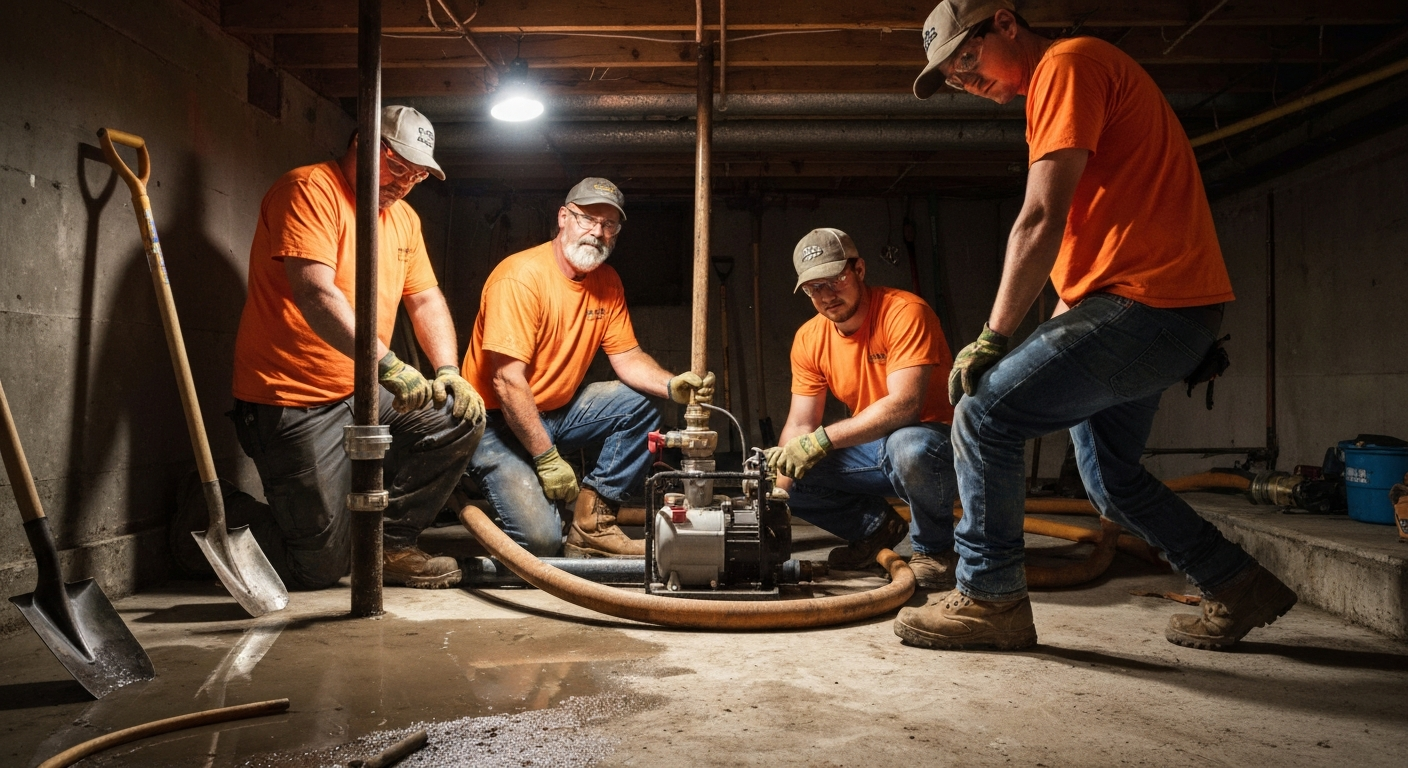
Basement waterproofing options and costs in Smiths Falls
Basement waterproofing in Smiths Falls usually starts with a simple question: where is the water getting in, and what’s pushing it in? With 9,254 residents and an older housing stock—79.8% of homes built before 1981—many basements in town still rely on original, sometimes failing, waterproofing methods and weeping tile setups. That age factor matters because older tar-and-paper systems and dated drainage details can wear out, leaving seepage paths along joints, tie holes, and cracks.
In the Kingston–Pembroke economic region, the biggest cost drivers are soil behavior and groundwater pressure. Clay-rich soils in parts of Eastern Ontario hold water and expand when saturated, increasing lateral pressure on foundation walls. Add freeze–thaw cycles, and even small cracks can widen over time—often making exterior excavation more effective, or making interior systems a practical complement when access is limited. You’ll also see higher demand in established neighbourhoods where lots are mature and landscaping can make excavation more disruptive, such as the downtown core area near the Rideau River corridor and older residential pockets off Perth Street.
Below is a quick comparison of common approaches, what they target, typical disruption, and the price ranges local homeowners most often see before an inspection. After you match your problem (seepage, active leaks, chronic dampness, or stormwater-driven pooling) to the right method, you can budget with confidence and ask better questions in your quotes.
| Method |
What It Addresses |
Disruption Level |
Durability |
Price Range |
| Exterior excavation + new membrane + drainage tile |
Stops water at the source by replacing the waterproofing and restoring controlled drainage around the foundation |
High (excavation, landscaping/driveway disruption) |
High (typically decades with proper backfill and drainage) |
$12,000–$25,000 |
| Interior perimeter drain channel + sump pit |
Collects water after it enters the basement and pumps it away to reduce hydrostatic pressure effects inside |
Medium (floor/ wall cutting, minimal landscaping disruption) |
Medium to High (depends on discharge setup and discharge distance) |
$4,000–$10,000 |
| Foundation crack injection (epoxy or polyurethane) |
Seals cracks to prevent seepage pathways; product choice depends on whether the crack is active/leaking |
Low (targeted drilling and sealing) |
Medium (often improved with drainage upgrades) |
$800–$1,800 |
| Sump pump installation (primary + battery backup) |
Controls basement water during wet seasons and power disruptions |
Low to Medium (pit excavation, minor floor work) |
High (backup adds resilience for outages) |
$900–$2,200 |
| Window well drain installation |
Prevents rain/snow melt from saturating around egress windows and reduces seepage at penetrations |
Medium (excavation around window wells) |
Medium to High (good grading and discharge are key) |
$1,200–$3,500 |
| Lot re-grading / downspout extension |
Redirects surface water away from the foundation to reduce infiltration and freeze–thaw stress |
Low to Medium (topsoil, grading, downspout routing) |
Medium (works best when combined with drainage) |
$2,000–$6,000 |
Prices are estimates only and vary by project scope, site access and material selection.
What affects the price of waterproofing in Smiths Falls
In Smiths Falls and the wider Kingston–Pembroke area, two quotes for the same general “leaky basement” issue can differ by 30–50% because the underlying cause is rarely identical—and neither is the site. Contractors price for what they must do to control water safely: soil excavation, drainage restoration, crack stabilization, and discharge routing. Nationwide averages can also mislead homeowners because Eastern Ontario’s clay-heavy soils and groundwater behavior often increase both material usage and labour time.
The three biggest regional drivers that separate Kingston–Pembroke costs from many other areas are soil type, water table, and freeze-thaw. Clay-rich soils expand when saturated, increasing lateral pressure on foundation walls and worsening crack movement over time. High or fluctuating water tables raise sump pump run times and require correctly sized drainage paths. Freeze–thaw then widens existing joints and cracks, especially in older poured concrete and block foundations. In homes built before 1981—common here—original weeping tile systems are more likely to be clogged, broken, or missing, which means contractors must repair or replace drainage rather than simply “seal the inside.”
Concrete examples from Smiths Falls: (1) A basement with chronic dampness and floor joint seepage often pushes the job toward interior perimeter drains plus a sump; it can still land in the $4,000–$10,000 range when access is straightforward. (2) If water is actively entering from exterior wall cracks and the weeping tile is failed, full exterior work can move into the $12,000–$25,000 band because excavation, membrane installation, and new drainage tile must be done correctly. (3) Homes with limited excavation access—small side yards, mature landscaping near the foundation—can sometimes make interior systems more cost-effective even when the exterior would be ideal on paper.
| Price Factor |
Why It Matters |
Cost Impact |
| Interior vs. exterior approach — interior is less disruptive but addresses symptoms |
Exterior treats water at the source; interior manages water after entry |
Exterior typically costs more due to excavation and membrane work |
| Foundation type — poured concrete vs. block vs. stone vs. ICF |
Different walls leak differently and respond differently to crack sealing and drainage |
Block and older poured concrete often need added drainage and more crack prep |
| Soil type — clay expands more than sand, adding pressure |
Clay saturation increases hydrostatic/lateral pressure and worsens seepage pathways |
More robust drainage solutions and additional stabilization can be required |
| Crack type and length — hairline vs. structural horizontal cracks |
Active/structural movement needs the right injection approach and assessment |
Structural crack evaluation and extended injection work increases labour and materials |
| Sump pump backup system — battery or water-powered backup needed |
Power interruptions during wet seasons can turn “controlled” basements into active flooding |
Backup adds cost but reduces risk during spring events |
| Access — landscaping, decks, or driveways must be removed for exterior |
Exterior work requires excavation and restoration; access drives time and restoration cost |
Poor access can push costs upward by adding restoration scope |
| Weeping tile age — original tile (60+ years) may be completely failed |
Older systems frequently clog or break, allowing water to bypass drainage |
Replacement/repair of tile is often a major cost component |
| Mould or efflorescence remediation required before sealing |
Sealers and membranes don’t perform well over untreated contamination or salts |
Remediation requires labour, containment, and drying time before waterproofing |
Permits & regulations in Ontario
In Ontario, foundation excavation, structural crack repair, and changes to lot drainage typically require a building permit. If you’re planning exterior waterproofing that involves digging to the foundation, significant drainage modifications, or any work that impacts how water moves around the structure, treat the permit process as part of the project—not an afterthought. Sump pump installations that connect to the storm system or sanitary sewer also require municipal approval (rules vary by connection method and discharge plan). For structural crack repairs—especially horizontal cracks in block walls, major step cracks, or signs of movement—an assessment by a structural engineer is often required to confirm whether underpinning or structural reinforcement is needed.
To verify your contractor in Smiths Falls, follow a practical, step-by-step check before you sign: (1) Request the company’s Ontario business credentials and confirm they’re legitimate; (2) ask for a certificate of insurance showing general liability coverage that matches foundation work scope; (3) confirm WSIB/WCB clearance (or that the company is properly registered/covered, as applicable) and request written proof/clearance letter; (4) for structural-related work, ask whether they have engineering support for the repair plan; and (5) keep copies of everything you check—quotes, certificates, and clearance documents—so your warranty and liability are grounded in paperwork, not verbal assurances.
Interior vs exterior waterproofing — what does Smiths Falls need?
The fundamental difference is simple: exterior waterproofing permanently targets the source, while interior waterproofing manages the water once it enters. Exterior work means full excavation along the foundation, installation of a new membrane, replacement of drainage tile, and careful backfill. That approach generally gives the best long-term control because it reduces hydrostatic pressure against the wall itself. The trade-off is higher cost and more landscaping disruption.
Interior waterproofing—perimeter drain channel, sump pit, and a sump pump—collects and removes water from inside the basement. It’s usually less invasive and can be the right choice when access is tight or when the foundation walls are difficult to excavate. However, it doesn’t stop groundwater from pushing on the wall; it “bonds” your basement to a pumping system. In Smiths Falls’s climate, where freeze–thaw cycles can worsen joint movement, interiors often perform best when paired with proper exterior grading and targeted crack sealing.
How to match the approach to typical local conditions: in poured concrete basements, crack injection can be a strong complement because concrete cracks can be stabilized and sealed effectively when drainage is restored. In block foundations, interior drainage is commonly necessary as a practical way to manage water pathways and seepage through the wall and at mortar joints—especially when exterior drainage tile is original and likely underperforming. If you’re dealing with power reliability during spring wet periods, make sure your sump plan includes backup. A battery backup can be the difference between “damp” and a full cleanup.
Budget example: if inspection shows failing exterior weeping tile plus active wall seepage, exterior excavation often lands in the $12,000–$25,000 band. If the same home instead shows mainly interior floor joint dampness with good exterior drainage conditions, an interior drain and sump system is more likely to fit the $4,000–$10,000 range—without paying for excavation you don’t need.
| Method |
Best For |
Addresses Source? |
Disruption |
Lifespan |
Price Band |
| Full exterior excavation + membrane |
Active seepage where exterior drainage or membrane has failed |
Yes (source of water entry) |
High |
Long (often decades with correct drainage backfill) |
$12,000–$25,000 |
| Interior French drain + sump system |
Basements with recurring seepage, limited exterior access, or chronic dampness |
No (manages water after entry) |
Medium |
Medium to Long (depends on pump capacity and discharge) |
$4,000–$10,000 |
| Crack injection — epoxy (structural) |
Non-moving cracks where sealing is needed to stop moisture pathways |
Partial (seals entry points, but doesn’t replace drainage) |
Low |
Medium to Long |
$800–$1,800 |
| Crack injection — polyurethane (active leak) |
Cracks with active seepage or where the crack is still flexible under pressure |
Partial (stops active flow; still benefits from drainage) |
Low |
Medium |
$1,000–$2,200 |
| Interior drain channel only (no sump) |
Minor dampness and limited water volumes where gravity discharge is feasible |
No (relies on drainage to move water away) |
Medium |
Shorter than full sump systems |
$2,500–$6,500 |
| Re-grading + downspout extensions |
Surface water issues and foundation saturation triggered by grading |
No (indirectly reduces pressure) |
Low to Medium |
Medium (works best as part of a complete plan) |
$2,000–$6,000 |
How to choose a waterproofing contractor in Smiths Falls
Choosing a waterproofing contractor in Smiths Falls is mostly about proof: proof of insurance, proof of coverage, and proof that the scope matches what your basement actually needs. Start by verifying Ontario licensing and business standing where applicable, then request the contractor’s certificate of general liability insurance before work begins. Next, verify WSIB/WCB coverage by asking for a clearance letter or equivalent proof of registration/coverage status. If structural repair is part of the plan, confirm they can coordinate engineering support for crack and foundation assessments.
For pricing, get 2–3 itemised written quotes that separate labour and materials, and list exclusions clearly. Look for a scope that names the drainage approach, the system components (membrane, drainage tile, pipe, geotextile, sump pump model), the discharge method, and restoration. Ask whether permit pulling is included (if required), and whether disposal of excavated material and demolition of sections of floor/wall are included. Warranty terms should be in writing: workmanship warranty length, product/manufacturer warranty details, and whether the warranty transfers if you sell the home.
Payment schedule matters. Never allow more than 10–15% upfront; hold back a portion until the job is complete and you’ve confirmed performance and restoration quality. Finally, request a start date and completion estimate in writing so you’re not relying on verbal timelines—especially important for scheduling inspections and winter protection work.
- Ask for certificate of insurance (general liability) and confirm it covers basement waterproofing scope
- Request WSIB/WCB clearance/proof before any labour starts
- Get 2–3 itemised quotes (labour vs materials, and line-by-line inclusions/exclusions)
- Confirm whether permits are required and whether the contractor will pull them
- Ensure the quote lists the discharge plan for sump pumps (where water goes) and any approvals
- Demand specific details: membrane type, drainage tile size, geotextile, and backfill specification
- Match injection product to crack condition (epoxy for stabilized cracks, polyurethane for active seepage)
- Require a written warranty stating workmanship term and product warranty specifics
- Ask if warranty is transferable and how claims are handled
- Agree on a holdback and limit upfront payment to 10–15%
- Confirm site restoration scope (what landscaping/floors/walls will be repaired or replaced)
- Get a written schedule: inspection/first-day work, curing time, and completion date estimate
Red flags in Smiths Falls include: a quote that’s only a lump sum with no drainage/discharge details; refusal to provide insurance/WSIB/WCB clearance; promises to “stop all leaks” without addressing drainage tile, grading, or crack type; warranties that are vague or shorter than workmanship norms; and skipping pre-work moisture assessment or crack movement discussion.
Frequently asked questions — waterproofing in Smiths Falls
Do I need a permit for foundation work in Ontario?
In Ontario, permitting depends on what you’re doing and how it affects the structure or drainage. Foundation excavation, structural crack repair, and changes to lot drainage typically require a building permit. If you’re installing a sump pump and connecting it to storm or sanitary sewer systems, municipal approval is often required for the connection and discharge plan. For Smiths Falls homeowners, the safest approach is to ask your contractor what permit(s) apply before they schedule excavation. A reputable contractor will include permit responsibility clearly in the quote and can explain what’s required for your exact foundation condition (poured concrete vs. block) and the proposed discharge method.
How long does waterproofing last?
How long waterproofing lasts depends on whether you treated the source of water or only managed water after it enters. Exterior waterproofing—membrane plus new drainage tile and proper backfill—commonly performs for decades when installed to specification and paired with good grading. Interior systems often last a long time as well, but they rely on consistent pumping and electrical reliability; backup power becomes important during spring wet periods and outages. For a practical benchmark, many contractors budget exterior projects in the $12,000–$25,000 range because they’re building a more permanent drainage path, while interior drain and sump work commonly sits around $4,000–$10,000. Either way, the warranty terms and maintenance (like pump checks) are what determine real-world lifespan.
Can I waterproof my basement from the inside only?
Yes, you can often waterproof from the inside only, and many Smiths Falls homes do—especially when excavation would be too disruptive due to landscaping or tight side yards. Interior perimeter drains and sump pits are designed to capture seepage after water enters the basement. However, interior work doesn’t fully stop hydrostatic pressure on the wall, so it works best when combined with good surface grading and any necessary crack sealing. If your issue is active leakage through a foundation crack and the exterior drainage tile is failed, an interior-only approach may reduce water, but it may not address the root cause as effectively. Many homeowners choose interior first when costs or access limit excavation, then add targeted crack injection and grading improvements.
What causes foundation cracks in Smiths Falls?
In Smiths Falls, foundation cracks are commonly driven by seasonal freeze–thaw and soil moisture cycling. Clay-rich soils can expand when saturated and exert lateral pressure on foundation walls, and repeated winter thaw/refreeze can widen joints and hairline cracks over time. Older housing stock also plays a role: with many homes built before 1981, original materials and drainage details may be underperforming, allowing more water to reach the wall and exploit weak points like tie holes and control joints. Differential settlement and poor drainage around downspouts are also frequent contributors. If you have a structural horizontal crack or signs of movement, don’t just inject and hope—have the crack assessed so the repair approach matches the crack type and condition.
How do I compare waterproofing quotes?
To compare waterproofing quotes in Smiths Falls, don’t compare the total price first—compare the scope. Ask each contractor to itemize labour and materials and to clearly state what they’re addressing: exterior membrane and drainage tile replacement, interior perimeter drains, crack injection type (epoxy vs. polyurethane), or sump pump capacity and backup. Confirm discharge details (where the sump water goes) and whether approvals/permits are included. Look for specific inclusions like disposal, restoration, and curing/drying time. A quote that sits in the $4,000–$10,000 range but provides no plan for drainage tile, discharge route, or crack type may not be comparable to one in the $12,000–$25,000 range that addresses the full water path. Finally, verify insurance and WSIB/WCB coverage before you make a decision.
How long does basement waterproofing take in Smiths Falls?
The timeline depends on whether you’re doing exterior excavation or interior drainage, and how many problem areas are involved. Interior work (perimeter drain channel, sump pit, pump installation) is usually faster because there’s no exterior excavation, but it still requires time for demolition, prep, drainage line installation, waterproofing products where needed, and curing/drying. Exterior waterproofing typically takes longer due to excavation, membrane and drainage tile installation, and careful backfill and restoration. In practical terms, many projects take days to a few weeks depending on scope and access constraints. If permits or municipal approvals are required for discharge, that can add scheduling time. Ask your contractor for a written start date, completion estimate, and what conditions could delay work during Ontario’s wet spring and freeze–thaw seasons.