Basement waterproofing options and costs in Grande Cache
Basement waterproofing in Grande Cache needs to be matched to how water is entering—because the “fix” that works for one foundation wall crack or one blocked weeping-tile run can fall short if the source is different. Grande Cache is a small community (3,276 people as of the 2021 Census), and that size affects contractor availability: crews often consolidate multiple jobs and scheduling can be tighter, so mobilization and site-prep lines in the quote matter. Just as important, the housing mix in older Canadian communities increases the chance of legacy waterproofing systems—tar-and-paper membranes and corroded drainage tile that have long since reached the end of their service life.
In the Calgary region, clay-and-clay-till soils hold water and expand when saturated, increasing lateral pressure on foundation walls and footings. Combined with freeze–thaw, this widens joints and hairline cracks so meltwater and spring runoff can find a path into basements. That’s why exterior excavation and drainage upgrades are commonly priced higher (and why interior-only solutions are often positioned as symptom control). In Grande Cache, demand typically rises when homeowners are dealing with spring seepage, efflorescence, or wet corners—especially in older clusters like the downtown core area where lot grading and downspout routing are frequently dated.
Below is a practical comparison of the main waterproofing approaches used around Alberta, with typical price bands for Grande Cache projects. Use the table to translate “scope language” into a real sense of what you’re paying for before you compare bids.
| Method |
What It Addresses |
Disruption Level |
Durability |
Price Range |
| Exterior excavation + new membrane + drainage tile |
Primary water entry (hydrostatic pressure) by rebuilding the exterior water barrier and perimeter drainage |
High (excavation, removal/replacement of landscaping, patio/sidewalk impacts possible) |
Long-term when properly detailed (membrane + functioning drain + correct backfill) |
$14,000–$25,000 |
| Interior perimeter drain channel + sump pit |
Water after it enters by collecting seepage along the footing line and pumping it away |
Moderate (concrete floor cutting, sump location in basement) |
Very good for seepage management; depends on maintaining pump performance |
$8,000–$14,500 |
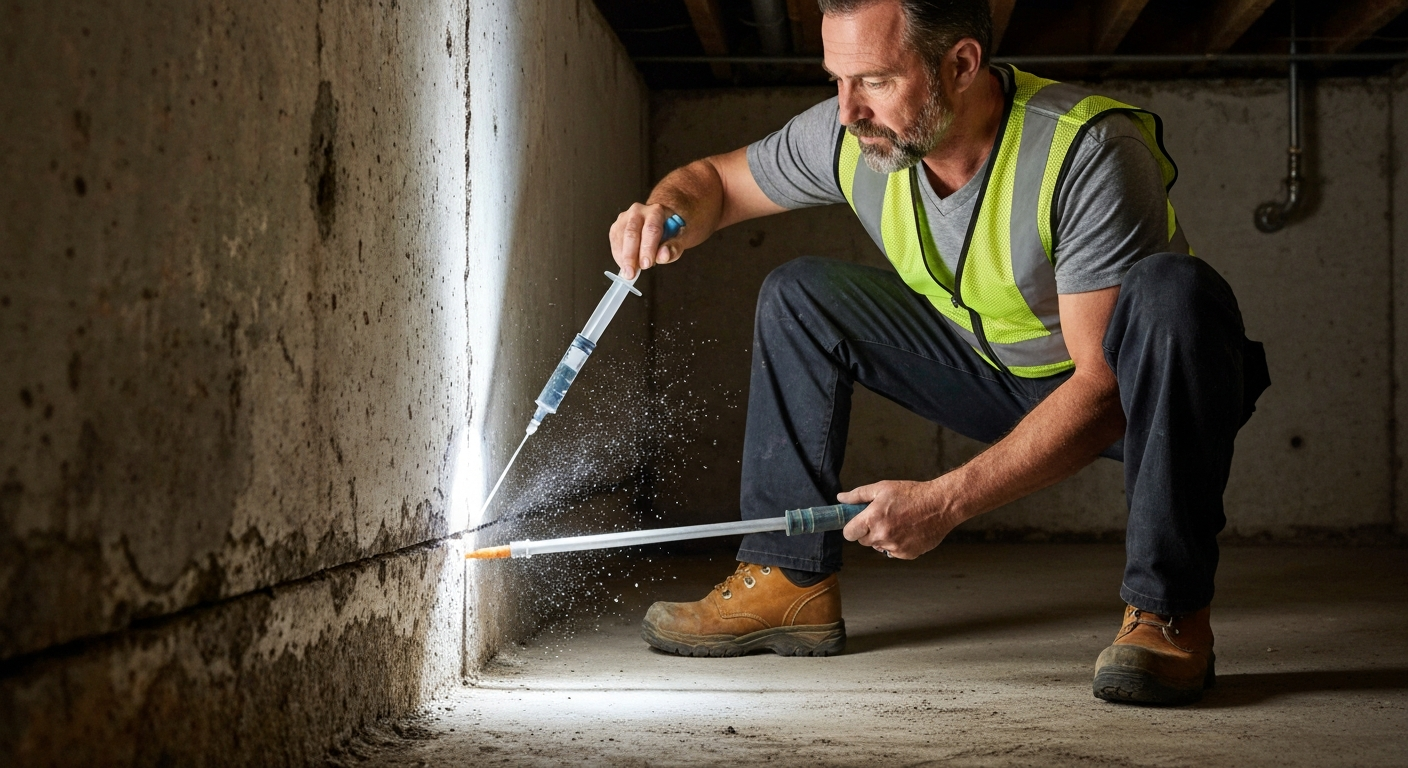
| Foundation crack injection (epoxy or polyurethane) |
Crack leakage pathway; epoxy for static structural sealing, polyurethane for active leaks |
Low (minor interior drilling; clean-up and patching) |
Good when the crack type is correctly matched and entry pressure is controlled |
$900–$2,800 |
| Sump pump installation (primary + battery backup) |
Reliable pumping during spring runoff and power interruptions |
Moderate (electrical tie-in, sump pit and discharge line work) |
High when combined with proper drainage and backup power |
$1,200–$3,500 |
| Window well drain installation |
Surface water and pooling around basement egress windows |
Low to moderate (excavation around window well areas) |
Good for localized leaks; relies on good grading and clear weep paths |
$1,200–$2,400 |
| Lot re-grading / downspout extension |
Reducing water load at the foundation by redirecting roof runoff and adjusting slope |
Low (yard access and small landscaping disturbance) |
Moderate (can slow entry, but doesn’t fix failed membranes/drains) |
$2,000–$6,000 |
Prices are estimates only and vary by project scope, site access and material selection.
What affects the price of waterproofing in Grande Cache
For the same basic waterproofing goal in Calgary-area markets, quotes can swing by 30–50% because the “how” changes: some companies price to manage symptoms, others rebuild the exterior drainage layer and membrane. In Grande Cache, you’ll often see this difference amplified by mobilization and haul/disposal costs when heavy clay spoils must be removed. Labour availability can also affect the total—if a crew has to reschedule excavation-days around delivery and disposal access, you feel it in site-prep and “standby” time.
There are three local-condition drivers that separate Calgary-area pricing from the national average: soil type, water table, and freeze–thaw. Clay-heavy soils common around the region expand when saturated and exert additional lateral pressure on foundation walls, worsening cracks over time. That means more crack work, more detailing, and more “proof” that the drainage system is functional. Where seasonal groundwater is higher (especially in low-lying pockets and during big spring storms), sump performance and discharge requirements can increase—sometimes adding backup power. And freeze–thaw cycles typical of southern Alberta widen existing joints, pushing water entry to more cracks and slab edges; the waterproofing scope has to reach beyond the one wet spot.
Concrete examples help show why cost moves: (1) if we find multiple seepage paths along a wall (not just one crack), a simple membrane patch becomes a full interior perimeter drain plan; interior work often lands around the $5,000–$15,000 bands. (2) if the weeping tile is original and has failed (60+ years is not unusual in older housing stock), exterior excavation + new drainage is more likely, often aligning with the $9,000–$25,000 excavation band. (3) if access is tight—patios, mature landscaping, or landings near the foundation—excavation becomes slower and disposal more expensive, pushing the same “scope” toward the top of its band.
| Price Factor |
Why It Matters |
Cost Impact |
| Interior vs. exterior approach — interior is less disruptive but addresses symptoms |
Interior systems collect and pump water after entry; exterior systems stop entry by rebuilding the barrier and drainage layer |
Interior often $5,000–$15,000; exterior commonly $9,000–$25,000 for excavation-led projects |
| Foundation type — poured concrete vs. block vs. stone vs. ICF |
Different wall systems respond differently; cracks, joints, and drainage interfaces vary |
Poured walls may seal better with crack injection; block often needs complementary interior drainage |
| Soil type — clay expands more than sand, adding pressure |
Clay holds more water and increases lateral wall pressure during freeze–thaw saturation |
Higher likelihood of multiple leak paths and more thorough drainage detailing |
| Crack type and length — hairline vs. structural horizontal cracks |
Structural movement cracks require assessment and possibly additional work beyond sealing |
Structural-grade repairs and engineering review can add cost versus straight injection |
| Sump pump backup system — battery or water-powered backup needed |
Backup reduces risk during outages during spring flooding events |
Typically adds to the sump scope; may push toward the upper end of sump installations |
| Access — landscaping, decks, or driveways must be removed for exterior |
Exterior excavation time increases with restricted access and restoration requirements |
Can add several thousand dollars depending on removal and reinstatement needs |
| Weeping tile age — original tile (60+ years) may be completely failed |
Failed tile often means water is not being relieved before it reaches the wall |
May shift a job from interior-only to perimeter drainage rebuild |
| Mould or efflorescence remediation required before sealing |
Moisture causes mineral deposits and biological growth that must be addressed for adhesion and indoor air safety |
Additional labour and materials before sealing/pumping |
Permits & regulations in Alberta
In Alberta, certain foundation-related changes typically require municipal or permit review, especially when the work affects drainage patterns, structural elements, or connects to municipal services. In most cases, foundation excavation near existing footings, structural crack repair that could be considered stability-related, and changes to lot grading/downspout discharge that alter how surface water moves away from the foundation should be confirmed through the proper building permitting process. Where sump pumps discharge to storm or sanitary infrastructure, approvals are commonly required—because the connection impacts municipal systems.
For structural crack repairs—particularly horizontal cracks in block walls, major step cracks, or any cracking that suggests movement—an engineer’s assessment is often needed to determine whether underpinning or other structural measures are required. A good contractor will tell you early if they anticipate engineering involvement and will carry liability insurance and WSIB/WCB coverage for their workers. Ask who provides engineering support and whether it’s part of their standard process or an additional subcontract.
Step-by-step, here’s how a homeowner in Grande Cache can verify a contractor’s Alberta coverage and licensing: (1) ask for their certificate of insurance and confirm general liability limits are current; (2) request WSIB/WCB clearance and ensure it’s not expired; (3) verify professional/engineering involvement if the plan includes structural crack work; (4) confirm any required permits are handled by the contractor or, at minimum, that you receive documentation of the permit application; (5) check online contractor information sources (and the contractor’s own business profile) before you sign a contract.
Interior vs exterior waterproofing — what does Grande Cache need?
In Grande Cache, the fundamental decision is whether you’re stopping water at the source or managing it after it enters. Exterior waterproofing—full excavation, new membrane, new perimeter drainage tile, and careful backfill—permanently addresses the route water takes to the foundation. It’s the most effective long-term approach when exterior walls are exposed to saturated clay conditions and when weeping tile has failed. The trade-off is cost and disruption: excavation typically means removing landscaping, working around patios or side access, and restoring finishes.
Interior waterproofing—perimeter drain channel, sump pit, and a properly sized sump pump—addresses the same problem in a different way: it captures seepage and relieves hydrostatic pressure inside the basement. It’s less invasive than excavation and is often the right choice when access is tight, when you need an immediate moisture-control outcome, or when the main issue is seepage through footing drains or minor wall leakage. For poured concrete walls, crack injection (when matched to the crack type) can be a strong complement because the wall’s sealing response is often better. For block foundations, interior drainage is commonly needed as a practical pairing because joints and drainage interfaces can allow persistent moisture under freeze–thaw.
Alberta’s spring conditions also favour reliability: if you install a sump, you should discuss backup power. In outages during peak runoff, battery or water-powered backup can be the difference between a dry basement and a full cleanup.
A real-world dollar example: if your scope is mainly perimeter seepage and localized wet corners, interior French drain plus sump often lands in the $8,000–$14,500 range, while full exterior excavation + membrane is frequently $14,000–$25,000 in Calgary-market pricing. The higher spend is justified when exterior drainage is failing or when water load is consistent along multiple wall sections.
| Method |
Best For |
Addresses Source? |
Disruption |
Lifespan |
Price Band |
| Full exterior excavation + membrane |
Widespread seepage, hydrostatic pressure concerns, failed weeping tile, and consistent exterior wall moisture |
Yes (controls entry and releases water externally) |
High (excavation and landscape restoration) |
Long-term when drain and backfill are properly detailed |
$14,000–$25,000 |
| Interior French drain + sump system |
Basement seepage along footing line, wet corners, and moisture management where exterior access is difficult |
No (manages water after entry) |
Moderate (floor cutting and basement equipment) |
Very good if sump is maintained and backup is considered |
$8,000–$14,500 |
| Crack injection — epoxy (structural) |
Static cracks where water entry is not actively running and there’s no ongoing movement |
Partial (seals the crack pathway, but doesn’t replace failed drainage) |
Low (drilling and patching) |
Good when matched to crack movement status |
$900–$2,200 |
| Crack injection — polyurethane (active leak) |
Active leaks, seeping cracks, and situations needing flexible sealing |
Partial (seals active pathway, but doesn’t remove exterior saturation) |
Low to moderate (more prep if moisture is active) |
Good when hydrostatic pressure is managed |
$1,200–$2,800 |
| Interior drain channel only (no sump) |
Minor seepage where gravity discharge is feasible and water volumes are limited |
No (captures/redirects but relies on conditions and discharge method) |
Low to moderate (floor work; less equipment) |
Variable (depends on discharge and maintenance) |
$5,000–$9,500 |
| Re-grading + downspout extensions |
Roof runoff-driven moisture, small exterior dampness, and improving drainage away from the foundation |
No (reduces load but doesn’t rebuild failed waterproofing) |
Low (yard and surface adjustments) |
Moderate (effectiveness depends on future landscaping and slope) |
$2,000–$6,000 |
How to choose a waterproofing contractor in Grande Cache
Start by verifying Alberta basics: ask for their current liability insurance certificate (so you’re protected if there’s property damage), and confirm their WSIB/WCB clearance (so you know workers’ coverage is in place). For licensing, review what credentials they hold for the scope being proposed—especially if structural crack work, engineered components, or permitted drainage changes are in the plan. In practice, you should be able to receive documents quickly: certificates of insurance, WSIB/WCB clearance letters, and any engineering/professional documentation when structural assessment is expected.
Next, don’t rely on lump sums. Get 2–3 itemised written quotes that separate labour and materials—membrane, drain tile, sump pit and pump, discharge piping, injection materials, and disposal/backfill. Make sure the quote specifies what’s included in the basement and what’s excluded (for example: mould remediation, concrete patching, electrical hook-ups, permit pull, and landscape restoration). If disposal fees for heavy clay spoils are not listed, clarify whether they’re included or billed separately.
Warranty matters in Alberta freeze–thaw climates. Look for a workmanship warranty length that matches the risk profile, and confirm whether product/manufacturer warranties apply and whether they’re transferable if you sell the home. Payment scheduling should be cautious: never pay more than about 10–15% upfront, and hold back a meaningful portion until completion and walkthrough sign-off. Finally, request a written start date and a completion estimate; waterproofing projects stall when excavation materials, pump components, or discharge approvals don’t line up.
- Ask what they will inspect on-site (crack mapping, efflorescence checks, drain condition, downspout routing).
- Require an itemised scope: materials, labour, and disposal/backfill line items.
- Clarify exclusions: permit fees, engineering, electrical, restoration, and any mould remediation.
- Confirm sump specs: pump capacity, discharge line routing, and backup type.
- Ask how they address foundation crack type (epoxy vs polyurethane selection process).
- Verify warranty terms in writing (workmanship + how long, and product warranty conditions).
- Request proof of liability insurance and WSIB/WCB clearance before work begins.
- Check that they provide a permit plan if discharge connections or grading changes require approval.
- Confirm concrete cutting/patching and finish restoration steps are included.
- Discuss schedule risk: what happens if weather delays excavation/backfill curing?
- Avoid “one-size-fits-all” promises like “we’ll seal everything with injection.”
- Get a start date and timeline in writing, including curing and inspection points.
Red flags in Grande Cache: contractors who won’t map cracks and only guess; quotes that mention waterproofing without stating drainage tile and how it ties into a functioning system; companies that omit sump pump backup discussion for spring conditions; vague warranty language (no clear workmanship term or what voids it); and proposals that skip permits when the scope includes discharge connections or drainage rework.
Frequently asked questions — waterproofing in Grande Cache
Can I waterproof my basement from the inside only?
Yes, interior waterproofing can work—especially in Grande Cache when access for exterior excavation is limited or the leak is mainly seepage after water entry. Interior options typically include a perimeter drain channel and a sump pit/pump, often with a backup for spring runoff. However, inside-only work does not stop hydrostatic pressure from building against the foundation wall; it manages water after it gets in. If your weeping tile has failed or the exterior membrane is compromised, interior systems may need to run frequently in wet seasons. A common scope choice is interior drainage plus sump in the $8,000–$14,500 band, and crack injection as an add-on when crack type matches. For a source-at-the-wall solution, full exterior excavation + membrane is usually more effective, but it’s a bigger disruption and cost.
What causes foundation cracks in Grande Cache?
In Alberta and the Calgary region, foundation cracking is usually driven by movement from freeze–thaw plus saturated soils. Clay-and-clay-till soils hold water, expand when saturated, and exert lateral pressure on foundation walls and footings. As temperatures swing, existing hairline cracks and joints widen, letting more water in, which can accelerate the cycle. Older housing stock also plays a role: original drainage systems like weeping tile can be clogged or failed, so wall pressure and seepage increase over time. In poured concrete walls, cracks may stay localized, but in block walls joints can be more susceptible to seepage through freeze–thaw. If your crack looks horizontal, steps through mortar joints, or changes over seasons, that’s a sign to investigate structural movement and consider engineering before simply injecting.
How do I compare waterproofing quotes?
Compare quotes line-by-line, not by total price alone. Ask each contractor to itemise labour and materials: membrane (if exterior), drain tile, sump pit and pump, discharge piping, injection materials, concrete cutting and patching, and disposal/backfill details. Confirm whether permit pull is included—especially if the plan includes changing grading or connecting sump discharge to storm/sanitary services. Make sure they explain disruption: exterior work means excavation and restoration; interior work means floor cutting and basement mechanical equipment. A good quote will also describe exclusions: mould remediation, engineering assessments, and any yard reinstatement. For pricing, interior-only solutions often fit the $5,000–$15,000 range, while excavation-led exterior waterproofing typically sits closer to $9,000–$25,000 depending on access and length of perimeter. If one quote is dramatically cheaper, ask what they’re leaving out.
How long does basement waterproofing take in Grande Cache?
Timelines depend on whether you’re doing exterior or interior work and how much preparation is required. Interior perimeter drain plus sump typically takes several working days, then additional time for concrete repair and curing before finishing. Crack injection is often faster—generally a shorter on-site window—but it still requires proper surface prep and curing, especially if active seepage is present. Exterior excavation can take longer because of excavation/benching, membrane and drainage installation, and careful backfill compaction, plus weather delays during Alberta freeze–thaw transitions. If permit approvals or discharge logistics are needed for a sump connection, they can also impact start dates. A realistic approach is to get the contractor to provide a start date and an estimated completion schedule in writing, including key milestones (excavation readiness, installation completion, curing time, final patch/cleanup).
What is a weeping tile and does my Grande Cache home have one?
A weeping tile is a perimeter drainage system installed below grade around the foundation to collect groundwater and seepage and direct it to a sump, daylight, or another controlled outlet. Many older homes in Alberta have some form of drainage tile, but it’s common for tile runs to be clogged, crushed, or disconnected over time—especially if original backfill settled or if clay soils held water against the foundation. Not every Grande Cache home will have it, particularly newer builds, but many older basements do. A practical way to confirm is to review original build documents if available, check basement records, and assess exterior signs like discharge locations. If you have efflorescence, recurring wet corners, or a sump that runs heavily in spring, that’s often evidence the drainage system is failing or inadequate. When weeping tile has been in place 60+ years, replacement or a complementary interior system is frequently recommended.
Can I waterproof my basement in winter in Grande Cache?
Sometimes, but it’s not ideal for exterior waterproofing and it must be planned carefully for Alberta winter conditions. Interior work (like crack injection, perimeter drain channels, or sump installation) can often proceed when floors and walls are accessible and materials can be stored/handled safely. Exterior excavation is different: freezing conditions make digging slower, can increase damage risk to foundation edges, and complicates membrane installation and backfill compaction. If the ground is frozen, exterior work may be delayed until workable thaw windows. That said, homeowners sometimes need immediate moisture control during winter—especially when seepage continues after freeze starts—so interior management can be the best short-term option. If your main problem is active leakage, polyurethane crack injection may be considered as part of an interim plan. Always discuss waterproofing sequencing and weather constraints; a contractor should tell you what they can do now and what should wait to achieve durable results.