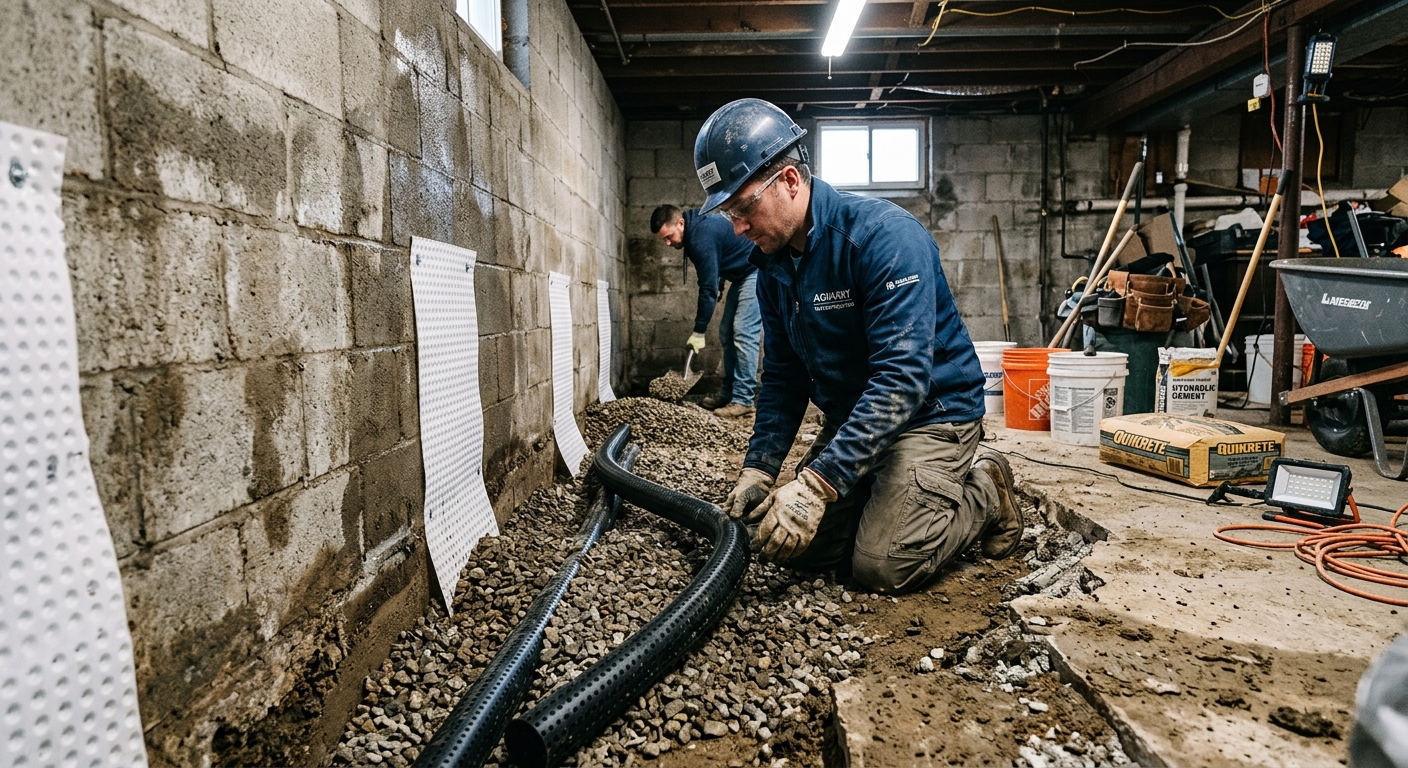
Basement waterproofing options and costs in Garden Village
Garden Village is a Lower Mainland–Southwest community of 10,087 people (Statistics Canada, 2021 Census), and basement moisture is a recurring concern for homeowners—especially as homes age. In older neighbourhoods, many properties still have the original drainage concepts from decades past, and those systems are more likely to have failed or become undersized. In this part of British Columbia, prolonged rainfall and high groundwater can keep hydrostatic pressure on foundation walls and slabs long after a dry day arrives, which is why “quick fixes” often don’t hold.
Costs here are shaped by persistent soil saturation, drainage challenges, and labour/access constraints typical of dense lots and mature landscaping. Contractors frequently have to manage excavation close to fences, decks, and driveways, and rocky sections can require mechanical breaking. The result is that full-perimeter exterior work sits at the higher end of the national range, while interior systems can be a practical first step when exterior access is limited.
In Garden Village’s older pockets near the downtown residential core, demand is especially strong for perimeter drain replacement, interior retrofits, and sump upgrades because more basements show recurring dampness, efflorescence, or musty odours after wet spells. Use the options below to compare typical scopes and disruption levels, then choose an approach that matches your foundation type, crack pattern, and how quickly water appears after storms.
| Method |
What It Addresses |
Disruption Level |
Durability |
Price Range |
| Exterior excavation + new membrane + drainage tile |
Primary source control (hydrostatic pressure management), replaces failing perimeter drainage |
High (yard excavation, landscaping disruption) |
Long-term with correct backfill and sealing details |
$15,000–$30,000 |
| Interior perimeter drain channel + sump pit |
Water collected after it enters; reduces seepage and floor dampness |
Medium (interior cutting and floor works) |
Very reliable when paired with proper sump and discharge routing |
$8,000–$18,000 |
| Foundation crack injection (epoxy or polyurethane) |
Sealing cracks; polyurethane targets active leaks, epoxy suits stable cracks |
Low to medium (surface prep; access needed) |
Depends on crack movement and whether water is active |
$500–$2,000 |
| Sump pump installation (primary + battery backup) |
Prevents buildup in sump; maintains drainage during outages or heavy rainfall |
Low (minor interior work) |
High when discharge lines are sized and backup is included |
$1,000–$5,000 |
| Window well drain installation |
Manages rainwater/sidewater at egress areas; reduces localized seepage |
Low to medium (well excavation/pipe routing) |
Good for targeted leaks when grading and weep paths are correct |
$1,200–$4,000 |
| Lot re-grading / downspout extension |
Redirects surface water away from foundation to reduce seepage load |
Low (light excavation and landscaping changes) |
Moderate; best as a supporting measure with drainage |
$1,500–$6,500 |
Prices are estimates only and vary by project scope, site access and material selection.
What affects the price of waterproofing in Garden Village
In Garden Village and across the Lower Mainland–Southwest, homeowners often see quotes for the “same” basement issue that differ by 30–50%. The reason is that waterproofing is site-specific: groundwater conditions, foundation construction, and how water is getting in can make two basements look similar while requiring different controls. Labour rates and excavation logistics also play a big role here, especially on tight urban lots where crews must work around decks, driveways, mature trees, and buried services.
The three biggest cost drivers that separate Lower Mainland–Southwest pricing from the national average are soil type, water table, and freeze-thaw. Even when the soil isn’t highly expansive like some clay-heavy parts of Ontario and the Prairies, Lower Mainland soils more often stay saturated. High groundwater means sump capacity, discharge routing, and drainage sizing matter more, because pumps run longer during wet stretches. Coastal BC’s rainfall saturates backfill quickly when original drainage fails, and frequent freeze-thaw cycles widen existing cracks and joints, which can increase the amount of prep and sealing needed.
Concrete examples from Garden Village projects: (1) a poured-concrete wall with stable hairline cracks may only need crack injection plus targeted drainage improvements; (2) a block foundation with long step cracks often triggers an interior perimeter drain plus sump, because block joints can channel water; (3) yards with multiple obstacles can push exterior excavation toward the upper range—exterior excavation projects commonly fall into the $15,000–$30,000 band, while interior perimeter drain systems often fit the $8,000–$18,000 band.
| Price Factor |
Why It Matters |
Cost Impact |
| Interior vs. exterior approach — interior is less disruptive but addresses symptoms |
Exterior removes the source; interior collects water after entry |
Interior often 40%–60% less than full exterior; can rise if floor removal and extensive tie-ins are needed |
| Foundation type — poured concrete vs. block vs. stone vs. ICF |
Crack behaviour and water paths differ by wall material and joints |
Poured concrete usually easier to seal; block/stone can require more drainage and patching |
| Soil type — clay expands more than sand, adding pressure |
Pressure and movement stress seals and joints |
Clay-heavy sites can increase injection prep and require more robust drainage |
| Crack type and length — hairline vs. structural horizontal cracks |
Structural cracks may require engineering review and more work |
Hairline fixes are cheaper; structural repairs can expand scope beyond typical bands |
| Sump pump backup system — battery or water-powered backup needed |
Reduces risk during outages during spring wet periods |
Backup adds cost, but it can be the difference between “dry after storms” and repeat calls |
| Access — landscaping, decks, or driveways must be removed for exterior |
More demolition equals higher labour and disposal |
Access constraints frequently push exterior projects toward the top of the $15,000–$30,000 range |
| Weeping tile age — original tile (60+ years) may be completely failed |
Older systems can collapse, clog, or disconnect |
Replacement can increase excavation time and drainage material quantities |
| Mould or efflorescence remediation required before sealing |
Moisture must be controlled before coatings and sealing perform well |
Proper remediation adds prep and curing time; skipping it shortens lifespan |
Permits & regulations in British Columbia
In British Columbia, foundation excavation, structural crack repair, and changes to lot drainage typically require a building permit. Sump pump installations that connect to the storm or sanitary sewer generally require municipal approval, because discharge routing must comply with local requirements. For structural crack repair—particularly horizontal cracks in block walls, major step cracks, or signs the foundation may be moving—a structural engineer’s assessment is often needed to confirm whether underpinning or other structural work is required.
For homeowners in Garden Village, the best way to verify you’re protected is to treat “permit coverage” and “engineering support” as part of the quote, not an afterthought. Ask the contractor to confirm in writing: whether they will pull the permit, or if you will; whether engineering review is included if the crack pattern is structural; and how they handle municipal approvals for discharge.
To check a contractor’s status in BC, start with the online registry for the relevant trades to confirm their licence. Next, request a certificate of insurance (liability) showing coverage in good standing. For work that falls under workplace safety coverage, verify WSIB/WCB clearance; ask for proof of clearance letter or documentation that matches your project date. Finally, for structural elements, ask for evidence they carry engineering support (or partner with a structural engineer) and that their scope aligns with the approved permit documents.
Interior vs exterior waterproofing — what does Garden Village need?
Exterior waterproofing is the “source” solution: full excavation exposes the foundation, allowing installers to apply a durable membrane system and replace or install drainage tile, then backfill properly. Done correctly in Garden Village’s Lower Mainland–Southwest climate, this approach reduces hydrostatic pressure at the wall. It costs more and disrupts landscaping, but it directly targets the groundwater pathway. Interior waterproofing—such as a perimeter drain channel, sump pit, and sump pump—does not stop water from pressing on the wall; instead, it captures water after it enters and routes it to a sump. That makes it less invasive and often faster to start, but it depends heavily on pump reliability and discharge routing.
Which approach is best here? In Garden Village, poured-concrete walls often respond well to crack injection when cracks are stable, while block foundations frequently need interior drainage as a practical complement because water can travel through mortar joints and irregularities. If your basement shows recurring seepage after heavy rain, persistent efflorescence, or floor dampness across seasons, exterior drainage replacement is usually the more complete plan. If the yard can’t be excavated safely—due to patios, retaining walls, or complicated access—interior systems can still be effective, especially when you include a sump pump with backup.
As a pricing example, a homeowner might face roughly $15,000–$30,000 for an exterior excavation + membrane + new drainage tile, while an interior perimeter drain + sump system often lands in the $8,000–$18,000 band. The difference is justified when exterior access is feasible and your soil/water conditions are clearly driving seepage; it’s less justified when the foundation is structurally sound, cracks are stable, and the main issue is localized interior water management.
| Method |
Best For |
Addresses Source? |
Disruption |
Lifespan |
Price Band |
| Full exterior excavation + membrane |
Frequent seepage, high groundwater pressure, failing exterior drainage |
Yes |
High |
Many years when backfill and tie-ins are done correctly |
$15,000–$30,000 |
| Interior French drain + sump system |
Limited yard access, recurring wet walls or damp floors |
No (manages water after entry) |
Medium |
Long-lasting with a properly sized sump and discharge |
$8,000–$18,000 |
| Crack injection — epoxy (structural) |
Stable, non-moving cracks in poured concrete where moisture is controlled |
Partially (seals pathways) |
Low to medium |
Good for stable cracks with correct surface prep |
$500–$2,000 |
| Crack injection — polyurethane (active leak) |
Active seepage and cracks where water pressure is still present |
Partially (seals active pathways) |
Low to medium |
Effective when active conditions are expected and controlled |
$700–$2,500 |
| Interior drain channel only (no sump) |
Minor dampness that can be gravity-managed; low risk of saturation |
No |
Medium |
Shorter if groundwater rises and there’s no pump capacity |
$6,000–$12,000 |
| Re-grading + downspout extensions |
Surface water issues (gutters overflowing, pooling near foundation) |
No (reduces load) |
Low |
Moderate; performs best with working drainage |
$1,500–$6,500 |
How to choose a waterproofing contractor in Garden Village
Start by verifying British Columbia licensing and proof of coverage before you sign anything. In BC, your contractor should provide their licence details for the relevant trade and show current liability insurance—request a certificate of insurance and confirm the project is covered for the work described. For worker protection, ask for WSIB/WCB clearance documentation. If structural crack repair is proposed, confirm the contractor includes engineering support or a documented plan for engineer involvement where required.
Next, get 2–3 itemised written quotes that separate labour, equipment, materials, and disposal. Avoid “lump sum only” quotes that don’t show what happens if water levels are higher than expected or if drain tile conditions differ from assumptions. Read the exclusions line-by-line: Is permit pulling included? Are repairs to landscaping, patios, or driveways restored to a defined standard? Who handles tipping/disposal fees for excavated material? Warranty terms matter too—ask for the workmanship warranty length, product/manufacturer warranty details, and whether the warranty is transferable to a future owner.
On payment structure, never pay more than 10–15% upfront. Use a holdback until key milestones are complete (for example, after drainage testing and membrane install milestones for exterior work). Demand a start date and a realistic completion estimate in writing, including weather contingencies since Lower Mainland rainfall can delay exterior excavation and cure times.
- Ask for a site-specific waterproofing plan, not a generic brochure scope.
- Confirm whether the contractor will inspect and report on existing weeping tile condition.
- Require a written description of discharge location for sump discharge (and who manages approvals).
- Check that the quote states what is included in excavation, disposal, and backfill compaction.
- Verify permit responsibility in writing (who pulls it and what inspections are expected).
- Confirm engineering involvement for structural crack patterns (horizontal cracks/major step cracking).
- Request a warranty document with workmanship term and product term shown separately.
- Ask whether any membrane/coating system has a documented cure time and application method.
- Ensure the contract specifies how cracks will be classified (stable vs active) before injection type is chosen.
- Get a detailed pump spec if a sump is included: horsepower, float controls, and discharge pipe size.
- Confirm backup plan: battery backup or water-powered backup, and what triggers it.
- Review payment schedule; keep holdback until the work is complete and cleaned up.
Red flags in Garden Village include contractors who (1) promise “guaranteed dryness” without identifying water entry paths, (2) suggest epoxy injection for active leaks, (3) omit engineered assessment when cracks appear structural, (4) provide no written discharge plan for sump discharge, and (5) ask for large upfront payments with no defined milestones.
Frequently asked questions — waterproofing in Garden Village
How much does foundation crack repair cost in Garden Village?
In Garden Village, foundation crack repair typically depends on whether you’re sealing a stable crack or stopping an active leak. Most homeowners end up in the $500–$2,000 range for crack injection scopes, with final pricing driven by crack length, access (inside only vs both sides), and whether surface prep reveals additional faults. In Lower Mainland–Southwest basements, freeze-thaw can widen joints, so installers often charge more when prep and cleaning are needed for proper adhesion. If your cracks are structural (for example, significant horizontal movement in a block wall), expect a different scope that may require engineering review before any injection system is selected.
Do I need a sump pump in Garden Village?
You may need a sump pump if your basement shows recurring seepage after wet spells, if floor dampness develops across seasons, or if an interior perimeter drain needs active removal to prevent water buildup. In coastal BC conditions, groundwater and prolonged rainfall can keep hydrostatic pressure high, so sump run times increase compared with drier regions. Many projects in Garden Village fall into the $1,000–$5,000 range for sump pump installation depending on whether backup power (battery backup) is included. If there’s a power outage risk during spring wet periods, a backup system can be the difference between a temporary wetting event and a repeated flooding cycle.
How does Garden Village's soil affect my foundation?
Garden Village sits in a coastal BC climate where persistent saturation is often the main issue rather than classic seasonal clay heave. When drainage fails, backfill stays wet and can maintain pressure against basement walls and slabs for extended periods. That constant moisture load increases the likelihood of seepage at joints, accelerating efflorescence and deterioration over time. Freeze-thaw can then widen cracks and allow water to penetrate deeper—especially around older joints. If your home has older perimeter drainage concepts, the weeping tile may be clogged or disconnected, meaning even “small” rain events can cause measurable dampness. For context, Garden Village has 10,087 residents (Statistics Canada, 2021 Census), and many basements reflect earlier construction and drainage standards.
Do I need a permit for foundation work in British Columbia?
Often, yes—especially for foundation excavation, structural crack repair, and changes to lot drainage in British Columbia. If work involves structural elements (for example, significant horizontal cracks in block walls or evidence of foundation movement), you may need a building permit and an engineering assessment to determine whether underpinning or related structural work is required. Sump pump installations that connect to the storm or sanitary sewer typically require municipal approval because discharge routing must comply with local rules. For homeowners in Garden Village, the practical step is to ask the contractor to specify in writing whether they will pull the permit, what inspections are expected, and how discharge approvals are handled.
How long does waterproofing last?
Waterproofing longevity depends on what “source control” was actually addressed. Exterior waterproofing systems—membrane plus properly installed drainage tile, backfill, and sealing details—typically provide the longest performance because they reduce hydrostatic pressure before it enters the basement. Interior systems can also last many years, but they rely on pump performance and clear discharge routing; the weaker link becomes the sump operation and any backup system readiness. Crack injection longevity is strongest when the crack is stable: epoxy is generally suited to stable cracks, while polyurethane is selected for active leaks. In Lower Mainland–Southwest conditions with heavy rain and freeze-thaw, workmanship details and preparation are critical to avoid early failure.
Can I waterproof my basement from the inside only?
Yes, interior-only waterproofing can be a valid option in British Columbia when exterior excavation isn’t practical or when you’re addressing symptoms after water enters. Common approaches include an interior perimeter drain channel with a sump pit and sump pump, which can significantly reduce seepage and floor dampness. For some basement leaks, crack injection (often in the $500–$2,000 range depending on scope) can help if cracks are stable or clearly active. However, interior solutions don’t stop hydrostatic pressure against the wall itself, so if your weeping tile is failing or groundwater is consistently high, interior-only work may require stronger pump/backup planning. A proper site assessment is key to deciding whether inside-only is enough or if you need exterior drainage replacement.