Basement waterproofing options and costs in Ingersoll
In Ingersoll, Ontario, basement waterproofing decisions usually start with two realities: many homes are older (54.6% were built before 1981, Statistics Canada, 2021 Census), and London-area soils often hold water. In neighbourhoods with clay-rich, poorly draining ground, moisture cycles can press against foundation walls and worsen existing cracks over time. When the water table is closer to the surface during spring melt, hydrostatic pressure can overwhelm older or partially failed weeping tile, making “one-off” fixes less reliable in practice.
Cost in Ingersoll also reflects site conditions and access. Exterior work (excavation, membrane, and new drainage tile) is more labour-intensive and disruptive, which is why prices in the London economic region commonly land in the upper portion of the provincial bands when basements are deeper, lots are tight, or landscaping and driveways must be removed. Interior solutions cost less because they avoid full excavation, but they’re typically used when the goal is to manage seepage after it enters, not to stop pressure at the source.
You’ll often see the strongest demand for remedial waterproofing around established residential pockets and older streets where original drainage is aging—customers in and around downtown Ingersoll and the older Westervelt-style residential blocks tend to contact contractors after repeated spring leaks, damp odours, or visible foundation seepage. Next, use the comparison table to match the method to your leak pattern and disruption tolerance.
| Method |
What It Addresses |
Disruption Level |
Durability |
Price Range |
| Exterior excavation + new membrane + drainage tile |
Primary water entry prevention; re-routes groundwater away from the foundation |
High (excavation, landscaping restoration) |
High (source control with modern drainage) |
$12,000–$25,000 |
| Interior perimeter drain channel + sump pit |
Seepage capture after water enters; controls hydrostatic water inside |
Medium (interior floor access, wall patching) |
Medium-to-High (depends on sump maintenance and discharge routing) |
$8,000–$18,000 |
| Foundation crack injection (epoxy or polyurethane) |
Sealing leaks through cracks and reducing crack movement effects |
Low-to-Medium (drilling, surface prep) |
Medium (best when cracks are stable; may be paired with drainage) |
$600–$2,500 |
| Sump pump installation (primary + battery backup) |
Prevents basement flooding during pump failure or outage; reduces standing water |
Low-to-Medium (pit excavation, discharge line work) |
High (especially with backup) |
$1,500–$3,500 |
| Window well drain installation |
Controls water pooling at window wells that feeds basement seepage |
Low (localized exterior/interior access depending on layout) |
Medium-to-High (good when grading/drainage is corrected) |
$900–$2,200 |
| Lot re-grading / downspout extension |
Reduces runoff directed toward the foundation |
Low (grading and minor landscaping disruption) |
Low-to-Medium (relies on maintenance and site grading) |
$1,000–$4,000 |
Prices are estimates only and vary by project scope, site access and material selection.
What affects the price of waterproofing in Ingersoll
Two homeowners in the London region can receive quotes for a similar basement leak and still see a 30–50% difference. Ingersoll-specific factors—particularly soil behaviour, water levels, and freeze-thaw stress—are often the real reason, not contractor “pricing style.” Your quote is driven by whether the job becomes a surface-water fix, a drainage upgrade, or a full hydrostatic pressure solution.
The three biggest drivers that separate regional costs from the national average are soil type, water table conditions, and freeze-thaw. Clay-heavy ground common across Ontario tends to hold water, then expands and contracts as it freezes and dries. That movement can push laterally on foundation walls and widen cracks, increasing the chance that old weeping tile has become clogged or collapsed. When the water table is high, sump run times rise and discharge planning becomes more complex—especially where older weeping tile ties into drains that can’t handle the increased load. In winter, trapped moisture in cracks expands during freezing, worsening seepage. In older housing stock (in Ingersoll, many homes are pre-1981, Statistics Canada, 2021 Census), remedial work is more frequent because original drainage systems are often well past their service life.
Concrete examples of cost swings in Ingersoll: (1) A basement with visible stair-step cracking in a block wall often shifts the scope toward interior drainage plus crack sealing; that can land around the $8,000–$18,000 interior band rather than a small injection-only approach. (2) If you need full exterior excavation because down-slope grading sends water toward the foundation, costs commonly approach the $12,000–$25,000 exterior band. (3) If excavation access is limited by a deck, retaining wall, or narrow side yard, contractors may increase labour and equipment time—even when the total wall length treated is similar.
| Price Factor |
Why It Matters |
Cost Impact |
| Interior vs. exterior approach — interior is less disruptive but addresses symptoms |
Exterior stops water entry; interior manages water after it enters |
Exterior can add 40–120% versus interior depending on access |
| Foundation type — poured concrete vs. block vs. stone vs. ICF |
Different crack patterns and sealing behaviour change labour and products |
Poured concrete often needs sealing + drainage; block may require more interior drainage work |
| Soil type — clay expands more than sand, adding pressure |
Clay moisture cycles increase hydrostatic pressure and crack activity |
Higher probability of requiring sump + full interior perimeter drain |
| Crack type and length — hairline vs. structural horizontal cracks |
Structural movement may need engineering and additional remediation |
Horizontal/step cracks can push costs from crack injection ($600–$2,500) to broader repair scopes |
| Sump pump backup system — battery or water-powered backup needed |
Backup reduces risk during spring outages and heavy melt events |
Typically increases total sump cost by several thousand dollars |
| Access — landscaping, decks, or driveways must be removed for exterior |
Excavation and reinstatement drive equipment time and restoration cost |
Tight access can raise exterior pricing even with short wall runs |
| Weeping tile age — original tile (60+ years) may be completely failed |
Replacement or abandonment changes drainage layout and excavation depth |
Failed tile often turns a minor job into a full drainage upgrade |
| Mould or efflorescence remediation required before sealing |
Moisture damage must be treated for the coating/injection to bond |
May add time for drying, cleaning, and stain/efflorescence removal |
Permits & regulations in Ontario
In Ontario, certain basement waterproofing-related work typically requires a permit, especially when it involves foundation excavation, structural crack repair, or changes that affect lot drainage. Foundation excavation and associated drainage improvements (like replacing or tying into drain systems) are commonly handled under permit requirements. Structural crack repair—particularly for horizontal cracks in block walls, significant step cracking, or indications of movement—often triggers an engineering review to confirm whether underpinning or other structural interventions are necessary.
Sump pump installations may also require municipal approval if the discharge connects to storm or sanitary services. Even when the waterproofing itself isn’t complicated, the discharge route is a common compliance point, so you should ask how the contractor plans to terminate the discharge and whether approvals are needed.
Here’s how a homeowner in Ingersoll can verify compliance step-by-step. First, ask for the contractor’s certificate of insurance (liability) and confirm the coverage is active for the project dates. Second, confirm the contractor carries WSIB/WCB coverage (or the applicable clearance/registration status where you can verify it). Third, for structural repairs, confirm they have engineering support available (engineer assessment letter or plan). Finally, verify the Ontario licence/credentials applicable to their scope using the relevant online registry tools they provide references for, and ensure the work is not being subcontracted without the same proof of coverage.
Interior vs exterior waterproofing — what does Ingersoll need?
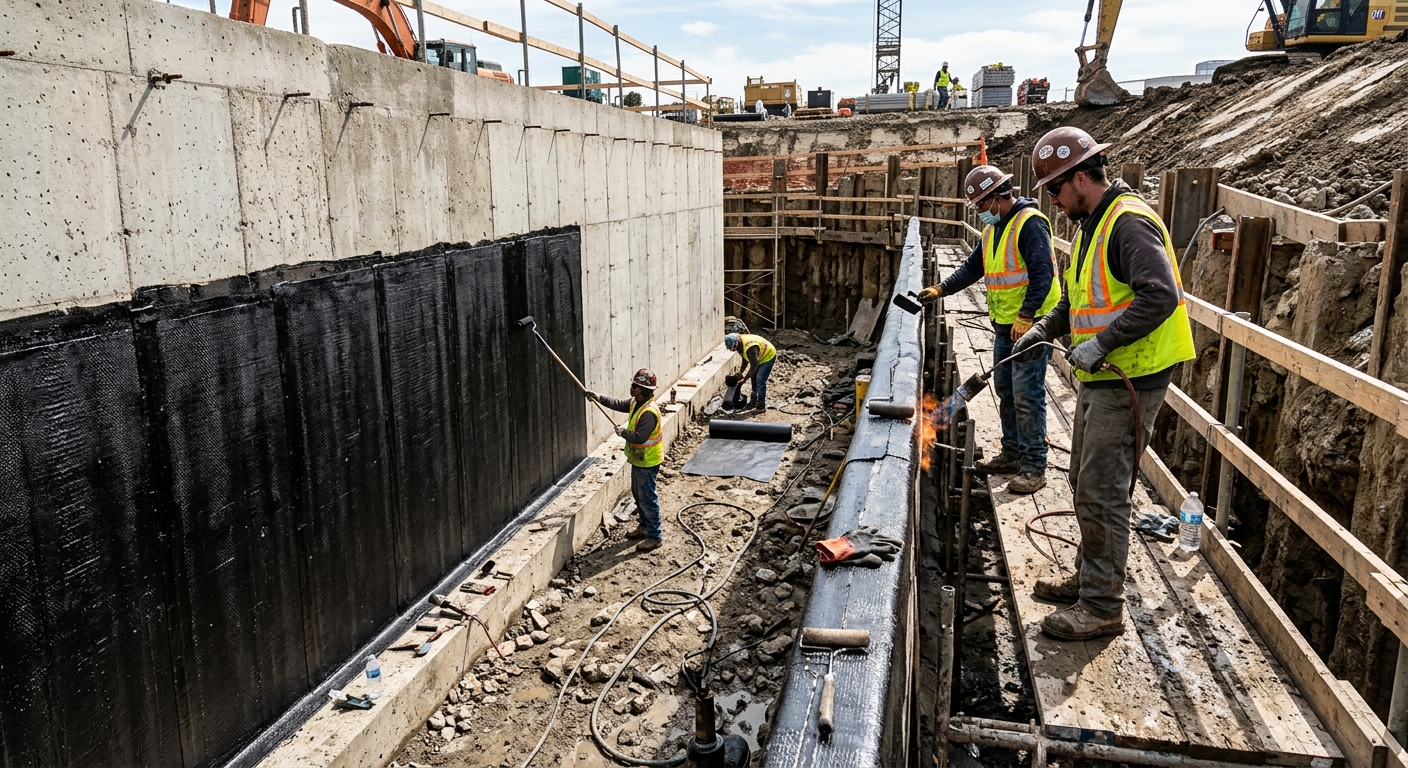
The fundamental difference is straightforward. Exterior waterproofing—full excavation, new membrane, new drainage tile, and backfill—treats water before it reaches your foundation. It’s the most permanent “source control” approach, but it is significantly more expensive and disruptive because it requires digging down along the wall and restoring landscaping afterward. Interior waterproofing—an interior perimeter drain channel, sump pit, and sump pump—captures water after it enters and removes it from the basement. It can be faster, less invasive, and more affordable, but it doesn’t stop hydrostatic pressure from acting on the wall in the first place.
For Ingersoll’s clay-influenced, freeze-thaw conditions, the choice often depends on how water is getting in and what kind of wall system you have. Poured concrete walls often respond well to crack injection when cracks are stable, and interior drainage can be a practical complement. Block foundations, on the other hand, frequently benefit from interior perimeter drainage as a practical solution because moisture movement can occur through capillary pathways and joint areas. In homes where older weeping tile is failing during spring melt, many crews combine crack sealing with a modern interior drain/sump system for reliable results.
Sump pump backup matters in Ontario. Spring flooding and winter storms can overlap with outages, and without backup you risk standing water—even if the primary pump is sized correctly. A battery backup or water-powered backup is often the difference between a damp corner and a true basement flooding event.
For a concrete dollar example: if you’re seeing localized seepage and your foundation wall cracks are hairline without signs of movement, a paired interior perimeter drain plus sump may land in the $8,000–$18,000 range. If, however, inspection shows the exterior drainage strategy has failed and water is being driven toward the foundation, upgrading to exterior work commonly moves into the $12,000–$25,000 band—where that extra cost is justified because it removes the source rather than only managing water after entry.
| Method |
Best For |
Addresses Source? |
Disruption |
Lifespan |
Price Band |
| Full exterior excavation + membrane |
High water table seepage, repeated spring leaks, failed exterior drainage |
Yes |
High |
Long (often 20+ years with proper drainage) |
$12,000–$25,000 |
| Interior French drain + sump system |
Interior seepage capture, hydrostatic relief, older drainage that can’t be reliably kept |
No (manages after entry) |
Medium |
Medium-to-Long (depends on pump and maintenance) |
$8,000–$18,000 |
| Crack injection — epoxy (structural) |
Stable cracks that are not actively leaking |
No |
Low-to-Medium |
Medium (best when the crack is stable and water is controlled) |
$600–$2,500 |
| Crack injection — polyurethane (active leak) |
Active water seepage through cracks |
No |
Low-to-Medium |
Medium (improves sealing but often paired with drainage) |
$800–$2,800 |
| Interior drain channel only (no sump) |
Light seepage, low moisture load, seasonal dampness management |
No |
Medium-to-Low |
Limited if water load is high |
$5,000–$10,000 |
| Re-grading + downspout extensions |
Surface-water runoff toward the foundation, minor wetting after storms |
Sometimes (if water is surface-driven) |
Low |
Short-to-Medium (depends on ongoing maintenance) |
$1,000–$4,000 |
How to choose a waterproofing contractor in Ingersoll
Start by verifying the contractor’s credentials before you compare “bottom line” numbers. In Ontario, confirm they can show active liability insurance (request a certificate of insurance and ensure the coverage dates align with your job). Next, verify WSIB/WCB coverage—ask for confirmation documents and check that their coverage is not expired. For waterproofing scopes that involve structural cracks, also ask how they handle engineering support (who assesses the wall and provides recommendations) so the repair is appropriate and not just cosmetic.
When you request quotes, get 2–3 itemised written proposals, not one-page estimates. You want a breakdown that separates labour, excavation/disposal, drainage components, membrane materials, crack repair products, and sump pump systems (including any backup). Read the exclusions carefully: does the quote include permit pulls (if required), disposal, wall/ floor patching, and proper discharge routing? If it doesn’t specify them, assume those items may cost extra.
Warranty should be specific: ask for the length of the workmanship warranty and whether it covers installation failures due to materials/workmanship. Also ask about the product/manufacturer warranty and whether it transfers to a new homeowner if you sell. For payments, a safe approach is to avoid large deposits—typically keep initial payment around 10–15% and use a holdback until the job is complete and clean-up is done. Finally, get the start date and expected completion timeline in writing, including weather-dependent milestones for exterior excavation and backfill.
- Ask how they confirm water entry points (inspection methods, dye testing, moisture mapping where used).
- Require an itemised quote with quantities (linear feet of drain, number of sump pumps, pump discharge details).
- Confirm who pulls permits (and whether it’s included in the price).
- Ask where the pump discharges and how they handle discharge approvals.
- Request proof of liability insurance and WSIB/WCB coverage before signing.
- Check warranty: workmanship term, product term, exclusions, and transferability.
- Confirm materials: membrane type, drainage board, filter fabric, and sump components.
- Look for a clear plan for clay soils—how they manage backfill and compaction.
- Ask about freeze-thaw protection details (sealants, crack preparation, curing times).
- Verify they include disposal/restoration scope for excavation areas.
- Confirm cleanup standards and how they protect landscaping during work.
- Set a payment schedule aligned with milestones; keep 10–15% upfront and hold back the final portion.
Red flags in Ingersoll include contractors who: (1) propose an interior-only fix without evaluating whether exterior drainage has failed; (2) refuse to provide proof of WSIB/WCB and liability coverage; (3) offer “guaranteed forever” waterproofing without site-specific diagnostics; (4) give only lump-sum pricing with missing line items (no pump backup, no discharge plan, no disposal); and (5) push for large upfront payments beyond 10–15%.
Frequently asked questions — waterproofing in Ingersoll
Can I waterproof my basement from the inside only?
Yes, and many Ingersoll homeowners do—especially when access to the exterior is limited or when the main issue is intermittent seepage. Interior systems (a perimeter drain channel plus a sump pit and pump) capture water after it enters, which can be a smart fit for clay-influenced basements where spring melt overwhelms older drainage. However, interior-only work doesn’t stop hydrostatic pressure on the foundation wall itself, so it’s not always the best choice for recurring high-water events.
For pricing, interior perimeter drainage and sump solutions commonly fall in the $8,000–$18,000 range, depending on wall length and whether a pump backup is included. If you have active leaking cracks, injection can help, but it’s usually paired with drainage for long-term reliability in Ontario freeze-thaw conditions.
What causes foundation cracks in Ingersoll?
Ingersoll foundation cracks often result from a combination of soil moisture changes and freeze-thaw cycles. With clay-rich, poorly draining ground, soils swell when wet and shrink when drier—pushing and pulling on foundation walls. As water repeatedly freezes in small gaps, it expands and can widen hairline cracks over multiple seasons. In older homes (many built before 1981 in the region, Statistics Canada, 2021 Census), original drainage like weeping tile may be clogged or collapsed, increasing the time foundations sit under moisture pressure.
Common local patterns include cracks that appear or worsen after heavy rain or spring melt, damp corners near window openings, and efflorescence (white mineral deposits) along wall seams. If you have horizontal cracks, stair-step cracking that grows over time, or cracking that aligns with water entry, treat it as more than cosmetic and consider an engineer assessment before sealing only.
How do I compare waterproofing quotes?
Start by comparing apples to apples. Ask for itemised quotes that list labour and materials separately: drain channel footage, sump pit location, pump specs, whether you’re getting battery or water-powered backup, membrane/drainage board details (if exterior work is included), and how disposal and restoration are handled. Confirm what’s excluded—especially permit pulls, patching of floors/walls, discharge routing, and any temporary protective measures for landscaping.
Also compare scope based on diagnosis, not promises. A contractor who recommends exterior excavation should explain why interior-only management won’t handle your site’s water pressures. For example, if one quote includes only sump pumping while another proposes source control with exterior membrane and drainage tile, that difference typically aligns with the regional bands: interior jobs often track the $8,000–$18,000 range, while exterior excavation tends toward the $12,000–$25,000 band.
How long does basement waterproofing take in Ingersoll?
Typical timelines depend on whether you’re doing interior or exterior work and how accessible the foundation is. Interior perimeter drains and sump systems can often be completed in a matter of days to a couple of weeks once materials arrive, because the work is mostly internal and excavation is limited. Exterior waterproofing is slower: excavation, wall preparation, membrane and drainage tile installation, backfill, and landscaping restoration add time—often several weeks total depending on wall length and soil conditions.
In Ontario’s freeze-thaw season, scheduling matters. Exterior work is commonly planned for stretches when the soil isn’t frozen, and backfill/compaction requires attention to avoid future settlement. If you’re moving ahead after a spring leak, ask about drying time for efflorescence or mould remediation before sealing, since rushing can undermine system performance.
What is a weeping tile and does my Ingersoll home have one?
A weeping tile is an older perimeter drainage system installed around the foundation footer designed to collect groundwater and channel it away from your basement. Many older Ingersoll homes were built with original drainage systems that are decades old—often with clay or early-generation materials that can clog, crack, or collapse over time, especially if clay soils stay saturated. Because 54.6% of homes in the area were built before 1981 (Statistics Canada, 2021 Census), there’s a good chance a portion of homeowners have some form of original weeping tile.
That said, “having a weeping tile” isn’t always the same as it functioning. Contractors may confirm condition during excavation or by reviewing previous foundation drainage work. If it’s failed, the remediation plan may include replacing sections or installing a modern interior drain + sump so you’re not relying solely on an aging system.
Can I waterproof my basement in winter in Ingersoll?
It’s possible, but it depends on the type of waterproofing and the weather. In Ingersoll, winter freeze-thaw can make exterior excavation difficult—frozen ground, rapid temperature changes, and curing requirements for sealants/membranes can affect workmanship. Interior work is often more feasible in winter because it avoids full excavation and can be done in a controlled indoor environment.
If you’re facing active leaks, contractors sometimes recommend interior perimeter drainage and sump installation during colder months. Sump pump installs in the $1,500–$3,500 range are often sized to manage water entering during thaw events. For major exterior source control, many homeowners schedule excavation for milder periods so backfill can be properly compacted. Your contractor should explain cure times, drying needs, and whether efflorescence/mould remediation must be completed before sealing.