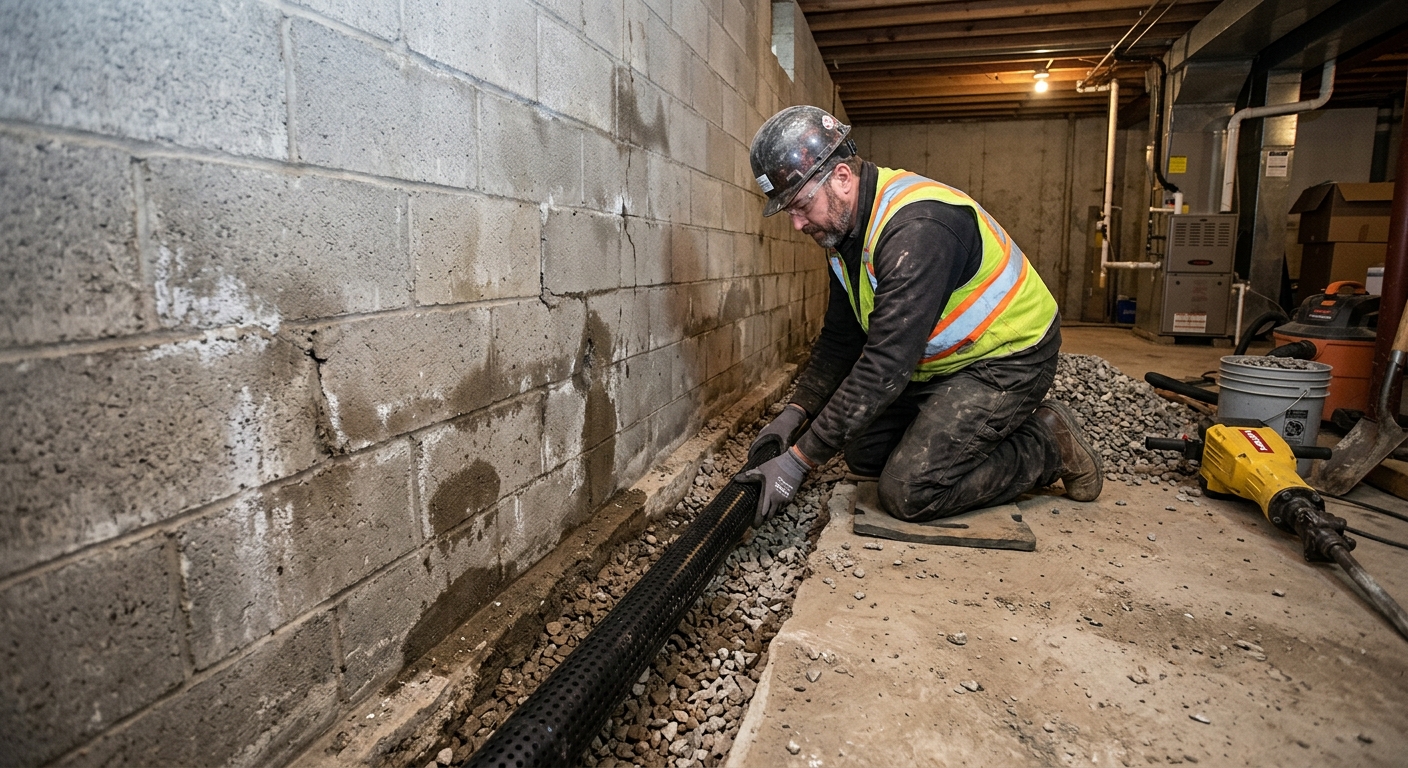
Basement waterproofing options and costs in University
In University, Ontario, homeowners typically choose between exterior waterproofing (attacking the water source) and interior waterproofing (containing water after it appears). The local reality is that many University basements were built before modern standards, and 7,607 residents (Statistics Canada, 2021 Census) live among many older homes that commonly have aging waterproofing systems. For homes built in the post-war era and through the 1960–1980s, it’s not unusual to see failing original weeping tiles or early drains that are now partially collapsed or clogged—so water finds paths through tie holes, cold joints, and small foundation cracks.
Toronto-area soils are often mixed glacial till and clay with pockets of dense clay that hold water against foundations. When saturated, clay can expand during freeze–thaw cycles and exert more lateral pressure, turning hairline defects into active seepage over a few winters. That’s why costs can swing significantly based on site access—tight urban lots, hand-digging around additions, and working below deck footings are frequent cost drivers in University and nearby areas like parts of North York and Scarborough where similar housing patterns exist.
Contractors in University generally price projects by “water management strategy”: excavation and membranes where lateral pressure and water table conditions are high; interior drains and sump systems for chronic seepage or failing exterior drainage; and targeted crack injection for isolated leaks. The comparison table below breaks down the most common options and realistic price ranges you’ll see for Toronto-tier projects.
| Method |
What It Addresses |
Disruption Level |
Durability |
Price Range |
| Exterior excavation + new membrane + drainage tile |
Hydrostatic water pressure from soil + water entry at foundation perimeter (requires full perimeter work in most cases) |
High (excavation, backfill, landscaping repairs) |
Long-term with proper drainage design |
$7,000–$25,000 |
| Interior perimeter drain channel + sump pit |
Water after it enters the wall/floor line; reduces seepage and efflorescence |
Medium (cutting floor/footing channel in the basement) |
Very good for chronic seepage |
$3,500–$15,000 |
| Foundation crack injection (epoxy or polyurethane) |
Targeted crack control (epoxy typically for stable cracks; polyurethane for active leaks) |
Low to medium (minor drilling/patching) |
Good when crack conditions are correctly matched |
$600–$3,000 |
| Sump pump installation (primary + battery backup) |
Floor seepage and sump accumulation during wet seasons; protects against power interruptions |
Low to medium (pit + discharge piping, minor interior work) |
Long-term with redundancy and proper pit sizing |
$800–$3,500 |
| Window well drain installation |
Localized water around egress/windows from pooling, surface runoff, and seepage behind wells |
Low (focused excavation near wells) |
Good for site-specific water control |
$1,000–$4,500 |
| Lot re-grading / downspout extension |
Reduces surface water flow toward the foundation (often a necessary “supporting fix”) |
Low to medium (light excavation, landscaping adjustments) |
Good when maintained (downspout routing stays clear) |
$1,200–$6,500 |
Prices are estimates only and vary by project scope, site access and material selection.
What affects the price of waterproofing in University
In University, Ontario, two contractors can quote the “same” basement issue but price it differently—often by 30–50%—because the real scope is tied to how water actually enters and where it travels. Toronto-tier projects also reflect higher labour and equipment costs, plus the practical challenge of working in established neighbourhoods with mature landscaping and tight setbacks.
The three biggest drivers that separate University-area costs from the national average are soil type, water table, and freeze–thaw. In clay-heavy conditions common across Southern Ontario, saturated soils can expand during freeze–thaw cycles and increase lateral pressure on foundation walls. That accelerates cracking at tie holes and cold joints, so what starts as dampness can become an active leak. In many Toronto-area neighbourhoods, high seasonal water levels mean a sump may run longer and require better discharge routing. Freeze–thaw then widens small defects in concrete and block foundations—so repairs that would be “good enough” in milder climates may fail in a few winters.
Concrete examples in University: (1) If your weeping tile is original (often 60+ years) and partially clogged, contractors typically shift from crack-only repair toward an interior perimeter drain or a higher-scope exterior approach—pushing the project toward the $7,000–$25,000 exterior band. (2) If only one corner shows water, an injection-only fix may land closer to the $600–$3,000 crack repair band, but only if the crack is stable. (3) If basement floors are already showing efflorescence, contractors often include a pre-seal clean-up step, which adds time and chemistry before membranes or coatings are applied.
| Price Factor |
Why It Matters |
Cost Impact |
| Interior vs. exterior approach — interior is less disruptive but addresses symptoms |
Exterior targets the source; interior manages water after entry |
Interior often runs lower, while exterior commonly pushes budgets to the higher band (equipment + excavation) |
| Foundation type — poured concrete vs. block vs. stone vs. ICF |
Different walls leak differently; repair products and detailing vary |
Block and older assemblies often need more perimeter drainage work |
| Soil type — clay expands more than sand, adding pressure |
Clay saturation increases hydrostatic/lateral pressure and repeat cracking risk |
More drainage layers or exterior membranes may be required |
| Crack type and length — hairline vs. structural horizontal cracks |
Stable, vertical cracks may take injection; structural cracks need assessment |
Misclassified structural work can double costs with engineering/potential underpinning |
| Sump pump backup system — battery or water-powered backup needed |
Backup reduces damage risk during outages in spring wet periods |
Increases material cost; typically shifts projects toward the higher end of the sump band |
| Access — landscaping, decks, or driveways must be removed for exterior |
More demo and rework increases labour and disposal |
Can move a project into the top half of the exterior band |
| Weeping tile age — original tile (60+ years) may be completely failed |
Partial failures still feed water; complete failure often requires replacing or bypassing |
Often triggers higher scope (drain replacement or full perimeter drainage) |
| Mould or efflorescence remediation required before sealing |
Sealers and membranes often fail over contaminated, mineralized surfaces |
Adds time, cleaning, and sometimes controlled drying |
Permits & regulations in Ontario
In Ontario, foundation excavation, structural crack repair, and changes that affect lot drainage typically require a permit. In practice, excavation for exterior waterproofing and most foundation-related concrete repairs usually fall under the “plumbing/structural work may be involved” umbrella that municipalities commonly require to be permitted before work starts. If a sump pump discharge ties into the storm or sanitary system, municipal approval is often needed, and a contractor should confirm the required connections and documentation before installing piping.
For structural crack repair—especially horizontal cracks in block walls or step cracks suggesting movement—an engineer’s assessment is frequently required. The engineer determines whether you need underpinning, wall stabilization, or other structural remediation rather than a standard injection job. Ask whether the contractor has engineering support for structural scopes and whether they carry liability insurance and WSIB/WCB coverage (or the correct equivalent coverage for their trade structure).
Step-by-step for University homeowners:
- Verify the contractor is properly registered/licensed for the work they’re proposing (ask for the exact licence category if applicable).
- Request a Certificate of Insurance showing liability coverage amount and effective dates; confirm it’s for the business name on the quote.
- Request WSIB/WCB clearance documentation; check that it’s current and matches the contractor’s operating name.
- Ask who pulls the permit (and whether it’s included in the quote). Get the permit responsibility in writing.
- For structural cracks, require written acknowledgement that an engineer assessment is arranged if needed.
Interior vs exterior waterproofing — what does University need?
The fundamental difference is that exterior waterproofing (full excavation, new membrane, and new drainage tile/backfill) permanently addresses the water source by stopping or managing water before it reaches your foundation. It usually costs more and disrupts landscaping, but it reduces repeat seepage risk—particularly in clay soils that push water laterally during freeze–thaw cycles. Interior waterproofing (perimeter drain channel, sump pit, and sump pump) manages water after it enters. It’s less invasive for many University basements and can be highly effective for chronic seepage, but it does not relieve the hydrostatic pressure against the wall itself.
Toronto-area conditions often make this decision straightforward: poured concrete walls frequently respond well to crack injection when the crack is stable and properly matched with epoxy or targeted sealing systems. By contrast, older block foundations and basements with failing weepers often need an interior perimeter drain as a practical complement because water can travel through mortar joints and block voids even when you repair visible cracks.
Sump pump backup matters in Ontario because power disruptions can occur during high-demand periods and severe weather around spring flooding. Battery backup (or a water-powered backup where appropriate) protects your system when the main pump is idle. As a cost example, exterior excavation commonly falls in the $7,000–$25,000 band due to excavation and drainage detailing. If you only have a few damp corners and a stable crack pattern, a targeted crack repair plus sump oversight might stay closer to the $600–$3,000 to $800–$3,500 range—if an inspection confirms the underlying drainage is the true cause.
| Method |
Best For |
Addresses Source? |
Disruption |
Lifespan |
Price Band |
| Full exterior excavation + membrane |
Widespread seepage, high water pressure sites, failing exterior drains, frequent water during wet seasons |
Yes |
High |
Long-term with correct drainage and backfill detailing |
$7,000–$25,000 |
| Interior French drain + sump system |
Chronic seepage, damp walls/floors, failing weepers where exterior access is tight |
No (manages entry) |
Medium |
Very good with proper pit sizing and backup planning |
$3,500–$15,000 |
| Crack injection — epoxy (structural) |
Non-moving, dry-to-damp cracks with stable geometry (common on poured concrete) |
Partial (restores barrier at crack) |
Low to medium |
Good when cracks are stable and surfaces are prepared correctly |
$600–$3,000 |
| Crack injection — polyurethane (active leak) |
Active leaks where water pressure is pushing through cracks or seams |
Partial (stops flow path at crack) |
Low to medium |
Good for active leaks when product match is correct |
$800–$3,500 |
| Interior drain channel only (no sump) |
Light seepage that can drain by gravity, limited water volume, or temporary mitigation |
No |
Medium to low |
Variable—often shorter if water volumes spike |
$1,500–$7,500 |
| Re-grading + downspout extensions |
Surface runoff driving water toward the foundation, localized wet spots near windows |
No (redirects external water) |
Low to medium |
Good if maintained and downspouts stay clear |
$1,200–$6,500 |
How to choose a waterproofing contractor in University
Start with licensing and coverage checks that protect you during excavation and interior demolition. In Ontario, confirm the contractor is properly registered for the type of work and that their trade status matches the scope (especially for structural repair and any work that touches drainage connections). For insurance, request a Certificate of Insurance with liability coverage and verify it’s active for the business name on the contract. Then ask for WSIB/WCB clearance or corresponding documentation—don’t accept verbal confirmation. Also ensure they can provide proof they can safely access your site (especially for tight University lots).
Get 2–3 itemised written quotes that separate labour and materials (not lump-sum only). Ask whether the quote includes: permit pull, saw-cut/disposal, dump fees, surface restoration, and how they’ll manage water during construction. Read exclusions carefully—common omissions include repairing failed tile, addressing roof downspout routing, or remediating mould/efflorescence before sealing. In Ontario basements, sealing over contaminated mineral deposits can lead to failure within a few seasons.
Warranty should be specific: workmanship warranty length and product/manufacturer warranty details, plus whether the warranty is transferable to the next homeowner. For payment, never pay more than 10–15% upfront; use a holdback until the job is complete and cleaned. Finally, demand a written timeline with a start date target and completion estimate.
- Ask for their plan to identify the leak path (interior staining map, crack mapping, exterior water observations).
- Confirm whether the scope includes pre-work cleaning for efflorescence and mould sources.
- Require a list of excavation limits and restoration scope if exterior work is proposed.
- Check that the quote names the exact waterproofing membrane/product system and drainage components.
- Ensure sump pump specifications include discharge line routing and check valves.
- Ask if battery backup is included or optional and what it costs.
- Confirm disposal/dump fees are included (especially for excavation and concrete drilling debris).
- Verify whether they pull permits and whether permit fees are included.
- Request a warranty in writing that covers workmanship, not just product supply.
- Use a payment schedule with 10–15% maximum deposit and holdback until final walkthrough.
- Look for clear exclusions about structural engineering if cracks suggest movement.
- Get start date and completion window in the signed contract.
Red flags to watch in University: (1) quotes that recommend exterior work without assessing access constraints or existing drainage condition; (2) injection-only proposals for horizontal/step cracks without engineering or a structural assessment; (3) vague language like “waterproofing membrane” without product names/specifications; (4) no written warranty terms for workmanship and product separation; (5) asking for large upfront payments (beyond 10–15%) without a staged contract and holdback.
Frequently asked questions — waterproofing in University
How do I compare waterproofing quotes?
In University and across Ontario, the most reliable way to compare quotes is to compare scope, not just the total price. Ask for an itemised breakdown of labour and materials, including what’s included for permit pull, excavation/disposal, and restoration. Make sure each contractor addresses the same water entry pathway—corner seepage, wall cracks, window well flooding, or floor seepage—because exterior excavation and membrane work can sit around $7,000–$25,000, while interior systems and drainage strategies may fit $3,500–$15,000 depending on the perimeter and pump design. If one quote only mentions crack injection (e.g., $600–$3,000) but your issue is seasonal floor dampness, you likely aren’t comparing equivalent solutions.
How long does basement waterproofing take in University?
Timelines in University vary by whether you’re doing exterior excavation or an interior perimeter solution. Interior work—like a French drain channel, sump pit, and piping—commonly takes about 3–7 working days depending on basement access, concrete cutting needs, and drying/curing time for sealants. Full exterior excavation typically takes longer due to excavation, membrane installation, drainage tile placement, and backfill/landscaping restoration; many projects run 2–3 weeks when access is constrained. Winter scheduling can add time for curing and moisture control. A contractor should provide a written schedule with start date and completion estimate, plus expected curing windows tied to the actual products they’ll use.
What is a weeping tile and does my University home have one?
A weeping tile is the under-drain system installed near the foundation that collects groundwater and directs it to a sump or outlet. Many Toronto-area homes have older drainage systems, and some still have original weepers that are now partially clogged or collapsed—especially in post-war and 1960–1980s housing stock. You can’t always confirm it just by looking: sometimes it’s buried, replaced, or tied into older piping. A qualified contractor can often identify it by inspecting the discharge/outlet, checking basement floor drains, and using camera/drain testing during scope exploration. If it has failed, homeowners often see interior dampness, efflorescence, and basement flooding without obvious exterior wall failure.
Can I waterproof my basement in winter in University?
Sometimes, but it depends on the method. In University/Ontario, winter work is more challenging because soils can be frozen, curing conditions can be less predictable, and exterior excavation may be impractical until thaw. Interior waterproofing is often still possible—crack injection and interior drain/sump installation can proceed if materials and workmanship can be maintained within required temperature ranges. However, exterior membrane and drainage tile work is usually delayed when excavation can’t reach proper depths or when backfill conditions won’t compact correctly. If you’re dealing with active seepage, contractors may focus on targeted crack control and interim water management while planning the full exterior scope for spring.
What is the difference between waterproofing and damp-proofing?
Homeowners in Ontario often hear these used interchangeably, but they’re not the same. “Damp-proofing” generally refers to treatment intended to resist minor moisture and reduce dampness—often appropriate for conditions with limited water pressure. True “waterproofing” aims to manage hydrostatic pressure and prevent water entry under wet conditions, which is crucial in Toronto-area freeze–thaw climates where small cracks can become active leaks. In practice, contractors choose the level based on symptoms: if you have recurring seepage, efflorescence, or floor wetness, that usually indicates water migration that typically needs a more robust system (interior drain/sump or exterior membrane and drainage) rather than a light damp-proof coating. Your quote should clearly state the system and its intended performance.
Will basement waterproofing affect my property value in University?
It can, especially when the work addresses an active water problem rather than just cosmetic dampness. In University, buyers increasingly look for evidence that water management is solved—dry basements, reduced odours, no efflorescence, and properly installed drainage/sump components. A waterproofing warranty and clear documentation (itemised scope, product specs, and maintenance details like keeping downspouts clear) can support resale confidence. That said, the value impact depends on the cause and the solution: exterior excavation and full drainage work (commonly in the $7,000–$25,000 range) can be a strong selling point when there’s significant water pressure, while targeted crack injection (often $600–$3,000) is best when leaks are isolated. The most valuable jobs match the solution to Toronto’s soil and freeze–thaw reality.